You Collection, Upper Volume
Radical: Speech (yán)
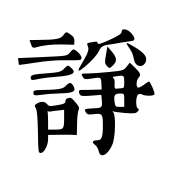
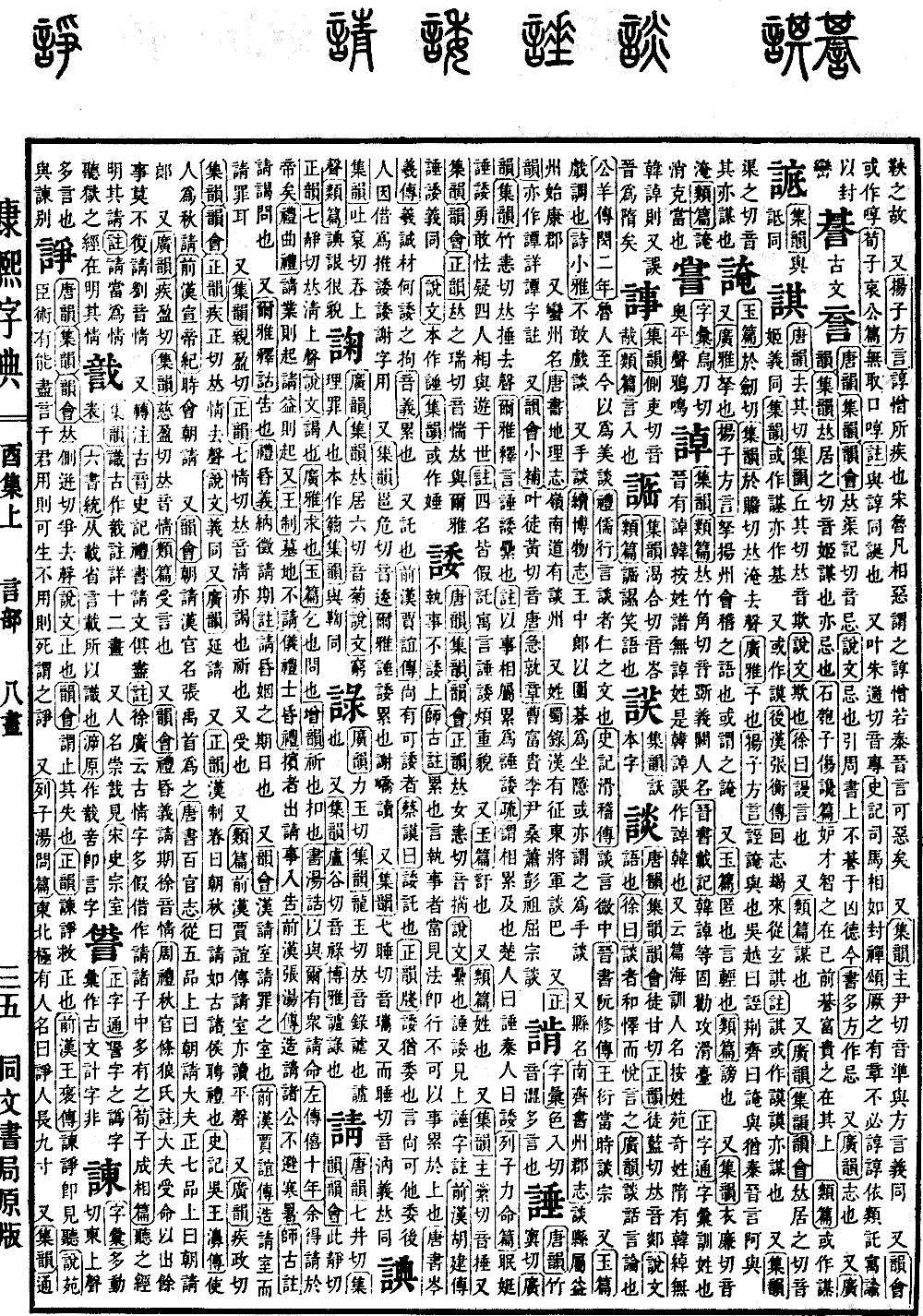
Zheng
Kangxi strokes: 15
Page 1167, Entry 22
Tang Rhymes (Tangyun), Collected Rhymes (Jiyun), and Rhyme Meeting (Yunhui) define the pronunciation as zheng (falling tone).
In the Discussion of Script (Shuowen), it means to stop.
The Rhyme Meeting (Yunhui) states it means to stop someone from committing an error.
Correct Rhymes (Zhengyun) defines it as remonstrance or correcting someone.
In the Biography of Wang Bao from the History of the Former Han (Qianhan shu), it says: If remonstrance is heard.
In the Garden of Stories (Shuoyuan), Chapter on Ministerial Arts (Chenshu pian), it says: One who can speak completely to the ruler, if used then one may live, if not used then one dies, this is called zheng.
Also, in the Questions of Tang from the Liezi, it says: In the far northeast there are people called zheng people, nine inches tall.
Also, Collected Rhymes (Jiyun) notes it is interchangeable with the character zheng (to dispute).
In the Classic of Filial Piety (Xiaojing), Chapter on Remonstrance (Jianzheng zhang), it says: The Son of Heaven has seven remonstrating ministers.
Also, Collected Rhymes (Jiyun) and Rhyme Meeting (Yunhui) give the pronunciation as zheng (level tone).
In Correct Rhymes (Zhengyun), the pronunciation is zheng (level tone).
It means to litigate.
In the Biography of Liu Shenggong from the History of the Later Han (Houhan shu), it says: To fairly settle litigation.
In the Book of Jin (Jin shu), Wang Shen, Explanation of Current Discourses (Shi lun), it says: The cowardly are brave in gluttonous litigation.
Note: The rhyme corresponds to the level tone.
Verification: In the Garden of Stories (Shuoyuan), Chapter on Ministerial Arts (Chenshu pian), it says: One who can speak completely to the ruler. I have carefully added the word chapter to conform with the original text.