Xu Collection, Upper Volume
Radical: Metal (jīn)
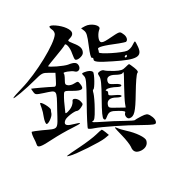
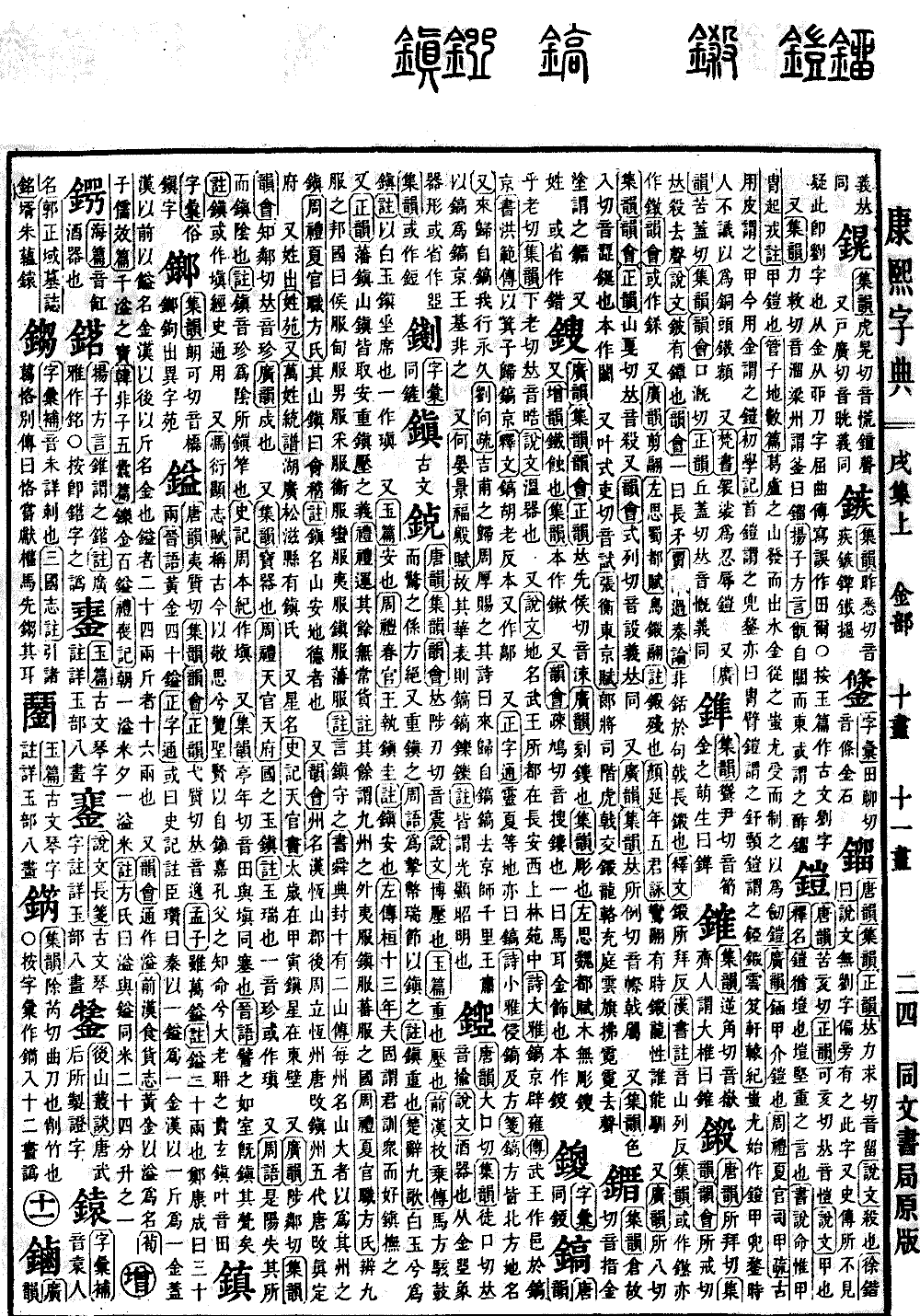
鎭; Kangxi stroke count: 18; Page 1318, Entry 15
Ancient script form. According to Tang Rhymes (Tangyun), Collection of Rhymes (Jiyun), and Dictionary of Rhymes (Yunhui), pronounced zhen (falling tone).
Shuowen Jiezi: To suppress by applying weight.
Yupian: Heavy; to suppress.
Records of the Grand Historian (Shiji), Biography of Mei Cheng: Horses are startled and frightened, beat the drums to frighten them; the ropes are about to break, and one adds more heavy pressure.
Discourses of Zhou (Zhouyu): Use ritual silks and tokens to guard and stabilize. Commentary: Zhen means heavy.
Songs of Chu (Chuci), Nine Songs: White jade used as a stabilizing object. Commentary: Using white jade to hold down a mat. One variant is written as tian.
Also, Yupian: To pacify.
Rites of Zhou (Zhouli), Spring Officials: The King holds the stabilizing jade tablet (gui). Commentary: Zhen means to pacify.
Zuo Tradition (Zuozhuan), Thirteenth Year of Duke Huan: Others have always said that you instruct the people and are skilled at pacifying them.
Also, Zhengyun: Regional military commands and mountain guards all derive their meaning from the sense of stability and heavy pressure.
Book of Rites (Liji), Rites and Vessels: The others refer to countries beyond the Nine Provinces, such as the Yifu, Zhenfu, and Fanfu states.
Rites of Zhou, Summer Officials: Differentiate the states of the Nine Borders, known as Houfu, Dianfu, Nanfu, Caifu, Weifu, Manfu, Yifu, Zhenfu, and Fanfu. Commentary: This refers to guarding.
Book of Documents (Shujing), Canon of Shun: The great mountains of each province serve as the stabilizing mountains for that province.
Rites of Zhou, Summer Officials: Its stabilizing mountain is called Kuaiji. Commentary: Zhen refers to a famous mountain capable of stabilizing the virtue of the earth.
Also, Yunhui: A prefecture name; Han dynasty Hengshan Commandery, later Zhou dynasty established Heng Prefecture, Tang dynasty changed it to Zhen Prefecture. During the Five Dynasties, the Later Tang changed it to Zhending Prefecture.
Also a surname. According to Surname Garden (Xingyuan).
Also, Wanxing Tongpu: There is a Zhen family in Songzi County, Huguang.
Also a star name. Records of the Grand Historian, Treatise on the Celestial Offices: When Tai-sui is in the Jia-yin year, the Stabilizing Star (Zhenxing) is in the Eastern Wall (Dongbi).
Also, Guangyun: Pronounced zhen. Jiyun and Yunhui: Pronounced zhen.
Guangyun: Garrison and guard.
Also, Jiyun: Precious vessel.
Rites of Zhou, Spring Officials, Celestial Treasury: The jade treasures of the state. Commentary: Jade tokens.
One pronunciation is zhen. Or written as tian.
Also, Discourses of Zhou: This is when Yang loses its position and is suppressed by Yin. Commentary: Zhen is pronounced zhen, meaning to be suppressed by Yin.
Records of the Grand Historian, Annals of the Zhou Dynasty: Written as tian.
Also, Jiyun: Pronounced tian. Identical to tian. To fill or plug.
Discourses of Jin (Jinyu): Like a house that has already been plugged at the roof. Commentary: Zhen or tian; used interchangeably in classics and histories.
Feng Yan, Manifesting Ambition Rhapsody (Xianzhi Fu): Drawing upon past and present to respectfully contemplate; observing sages to stabilize oneself. Praising Confucius for knowing heaven's mandate; honoring Lao Dan's preciousness. Zhen rhymes with tian.
Textual Research: In the citation from the Book of Rites, Rites and Vessels, changed from Rituals and Practices as per the original text. In the citation from the Rites of Zhou, Spring Officials, Celestial Treasury, changed from Celestial Officials as per the original text.