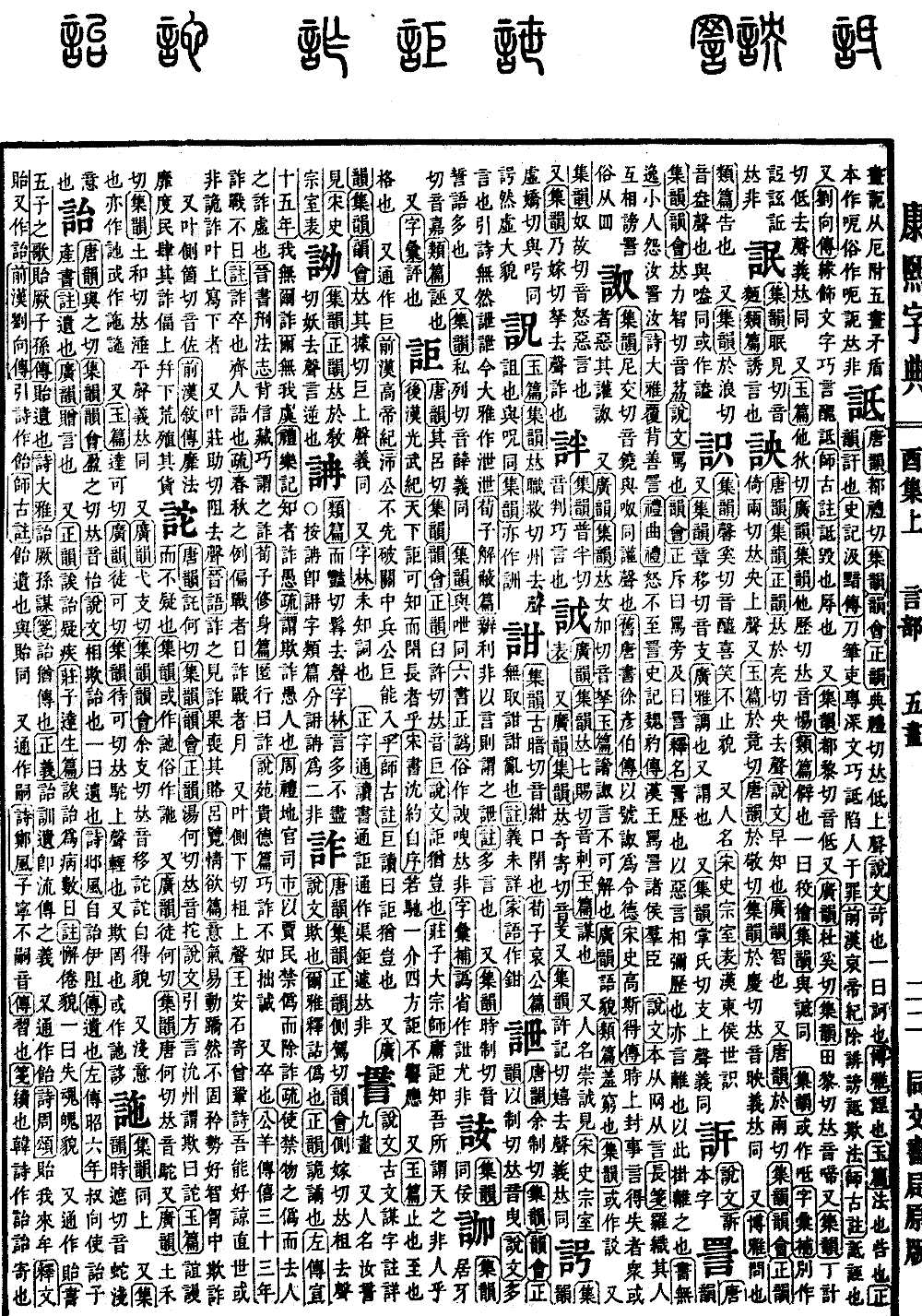
You Collection, Upper Volume
Radical: Speech (yán)
詐
Kangxi strokes: 12
Page 1154, Entry 20
Pronounced zhà (falling tone). According to the Tang Rhyme (Tang Yun), Collected Rhymes (Jiyun), and Correct Rhymes (Zhengyun), it is pronounced zhà. According to the Rhyme Collection (Yunhui), it is pronounced zhà. The pronunciation is similar to the character zha (falling tone).
In the Explanation of Script and Explanation of Names (Shuowen Jiezi), it is defined as to deceive.
In the Approaches to the Classics (Erya), it is defined as hypocritical.
In the Correct Rhymes (Zhengyun), it is defined as wily and cunning.
In the Commentary of Zuo (Zuo Zhuan), 15th Year of Duke Xuan: "I shall not deceive you, and you shall not guard against me."
In the Book of Rites (Liji), Record of Music: "The intelligent deceive the foolish." The Sub-commentary (Shu) explains: This refers to deceiving and defrauding the foolish.
In the Rites of Zhou (Zhou Li), Office of Earth, Minister of Markets: "Employ the merchant class to prohibit counterfeiting and eliminate fraud." The Sub-commentary (Shu) explains: This means to have them prohibit the counterfeiting of goods and remove the hypocrisy and fraudulence of men.
In the Book of Jin (Jin Shu), Treatise on Penal Law: "To violate trust and hide one's true motives is called zha."
In the Xunzi, Cultivating the Self: "To conceal one's evil deeds is called zha."
In the Garden of Stories (Shuoyuan), Noble Virtue: "Clever fraud is inferior to clumsy honesty."
Also defined as sudden or hasty.
In the Commentary of Gongyang (Gongyang Zhuan), 33rd Year of Duke Xi: "Sudden attacks in war are not recorded with specific dates." The Commentary (Zhu) explains: zha means sudden or hasty; this is a regional dialect of the Qi state. The Sub-commentary (Shu) explains: The style of the Spring and Autumn Annals (Chunqiu) is to record the date for battles arranged in advance, but to record only the month for sudden attacks.
Also phonetically matched (ye) to be pronounced zhǎ (rising tone).
In Wang Anshi’s poem Sent to Zeng Gong: "I am able to love the honest and upright, though the world may condemn deceit." The rhyming upper character is xie, and the lower character is zhe.
Also phonetically matched (ye) to be pronounced zù (falling tone).
In the Discourses of the States (Guoyu), Discourses of Jin: "To deceive others and be deceived in return, surely leads to the loss of one's wealth."
In the Spring and Autumn Annals of Mr. Lü (Lüshi Chunqiu), Section on Desires: "The will is easily swayed, flighty and lacking resolve. Relying on power and favoring cleverness, the heart becomes filled with fraud."
Also phonetically matched (ye) to be pronounced zuǒ (falling tone).
In the Book of Han (Han Shu), Narrative Account: "Without laws, the people behave with reckless deceit. Pressing the superiors to annex the inferiors, they amass wealth in great quantities."