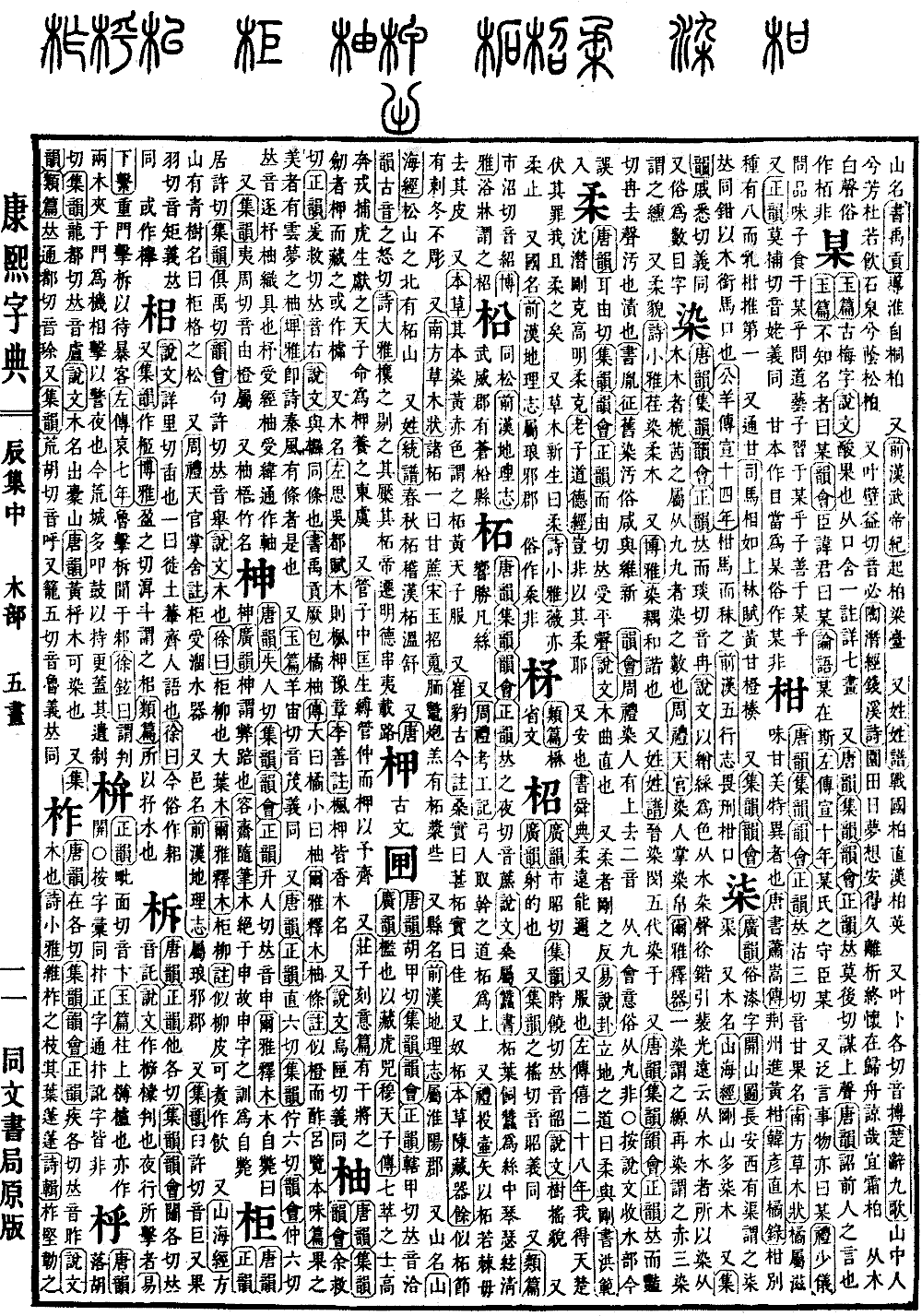
Chen Collection, Middle Volume
Radical: Tree (mù)
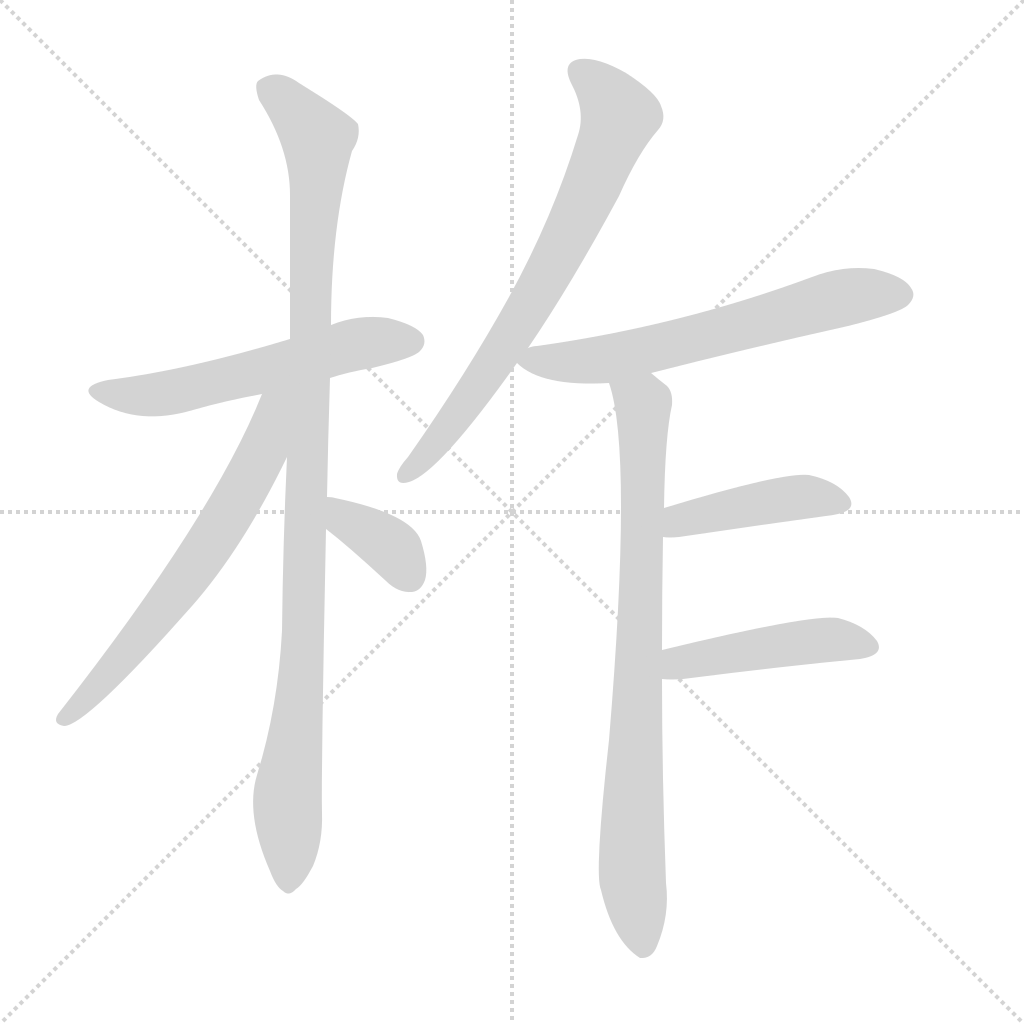
柞
Kangxi stroke count: 9
Page 519, Entry 19
Pronounced zuo.
According to the Explaining Graphs and Analyzing Characters (Shuowen Jiezi), it refers to a type of tree.
Book of Odes (Shijing), Lesser Odes: The branches of the oak, its leaves are lush and dense.
Collection of Commentaries on the Book of Odes (Shiji): The oak is a sturdy and resilient tree. When new leaves are about to sprout, the old leaves fall; they remain attached very firmly.
Also, in the History of the Former Han (Qian Hanshu), Annals of Emperor Wu: Proceeding to the Five Oaks Palace in Zhi. Zhang Yan comments: There were five oak trees, and the palace was named accordingly.
Pronounced zuo. The meaning is the same.
Pronounced zhai. To remove grass is called shan; to remove trees is called zuo.
Book of Odes (Shijing), Eulogies of Zhou: We mow and we clear.
Rites of Zhou (Zhouli), Summer Offices: The Officer of Clearing is in charge of attacking grass and trees.
Also, it means narrow or cramped.
Rites of Zhou (Zhouli), Winter Offices, Artificers' Record: If the hub is small and long, it is called restricted (zuo).
Also, it means large and spreading outward.
Artificers' Record: If the bell is widely flared, it is called zuo.
Pronounced zhuo. A mechanism within an animal trap is called a zuo'e.
Kong Yingda’s sub-commentary to the Doctrine of the Mean (Zhongyong): A trap is referred to as a zuo.
Pronounced cha. Equivalent to the character meaning to hew or cut obliquely.
Pronounced zhai. To gnaw.