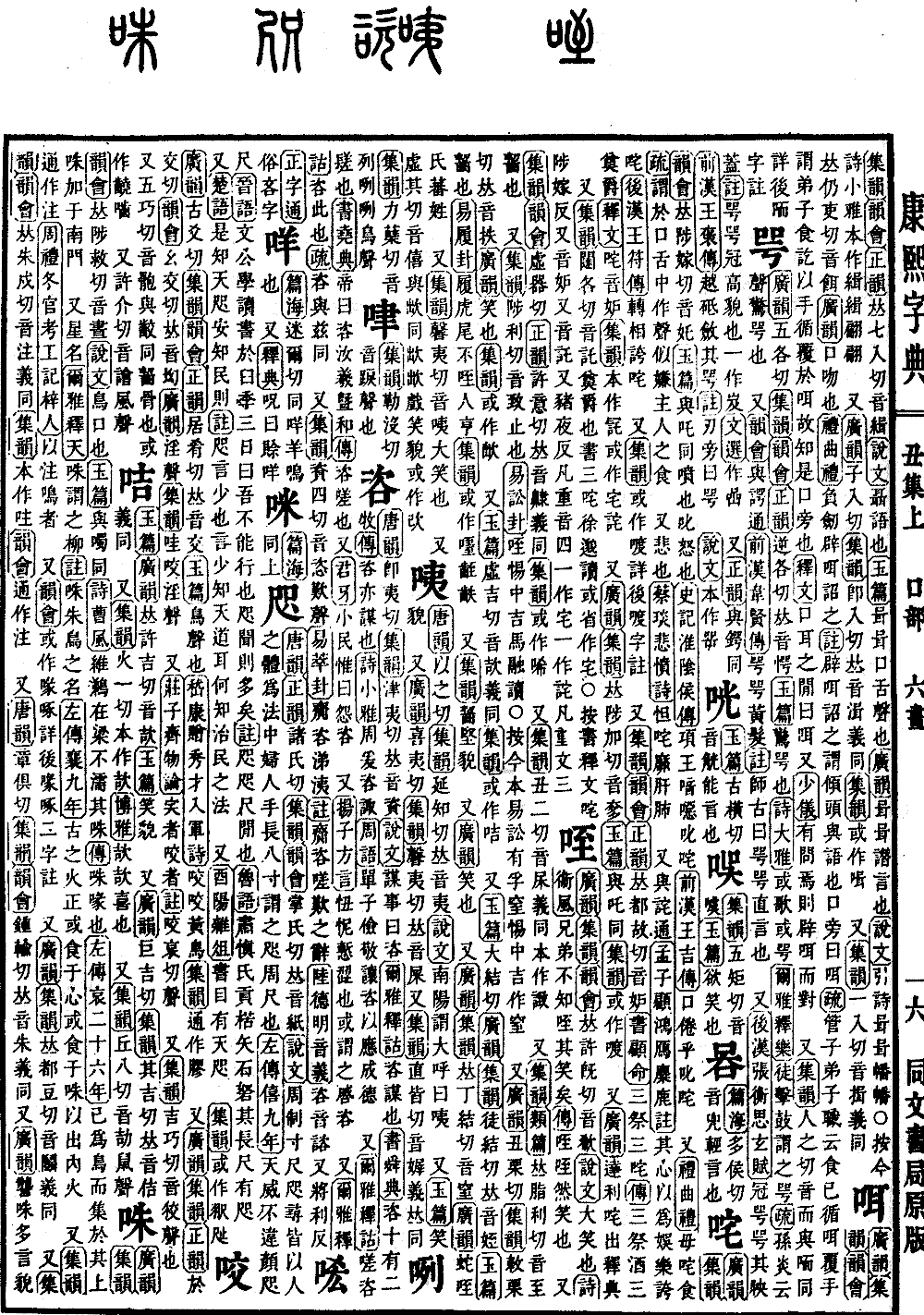
Chou Collection, Upper Volume
Radical: Mouth (kǒu)
咤
Kangxi strokes: 9
Page 186, Entry 06
Pronounced zhà
According to the Broad Rhymes (Guangyun), Collected Rhymes (Jiyun), and Rhyme Meeting (Yunhui), the pronunciation is the same as the character pronounced chà.
According to the Jade Chapters (Yupian), this is the same as the character pronounced zhā. It means to erupt or to scold in anger.
As cited in the Records of the Grand Historian (Shiji), Biography of the Marquis of Huaiyin: King Xiang was silent, then fierce and shouting.
As cited in the History of the Former Han (Qianhan), Biography of Wang Ji: The mouth is weary from shouting.
Also in the Book of Rites (Liji), Rites for the Common People (Quli): Do not make smacking sounds while eating.
The Commentary (Shu) explains: It means making a sound in the mouth as if expressing dislike for the host's food.
Also expresses sadness.
As cited in Cai Yan, Poem of Sorrow and Indignation (Beifen Shi): Filled with sorrow, my liver and lungs are torn.
Also interchangeable with the character pronounced chà.
As cited in the Mencius (Mengzi), Commentary on Looking at Wild Geese and Elk: His heart considers it entertainment and boasting.
As cited in the History of the Later Han (Houhan), Biography of Wang Fu: Turning to boast to one another.
Also, according to the Collected Rhymes (Jiyun), it is sometimes written as the character pronounced dù; for a detailed explanation, see the entry for that character.
Also, according to the Collected Rhymes (Jiyun), Rhyme Meeting (Yunhui), and Orthodox Rhymes (Zhengyun), it is pronounced dù.
As cited in the Book of Documents (Shangshu), Charge to the Ministers (Guming): Three libations, three sets.
The Commentary (Zhuan) explains: It means to pour the libation three times and set the cup down three times.
The Explanation of Text (Shiwen) notes: It is pronounced dù.
According to the Collected Rhymes (Jiyun), the original character is written as specified. It is sometimes written as the characters pronounced zhái or chà.
Also, according to the Broad Rhymes (Guangyun) and Collected Rhymes (Jiyun), it is pronounced zhā.
According to the Jade Chapters (Yupian), it is the same as the character pronounced zhā.
According to the Collected Rhymes (Jiyun), it is sometimes written as the character pronounced dù.
Also, according to the Broad Rhymes (Guangyun), there is the term dali-zha, which originates from the Buddhist Canon (Shidian).
Also, according to the Collected Rhymes (Jiyun), it is pronounced tuō. It means to set down a cup. Xu Miao reads it this way. It is sometimes simplified as the character pronounced zhái.
Note: In the Explanation of Text (Shiwen) for the Book of Documents (Shangshu), the character is given four pronunciations: zhà, dù, tuō, and zhūyè. It is sometimes written as zhái or chà, totaling three different written forms.