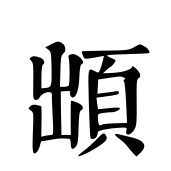
Pronounced zhi yue (entering tone) in the "Guangyun" (Guangyun) and zhu lie (entering tone) in the "Jiyun" (Jiyun), with the same pronunciation as "zhuo". The "Wuyin Jiyun" (Wuyin Jiyun) explains it as the beautiful bones of the face. The "Boyan" (Boyan) explains it as the cheekbone area. The "Yupian" (Yupian) records: Han Gaozu Liu Bang had prominent cheekbones and a dragon-like forehead. Note: "Shiji" (Shiji) and "Hanshu" (Hanshu) write it as "long zhun", pronounced "zhuo".
Also, pronounced zhi chu (entering tone) in the "Tangyun" (Tangyun) and "Jiyun" (Jiyun), with the same pronunciation as "chu". "Shuowen Jiezi" (Shuowen Jiezi) explains it as the cheekbone of the head. The character is from the "Page" (ye) radical, with "Chu" (chu) as the phonetic component. The "Jiyun" (Jiyun) explains it as the shape of the head.
Also, pronounced gu hu (entering tone) in the "Jiyun" (Jiyun), with the same pronunciation as "gu". It means the cheekbone of the face.