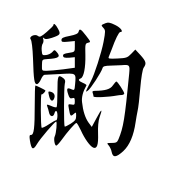
Pronounced zhuó (falling tone). In the "Guangyun" (Guangyun), it is spelled with the characters "zhī" and "ruò" (zhī ruò). In the "Jiyun" (Jiyun), it is spelled with the characters "zhí" and "lüè" (zhí lüè). The "Shuowen Jiezi" (Shuowen Jiezi) explains it as a type of wind rat from the Hu region.
Pronounced bào (falling tone). In the "Guangyun" (Guangyun), it is spelled with the characters "bǐ" and "jiào" (bǐ jiào). In the "Jiyun" (Jiyun) and "Yunhui" (Yunhui), it is spelled with the characters "bā" and "xiào" (bā xiào). The "Guangyun" (Guangyun) explains it as a type of rat that can fly and feeds on animals such as tigers and leopards.
Pronounced jué (rising tone). In the "Guangyun" (Guangyun), it is spelled with the characters "jí" and "lüè" (jí lüè). In the "Jiyun" (Jiyun), it is spelled with the characters "jí" and "yuē" (jí yuē). The "Guangyun" (Guangyun) explains it as a creature resembling a rat but smaller in size.
Pronounced dí (rising tone). In the "Guangyun" (Guangyun), it is spelled with the characters "dū" and "lì" (dū lì). In the "Jiyun" (Jiyun), it is spelled with the characters "dīng" and "lì" (dīng lì). The "Guangyun" (Guangyun) explains it as the name of a rat.
Pronounced jiào (falling tone). In the "Jiyun" (Jiyun), it is spelled with the characters "jí" and "què" (jí què). The meaning is the same as the previous entry.