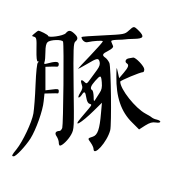
In the "Guangyun" and "Jiyun", it is recorded with the pronunciation "zhú jiǎo qiè", which sounds the same as "zhuó". The "Boyǎ" explains it as the buttocks. Another explanation is the meaning of fatness.
Also in the "Guangyun", it is recorded with the pronunciation "dīng mù qiè", which sounds the same as "zhú". It refers to the orifice below the tail. The "Guangyun" annotates the pronunciation as "dīng mù qiè", and the "Jiyun" annotates it as "dū mù qiè", which sounds the same as "dú". The "Boyǎ" explains it as the buttocks. The "Guangyun" explains it as the orifice below the tail. Sometimes written as "㞘". A common variant is written as "".
Also in the "Guangyun" and "Jiyun", it is recorded with the pronunciation "zhú jiǎo qiè", which sounds the same as "zhuó". The meaning is the same.
Also in the "Lèipiān", it is explained as the meaning of fatness.
Also in the "Guangyun", it is recorded as being the same as the character "".