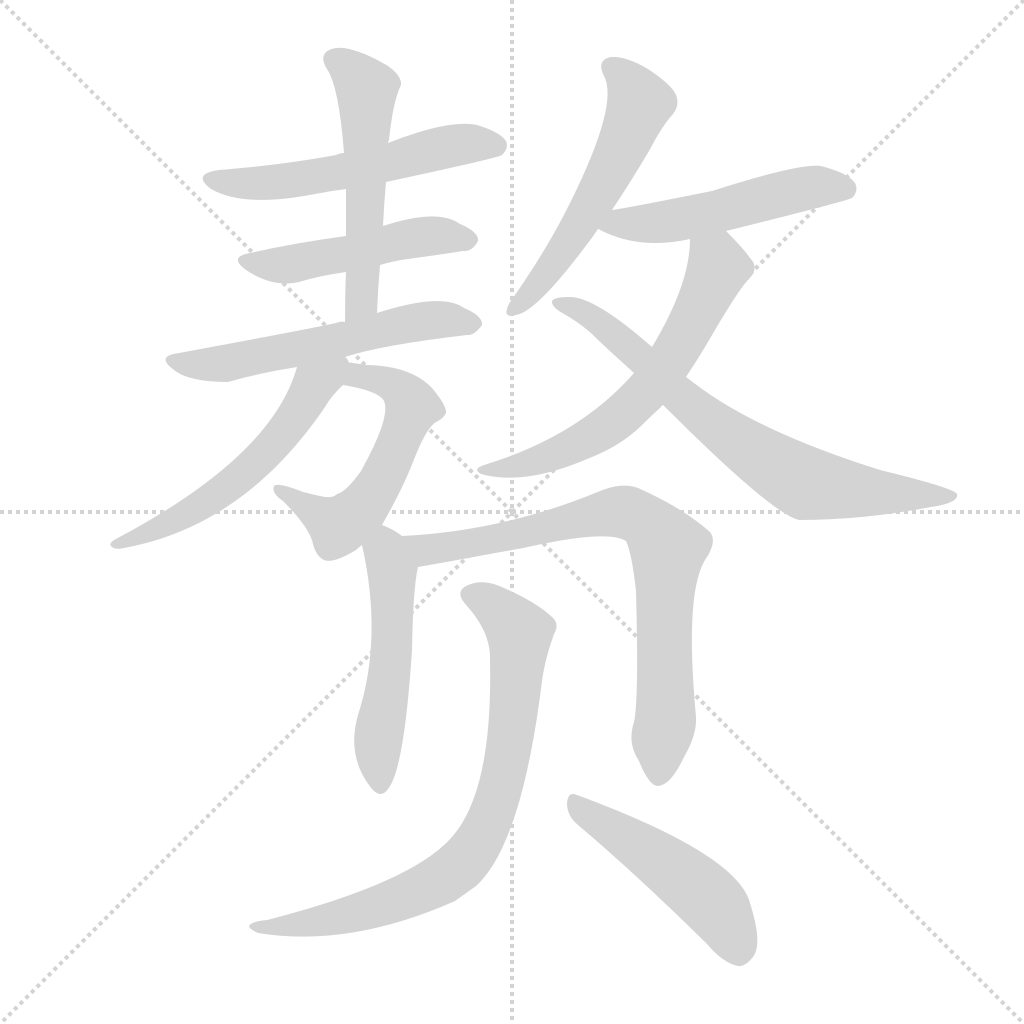
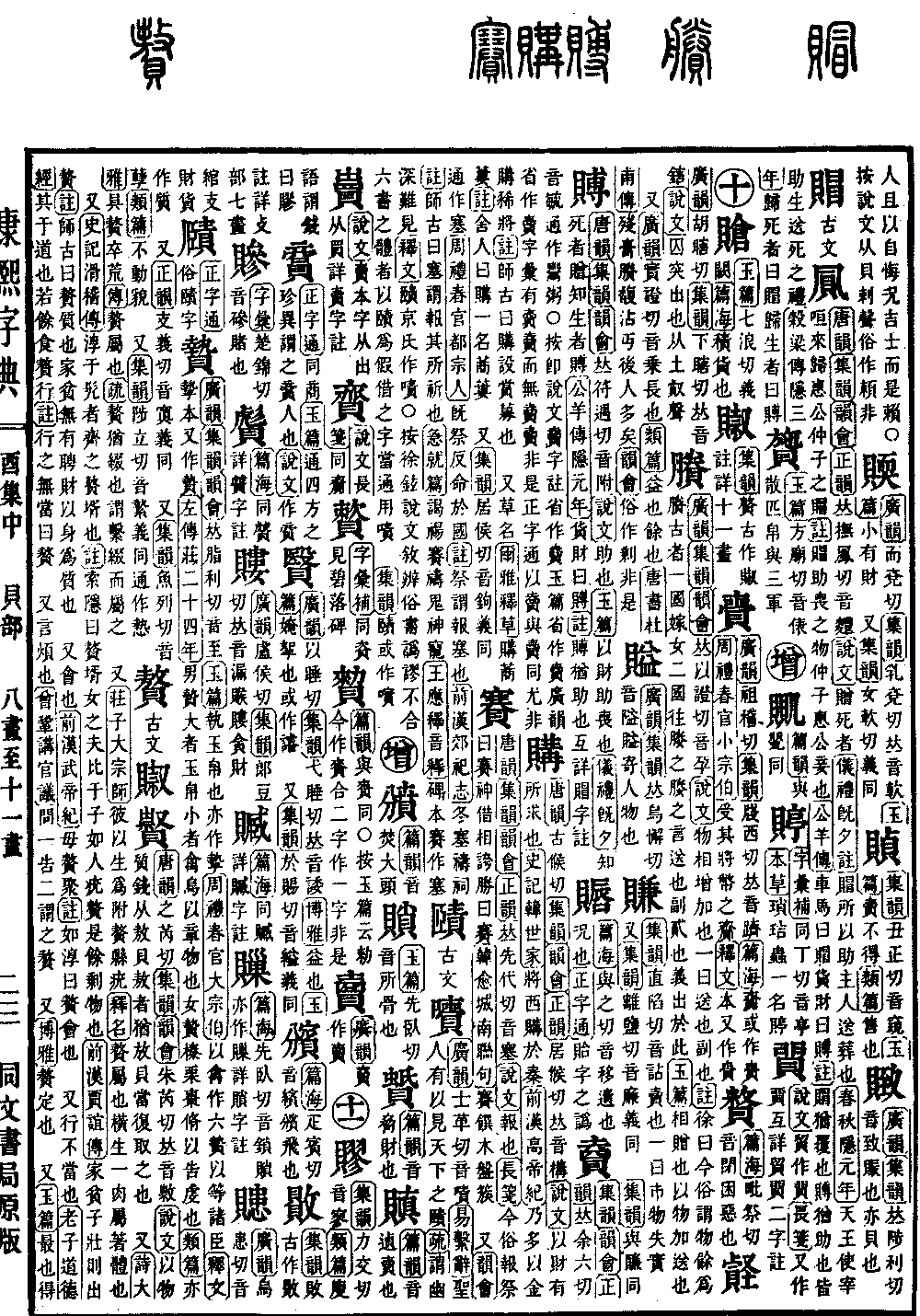
You Collection, Middle Volume
Radical: Shell (bèi)
Kangxi Strokes: 18
Page 1211, Entry 02
Ancient form. Pronounced zhui (falling tone).
According to the Explaining Graphs and Analyzing Characters (Shuowen Jiezi), it refers to using items as collateral to borrow money. It is composed of the radical for arrogant and the radical for shell. The meaning of arrogant implies that once money (shells) is released, it must be retrieved.
Also, in the Book of Odes (Shijing), it is used in the phrase referring to redundant officials leading to desolation. The commentary states that this means attached or auxiliary. The sub-commentary explains that it implies something tied or linked together.
In the Zhuangzi, it is used in the context of considering life as an attached tumor or a dangling wart. The Explaining Names (Shiming) states that it means to be attached, like a piece of flesh growing out and clinging to the body.
In the Records of the Grand Historian (Shiji), it mentions a son-in-law living in his wife's home. The commentary explains that such a son-in-law is likened to a superfluous tumor or growth on a person's body.
In the Book of Han (Hanshu), it mentions that if a family is poor and the son is grown, he may go out as a mortgaged son-in-law. The commentary states that this implies being used as collateral; if a family is poor and lacks a bride price, the man uses his own person as a pledge.
It also means to assemble or congregate. In the Book of Han (Hanshu), it states not to gather or congregate. The commentary notes this means to assemble.
It also refers to improper conduct. In the Laozi (Daodejing), it is used to describe conduct that is like leftover food or improper behavior. The commentary states that improper conduct is called zhui.
It also refers to verbose speech. Zeng Gong, in his Discussions on Lecturers, states that answering two things when asked only one is called zhui.
According to the Guangya, it means to be certain.
According to the Yupian, it means to be the most or to obtain.
Also, according to the Jiyun, pronounced ao (rising tone).
According to the Leipian, it refers to a lack of charm.