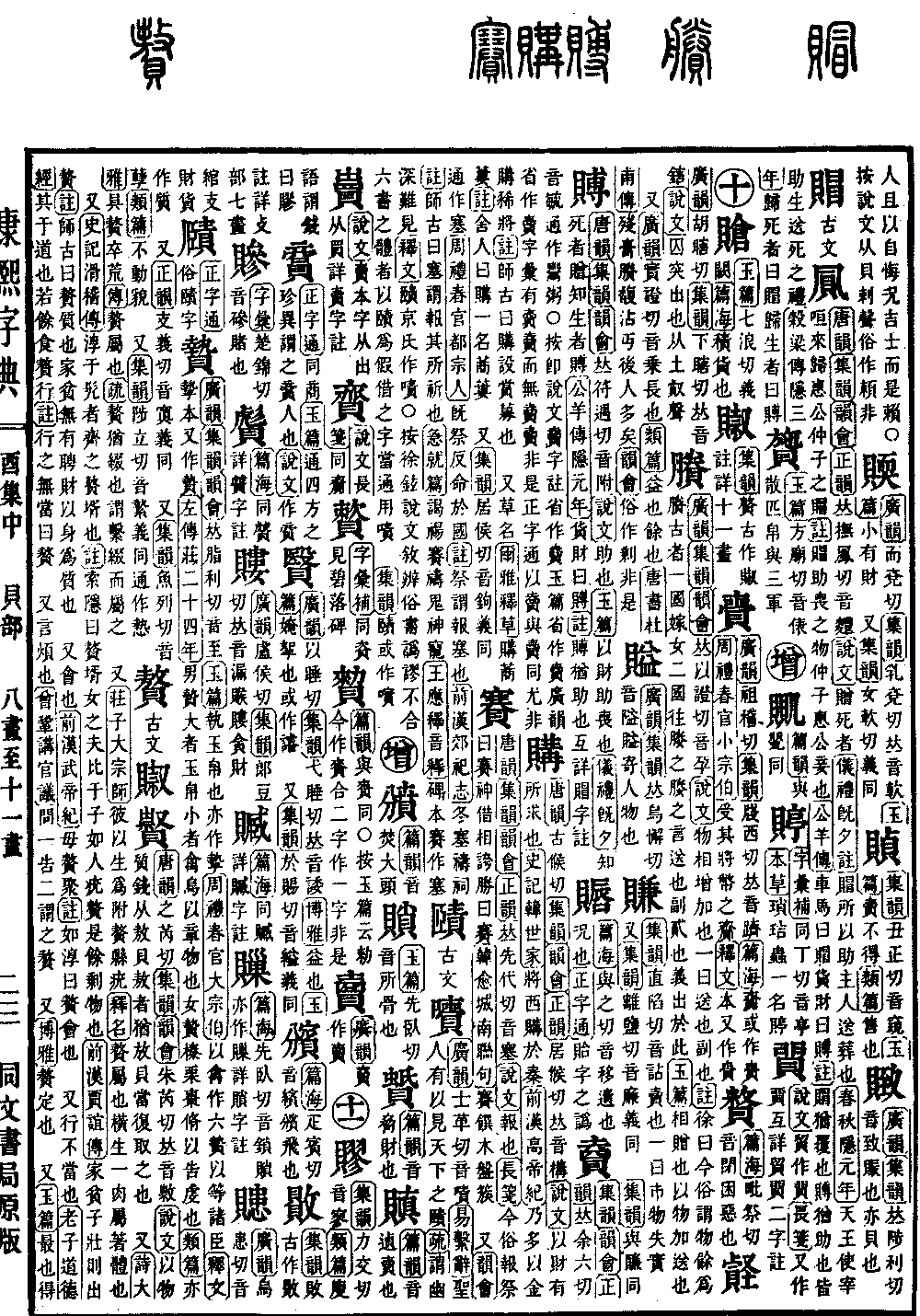
You Collection, Lower Volume
Radical: Shell (bèi)
Kangxi Strokes: 18
Page 1211, Entry 47
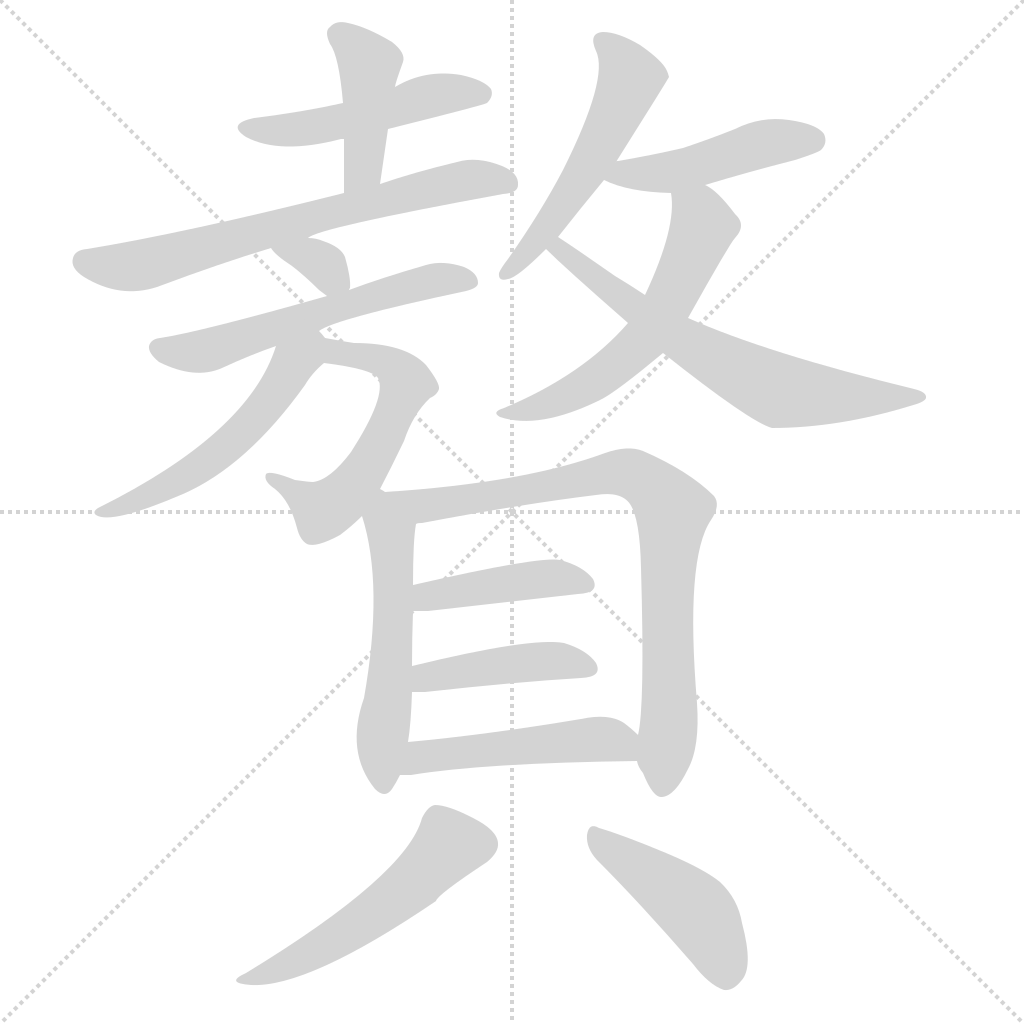
Pronounced zhui (falling tone). According to the Shuowen Jiezi (Explanation of Graphs and Analysis of Characters), it refers to the use of an item as collateral to borrow money. The character is composed of the components for being proud or arrogant and shell (wealth). The meaning implies that once the shell (wealth) is released, it must be reclaimed.
Also, from the Book of Odes (Shijing): To be attached or tethered, ending in desolation. The commentary states that zhui means to be attached or appended. The sub-commentary explains that zhui is like a connection, referring to being linked or attached.
Also, from the Zhuangzi (Master Zhuang): Viewing life as an attached tumor or a dangling wart. The Explaining Names (Shiming) states that zhui means to adhere, like a piece of flesh growing on the body.
Also, from the Records of the Grand Historian (Shiji): Chunyu Kun was a matrilocal son-in-law in the state of Qi. The commentary (Suoyin) notes that a matrilocal son-in-law is a husband who marries into the woman's family; compared to a true son, he is like an unnecessary tumor on a person's body.
From the History of the Former Han (Hanshu), Biography of Jia Yi: When a family is poor and the son is grown, he leaves to become a matrilocal husband. The commentary by Yan Shigu states that zhui refers to being a pledge; when a family is poor and cannot afford a dowry, the man serves as the collateral himself.
It also means to gather. From the History of the Former Han (Hanshu), Annals of Emperor Wu: Do not gather or hoard. The commentary by Ru Chun states that zhui means to gather or collect.
It also denotes improper behavior. From the Laozi (Daodejing): Concerning the Way, it is like leftover food or redundant actions. The commentary states that improper behavior is called zhui.
It also refers to wordiness. From Zeng Gong, Discussion on Officials: To ask about one matter but provide two explanations is called zhui.
Also, according to the Guangya (Expanded Elegance), zhui means to be certain or fixed.
According to the Yupian (Jade Compendium), it means most, or to obtain.
Also, pronounced ao (rising tone). According to the Leipian (Categorized Dictionary), the term ao-zhui refers to something that is not beautiful.