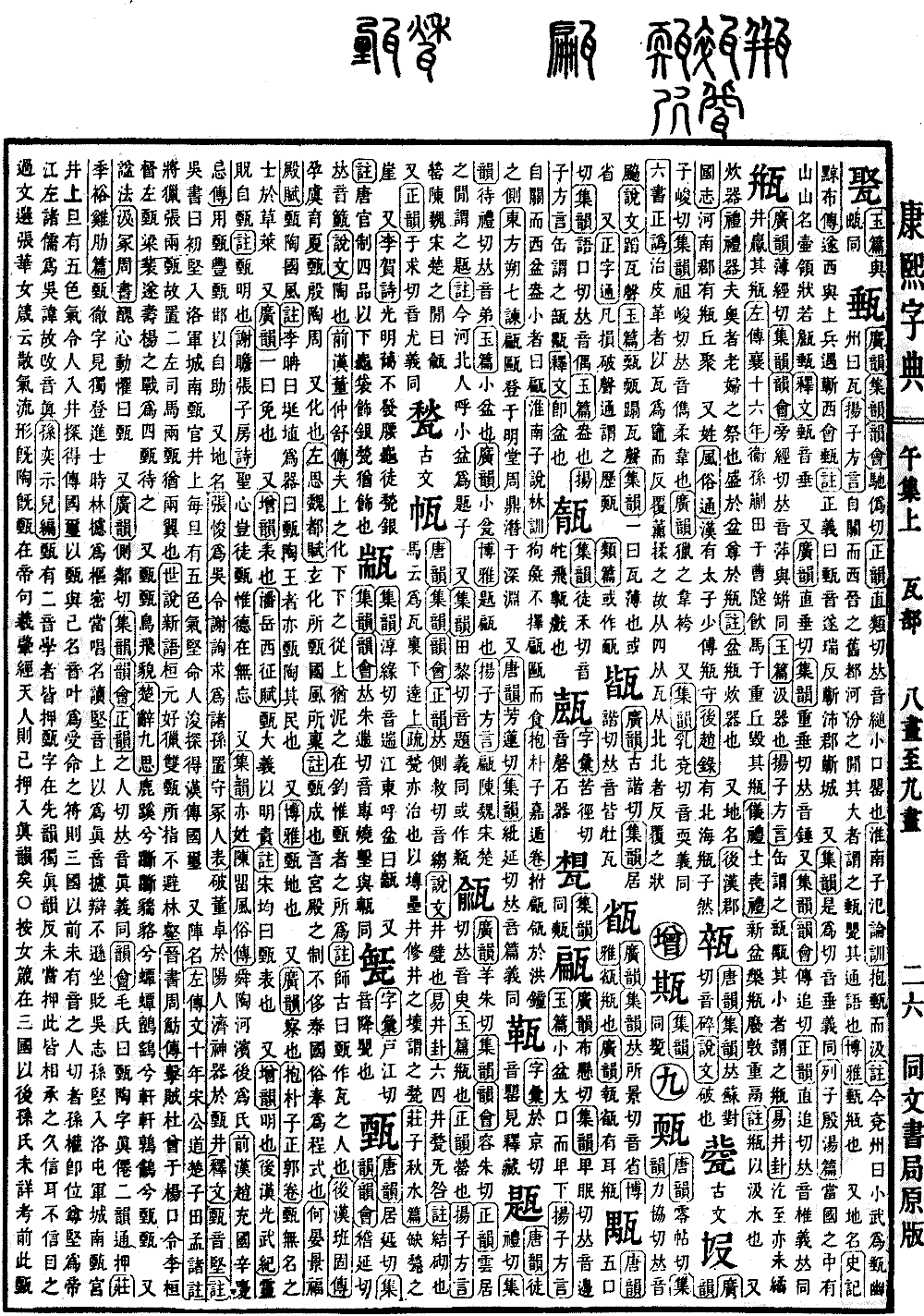
Wu Collection, Upper Volume
Radical: Tile (wǎ)
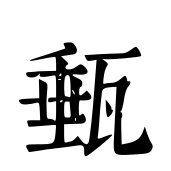
Character: Zhui
Kangxi Stroke Count: 13
Page 750, Entry 02
According to the Extensive Rhymes (Guangyun), Collected Rhymes (Jiyun), and Rhyme Compendium (Yunhui), pronounced zhui (falling tone). According to the Standardized Rhymes (Zhengyun), pronounced zhui (falling tone). The pronunciation is the same as the word for to weigh down or to let down on a rope.
Refers to an earthenware jar with a small opening.
Huainanzi, Treatise on Generalizations (Fanlun Xun): Holding a zhui to draw water.
Commentary: In the present-day Yanzhou region, a small earthenware jar is called a zhui; in the Youzhou region, it is called a tile.
Yangzi, Dialect Studies (Fangyan): West of Hangu Pass, in the region of the old capital of the Jin state along the He and Fen rivers, a large earthenware jar is called a zhui. Ying is the general term.
Broad Refinement (Boya): A zhui is a bottle.
Also refers to a place name.
Records of the Grand Historian (Shiji), Biography of Qing Bu: Thereupon, moving west, they met with the Emperor's army in Qi County, and joined forces to the west at Zhui.
Commentary: The Correct Meaning (Zhengyi) states: Zhui is pronounced sui (falling tone) and rui (rising tone). Qi refers to Qi City in Pei Commandery.
According to Collected Rhymes (Jiyun), pronounced wei (falling tone). The pronunciation is the same as the word for hang or drop. The meaning is the same.
Liezi, Questions of Tang (Tangwen Pian): In the center of the state, there is a mountain named Huling, shaped like a dan and a zhui.
Explanation of Texts (Shiwen): Zhui is pronounced chui (rising tone).
According to Extensive Rhymes (Guangyun), pronounced chui (rising tone). According to Collected Rhymes (Jiyun), pronounced chui (rising tone). The pronunciation is the same as the word for hammer.
According to Collected Rhymes (Jiyun) and Rhyme Compendium (Yunhui), pronounced zhui (level tone). According to Standardized Rhymes (Zhengyun), pronounced zhui (level tone). The pronunciation is the same as the word for hammer or pestle. The meaning is the same.
Textual Research: In Liezi, Yin Tang Pian, it has been corrected to Tangwen Pian in accordance with the original text.