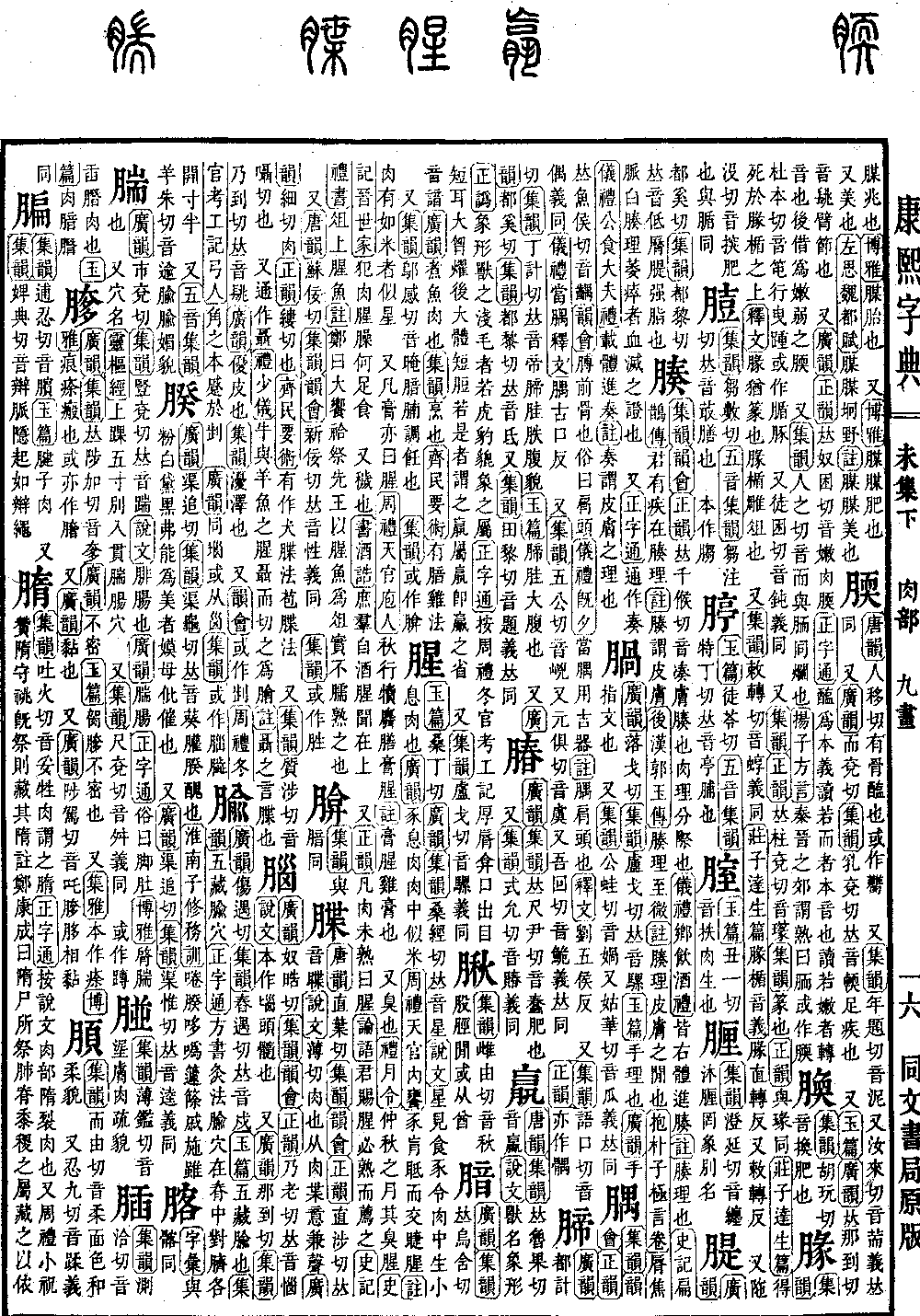
Pronounced zhiè (entering tone) according to "Tang Yun" (Tang Yun). Pronounced zhishè (entering tone) according to "Jiyun" (Jiyun), "Yunhui" (Yunhui), and "Zhengyun" (Zhengyun), with the same pronunciation as "䁋" (miàn). "Shuowen Jiezi" (Shuowen Jiezi) explains it as slicing meat into thin pieces. The character is composed of "ròu" (meat) and "yè" (leaf), where "yè" indicates both meaning and pronunciation. "Guangyun" (Guangyun) explains it as slicing meat into fine pieces. "Zhengyun" (Zhengyun) explains it as cutting into thin strips. "Qimin Yaoshu" (Qimin Yaoshu) records methods for making dog jerky and for wrapping meat slices with leaves.
Also, pronounced zhishè (entering tone) according to "Jiyun" (Jiyun), with the same pronunciation as "囁" (niè). The meaning is to cut.
It is also used as a phonetic loan for the character "聶" (niè). "Liji · Shaoyi" (Liji · Shaoyi) records that raw beef, lamb, and fish are first sliced thinly and then finely cut to make raw shredded meat. The commentary explains that "聶" (niè) here means "䐑" (niè).