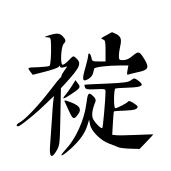
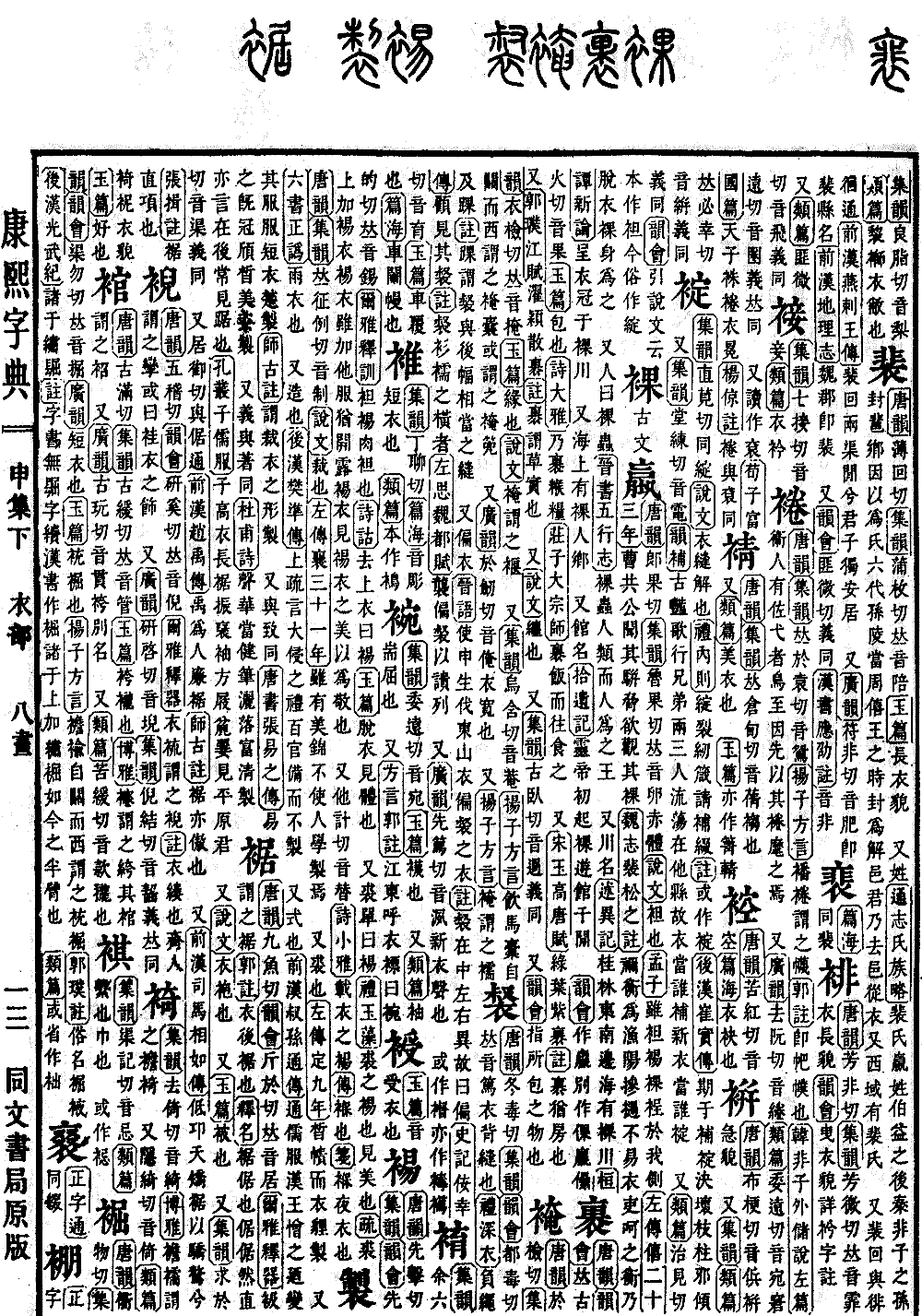
Zi Collection, Upper Volume, Page 12, Entry 03
Radical: Grass (cǎo)
Pronounced zhàn (falling tone)
Explanation: In the "Jiyun" (Jiyun), it is pronounced zhihan, with the same pronunciation as "zhan." The "Shuowen Jiezi" (Shuowen Jiezi) explains it as a tear in the seam of clothing. The "Liji - Neize" (Liji - Neize) records: "When clothing seams tear, mend them with needle and thread." The commentary states that it is sometimes also written as "zhan." The "Hou Hanshu - Cui Shi Zhuan" (Hou Hanshu - Cui Shi Zhuan) says: "Hoping to mend tears and repair breaches, to support and correct what is crooked and askew."
Also, in the "Jiyun" (Jiyun), it is pronounced tanglian, with the same pronunciation as "dian." The "Yunbu" (Yunbu) quotes the poem from "Gu Yan Ge Xing" (Gu Yan Ge Xing): "Brothers, two or three, adrift in a foreign land. Who will mend the old clothes, who will sew the new ones?"
Also, in the "Leipian" (Leipian), it is pronounced zhijian. The meaning is the same. The "Yunhui" (Yunhui) quotes the "Shuowen Jiezi" (Shuowen Jiezi) stating that it was originally written as "tan," but is now popularly written as "zhan."