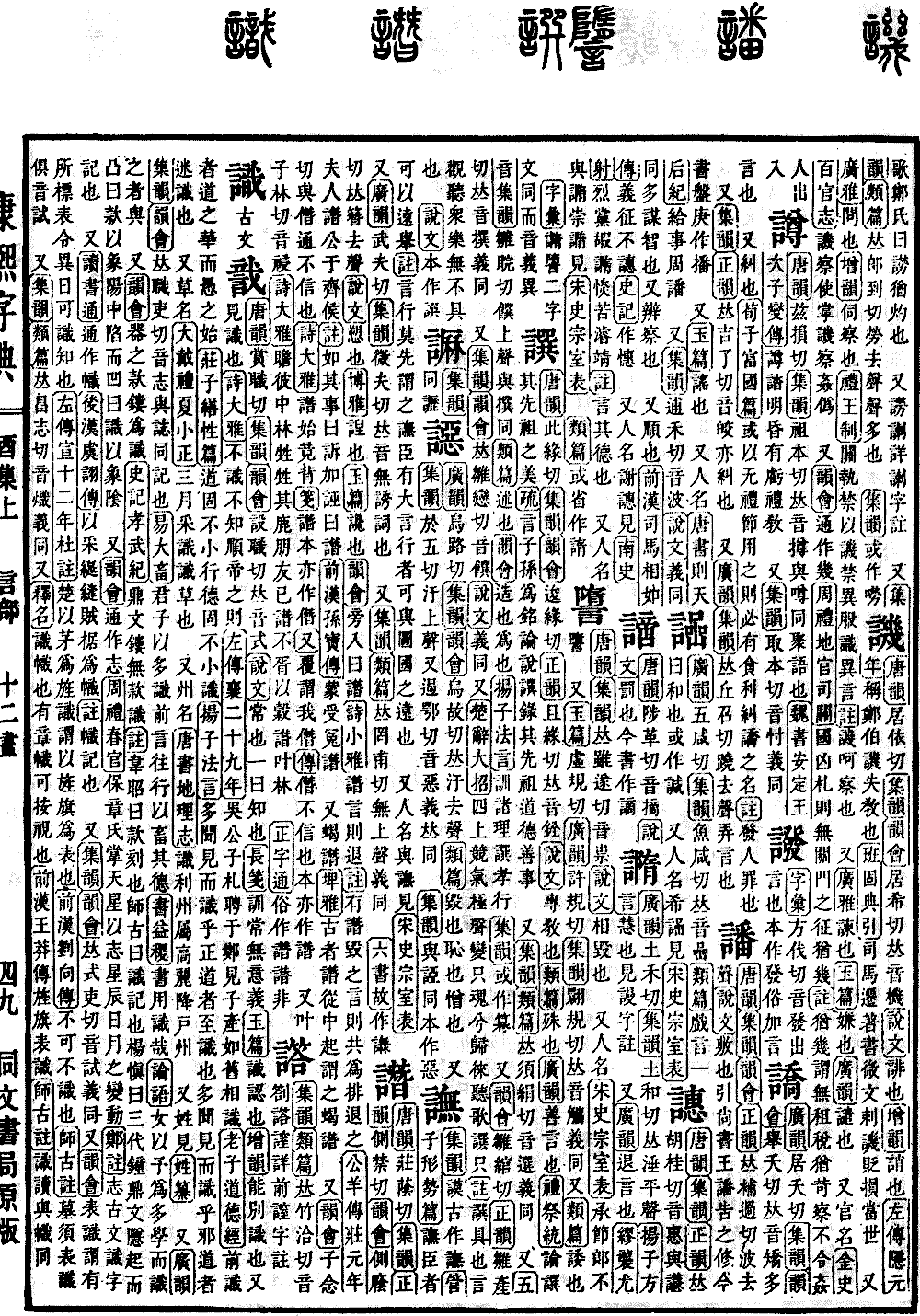
You Collection, Upper Volume
Radical: Speech (yán)
Zèn; Kangxi strokes: 19; Page 1181, Entry 15
Pronounced zèn (falling tone).
According to the Explaining Graphs and Analyzing Characters (Shuowen): To denounce or slander.
According to the Guangya: To defame.
According to the Yupian: To speak ill of and frame someone.
According to the Rhyme Collection (Yunhui): Secretly slandering someone from the side is called zèn.
Book of Odes (Shijing), Minor Odes: Hearing slanderous words, everyone crowds to exclude him.
Gongyang Commentary (Gongyang Zhuan), First Year of Duke Zhuang: The lady spoke ill of the Duke of Lu to the Marquis of Qi.
Commentary: A factual account is called a complaint; a fabricated accusation is called zèn.
History of the Former Han (Qianhan Shu), Biography of Sun Bao: To suffer injustice and slander.
Also, xie zèn.
According to the Piya: In ancient times, slander originating from within was called xie zèn.
Also, according to the Rhyme Collection (Yunhui): Pronounced jiàn. Used interchangeably with the character for僭 (jiàn, falling tone). Meaning untrue or untrustworthy.
Book of Odes (Shijing), Greater Odes: Initially believing slander, ultimately betraying trust.
Explanation of Texts (Shiwen): Some versions write this character as 僭 (jiàn).
Also: In turn, claiming I am not truthful.
Notes (Jian): 僭 (jiàn) means not truthful. Some versions are also written as 譖 (zèn).
Also, rhyming with the line, pronounced jìn (falling tone).
Book of Odes (Shijing), Greater Odes: Look at the forest; there are many deer. Friends have turned to slandering and harming one another, unable to treat each other with the proper path. The character zèn rhymes with the character for forest (lín).
Correct Graph Compendium (Zhengzitong): The common variant written as 譛 (zèn) is incorrect.
Textual Research: Book of Odes (Shijing), Greater Odes: zèn shǐ jìng bèi. Notes (Jian): zèn běn yì zuò jiàn. Also: fù wèi wǒ jiàn. Commentary (Zhuan): jiàn, bù xìn yě. běn yì zuò zèn. According to the original text, Jìan has been changed to Explanation of Texts (Shiwen), and Commentary (Zhuan) has been changed to Notes (Jian).