You Collection, Lower Volume
Radical: City (yì)
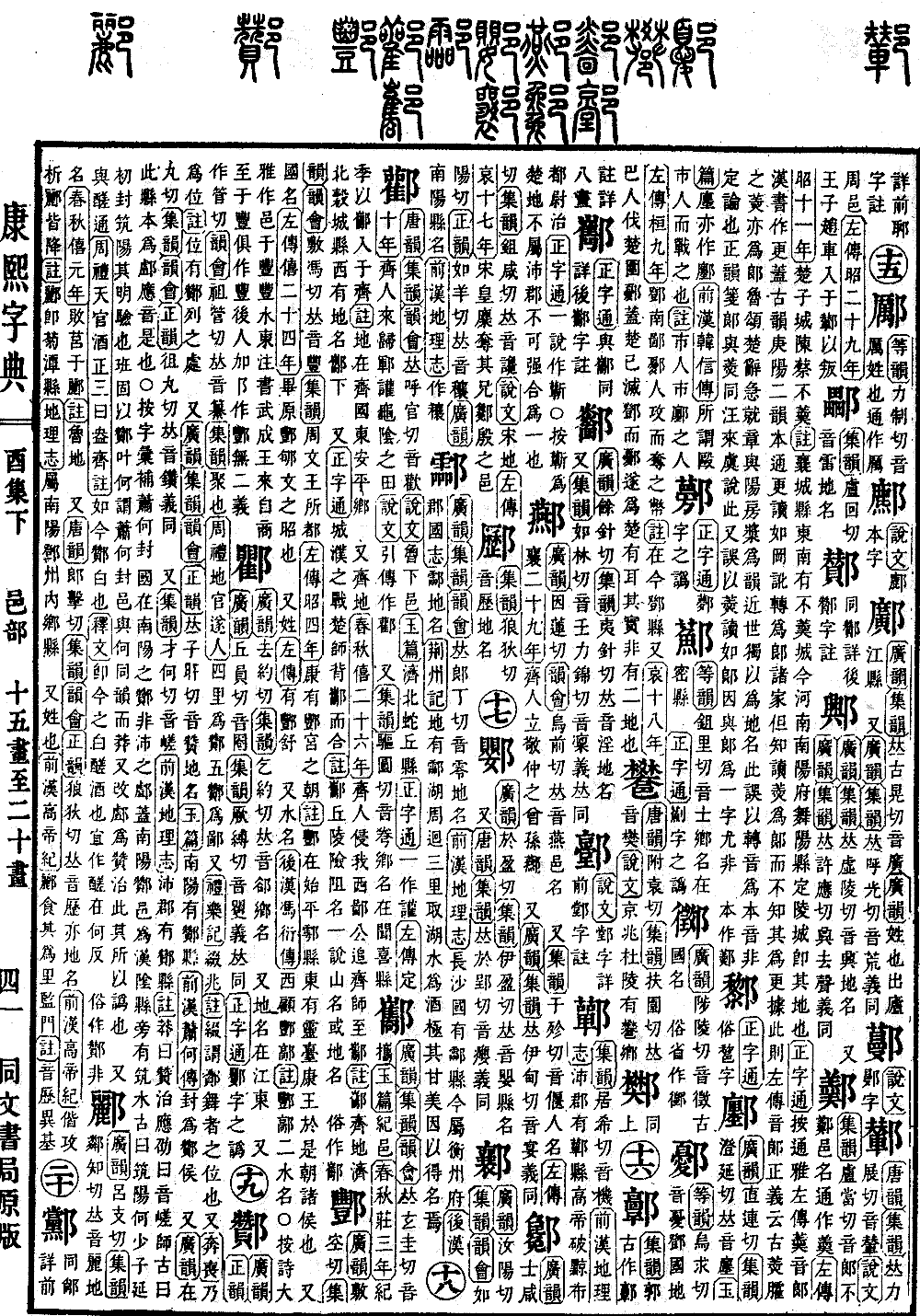
酇; Kangxi strokes: 26; Page 1279, entry 33
According to Guangyun (Guǎngyùn) and Zhengmao (Zhèngmào), pronounced zuòguǎnqiè. According to Yunhui (Yùnhuì), pronounced zǔguǎnqiè, with the sound of zuǎn. According to Jiyun (Jíyùn), it means to gather or collect. In Rites of Zhou (Zhōulǐ), "Officer of the Earth (Dìguān Tuìrén)", four li (a traditional unit of distance) are called a zǎn, and five zǎn are called a bǐ (an administrative division). Also, in Book of Rites (Lǐjì), "Record of Music (Yuèjì)", "zhuì zhào". The commentary states that zhuì refers to the positions of the zǎn dancers. Also, in "Running Mourning (Bēnsāng)", "nǎi wéi wèi". The commentary states that "wèi" has places arranged in zǎn formation.
Also, according to Guangyun (Guǎngyùn), Jiyun (Jíyùn), Yunhui (Yùnhuì), and Zhengmao (Zhèngmào), pronounced zǐgànqiè, with the sound of zàn. A place name. According to Yupian (Yùpiān), Nanyang (Nányáng) has Zàn County. In History of the Former Han (Qiánhàn), "Biography of Xiao He (Xiāo Hé Chuán)", he was enfeoffed as Marquis of Zàn.
Also, according to Guangyun (Guǎngyùn), pronounced zàiwánqiè. According to Jiyun (Jíyùn), Yunhui (Yùnhuì), and Zhengmao (Zhèngmào), pronounced cúwánqiè, with the sound of zuàn. The meaning is the same as the first definition (to gather or collect).
Also, according to Jiyun (Jíyùn), pronounced cáihéqiè, with the sound of cuó. In History of the Former Han (Qiánhàn), "Treatise on Geography (Dìlǐ Zhì)", Pei Commandery (Pèi Jùn) has Cuó County. The commentary states that during Wang Mang's (Wáng Mǎng) time, it was renamed Zànzhì. Ying Shao (Yīng Shào) said its pronunciation is cuó. Shi Gu (Shī Gǔ) said: "This county was originally Cuó, and Ying Shao's pronunciation is correct." According to Zihui Bu (Zìhuì Bǔ): Xiao He's (Xiāo Hé) enfeoffment was in Zàn of Nanyang (Nányáng), not Pei Commandery (Pèi Jùn). The Zàn settlement in Nanyang (Nányáng) was Han'yin County (Hànyīn Xiàn), next to the Zhù River (Zhù Shuǐ), and was anciently called Zhúyáng. Xiao He's (Xiāo Hé) youngest son, Xiao Yan (Xiāo Yán), was initially enfeoffed in Zhúyáng, which is clear evidence. Ban Gu (Bān Gù) used Zàn to rhyme with He (hé), stating that Xiao He's (Xiāo Hé) enfeoffment rhymed with He, and then Wang Mang (Wáng Mǎng) changed the name to Zànzhì, which is the reason for the error.
Also, it is interchangeable with cuó. In Rites of Zhou (Zhōulǐ), "Celestial Officers (Tiānguān), Chief Winemaker (Jiǔzhèng), Third: Ángqí (àngqí) Commentary", it is like the present-day Zàn White (zànbái). The Shìwén (Shìwén) states: "This is the present-day bái cuó wine. It should be written as cuó, pronounced zài hé fǎn. The common writing of zàn is incorrect."