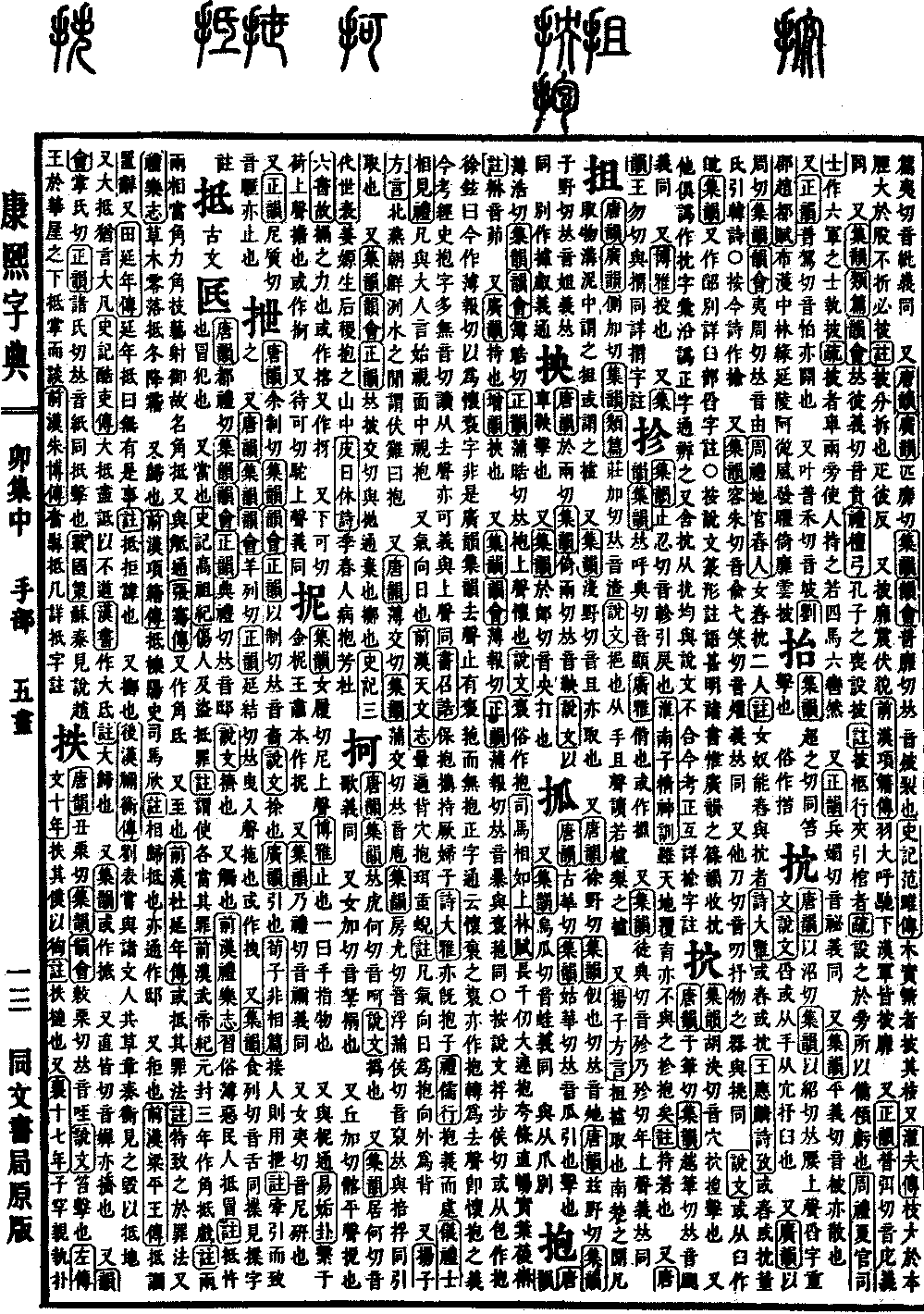
Mao Collection, Middle Volume
Radical: Hand (shǒu)
Page 423, Entry 02
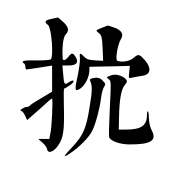
According to the Tang Rhymes (Tangyun), pronounced yao (rising tone). According to the Collected Rhymes (Jiyun), pronounced yao (rising tone). It is a variant form of another character. The Explaining Graphs and Analyzing Characters (Shuowen Jiezi) states: It is also written as a combination of Hand and Rong. The meaning is to scoop things out from a mortar.
According to the Broad Rhymes (Guangyun), pronounced zhou. According to the Collected Rhymes (Jiyun) and the Rhyme Collection (Yunhui), pronounced yi. The sound is the same as the word you.
In the Rites of Zhou (Zhouli), Section on Officers of Earth (Diguan), it is recorded: Two women perform grain-husking and scooping. The commentary explains: This refers to female slaves who can perform the work of husking grain and scooping it out.
The Book of Odes (Shijing), Greater Odes (Daya), states: Some people are husking, some people are scooping. Wang Yinglin's Odes Examination (Shikao) records: Some husk and some scoop; the Dong family cites the version from the Han School of Odes. Note: Existing editions of the Book of Odes use the character yu instead.
According to the Collected Rhymes (Jiyun), it is also pronounced rong. It is also pronounced yao. The meaning is the same. It is also pronounced tao. This refers to an implement for scooping things. It is the same as the character tiao.
The Explaining Graphs and Analyzing Characters (Shuowen Jiezi) states: It is also written with the Mortar radical. According to the Collected Rhymes (Jiyun), it is also written in a variant form. For further details, see the entry for the character in the Mortar radical section.
Note: The seal script form and the commentary in the Explaining Graphs and Analyzing Characters (Shuowen Jiezi) are very clear. Among various works, only the Xiao rhyme section of the Broad Rhymes (Guangyun) records the character, while other books incorrectly write it as dan. The Dictionary of Characters (Zihui) inherited this error. The Correcting Character Encyclopedia (Zhengzitong) analyzed it but discarded the character in favor of the character rao, both of which do not match the Explaining Graphs and Analyzing Characters (Shuowen Jiezi). This is now examined and corrected. Refer also to the commentary for the character yu.