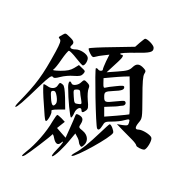
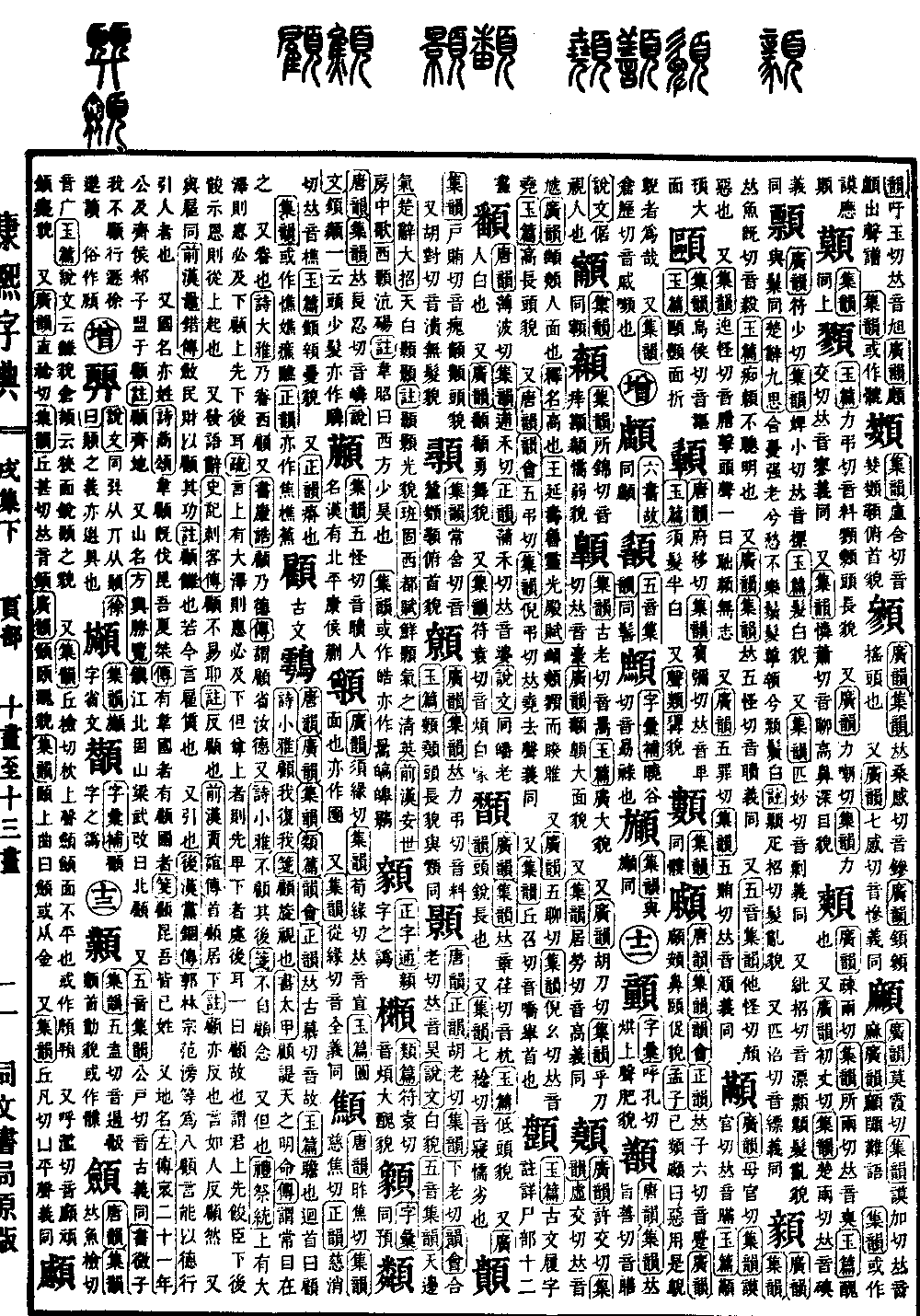
Xu Collection, Lower Volume
Radical: Page (yè)
Kangxi Strokes: 22
Page 1409, Entry 44
Tang Rhyme (Tangyun) and Collected Rhymes (Jiyun): Pronounced yan. Pronounced the same as guang.
Jade Chapter (Yupian): Interpreted in Explaining Graphs and Analyzing Characters (Shuowen) as the appearance of a face. The Cangjie Chapter (Cangjiepian) describes it as a face that is long and narrow with a sharp, tapering chin.
Also, in Collected Rhymes (Jiyun): Pronounced xian (rising tone). Yan-yan describes a face that is uneven. Some versions are written as a variant form.
Also pronounced lan. Pronounced the same as cu. Wan-yan refers to a dull or foolish appearance.
Also, in Wide Rhymes (Guangyun): Pronounced zhen. In Collected Rhymes (Jiyun): Pronounced qin (rising tone). Pronounced the same as qin.
In Wide Rhymes (Guangyun): Yan-yi refers to an ugly appearance.
In Collected Rhymes (Jiyun): A chin that curves upward is called yan. Some versions use the Metal radical.
Also, in Collected Rhymes (Jiyun): Pronounced qin. Pronounced the same as the level tone of qian. The meaning is the same.