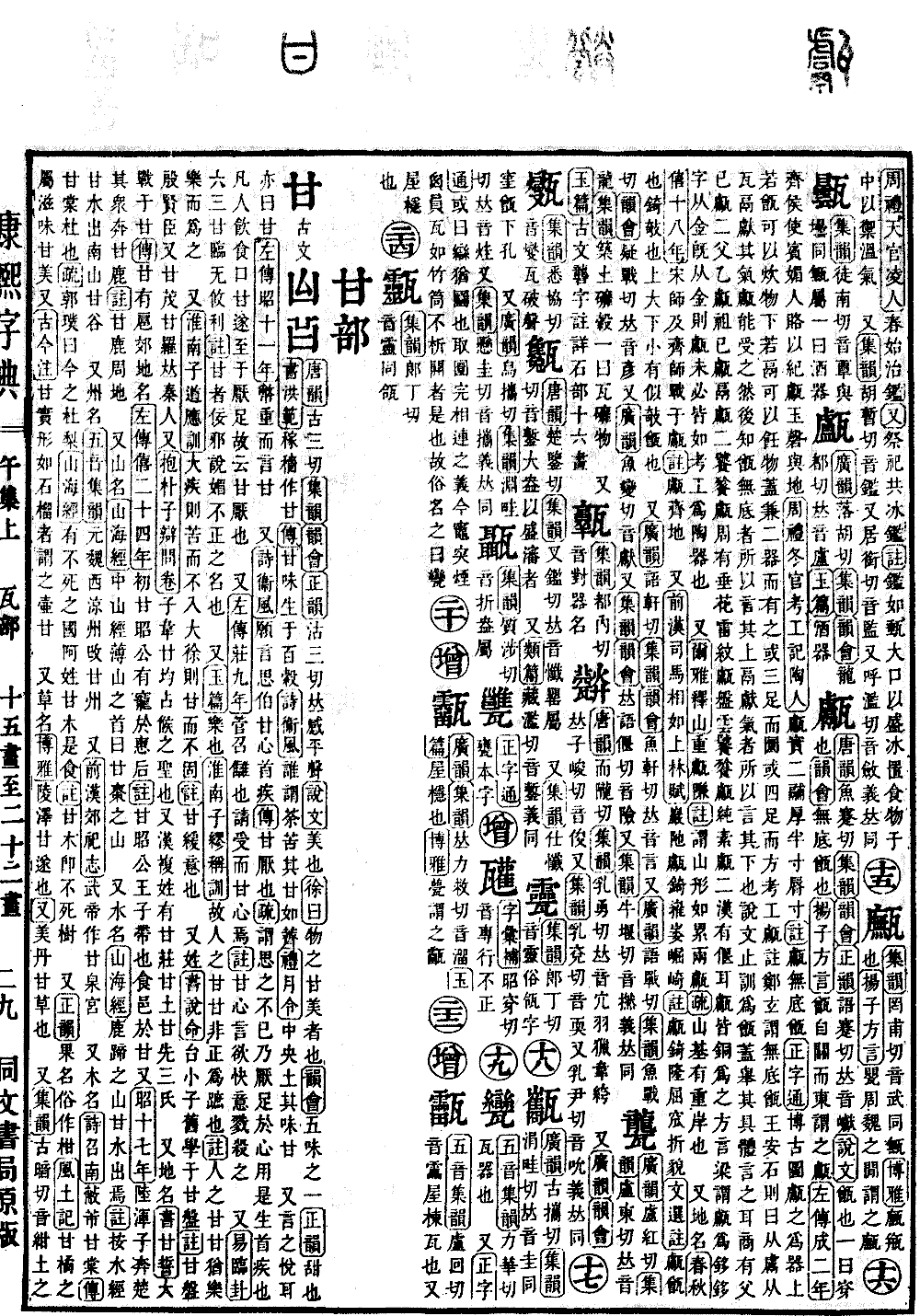
Wu Collection, Upper Volume
Radical: Tile (wǎ)
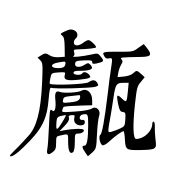
Yan
Kangxi strokes: 21
Page 753, Entry 04
Pronounced yan (rising tone).
According to the Tang Rhyme (Tangyun), the Jiyun, the Yunhui, and the Zhengyun: pronounced yan (rising tone).
According to the Explaining Graphs and Analyzing Characters (Shuowen): a steamer for cooking. Also means to perforate.
According to the Yunhui: a steamer without a bottom.
According to the Fangyan by Yang Xiong: a steamer is called a yan in regions east of the pass.
In the Zuo Tradition (Zuozhuan), second year of Duke Cheng: The Marquis of Qi sent Bin Meiren to offer the yan, the jade chimes, and land as a bribe.
In the Rites of Zhou (Zhouli), section on the Potters in the Record of Trades (Kaogongji): A yan holds two fu, with a thickness of half an inch and a rim of one inch.
Commentary: A yan is a steamer without a bottom.
According to the Correct Character Guide (Zhengzitong): In the Illustrations of Antiquities (Bogutu), the vessel known as a yan resembles a steamer on top, which can cook food, and a li-cauldron on the bottom, which can heat food; it combines both vessels. Some have three round legs, others have four square legs. Regarding the commentary on the Record of Trades: Zheng Xuan defines it as a steamer without a bottom. Wang Anshi stated: It is composed of the characters for yan and tile. The li-cauldron offers its steam, and the yan receives it; thus, we understand that the steamer being without a bottom refers to its top, and the li-cauldron offering steam refers to its bottom. The Explaining Graphs and Analyzing Characters defines it only as a steamer, which merely describes its function. During the Shang Dynasty, there were two Father Ji yan, a Father Yi yan, a Grandfather Yi yan, two li-yan, and a taotie-pattern yan. During the Zhou Dynasty, there were hanging-flower thunder-pattern yan-basins, cloud-taotie yan, and two plain yan. During the Han Dynasty, there were bent-ear yan, all made of bronze. The Fangyan notes: In the Liang region, a yan is called a chi. The character chi is formed with the metal radical; since it uses the metal radical, a yan is not necessarily always a ceramic vessel as described in the Record of Trades.
Also, according to the Erya, section on Explaining Mountains: A layered yan has a ridge.
Commentary: This refers to a mountain shape resembling two piled yan vessels.
Commentary: This refers to a mountain base with overlapping cliffs.
Also, a place name.
In the Spring and Autumn Annals (Chunqiu), eighteenth year of Duke Xi: The armies of Song and Qi fought at Yan.
Commentary: Yan is a location in the state of Qi.
Also, in the Rhapsody on the Shanglin Park (Shanglin Fu) by Sima Xiangru in the History of the Former Han (Qianhan): The cliffs and rock formations are jagged, uneven, and steep.
Commentary: Yan-qi refers to a bulging, bent, and broken appearance.
Commentary on the Anthology of Literature (Wenxuan): Yan means a steamer. Qi means tilted. It is large on top and small on the bottom, resembling a tilted steamer.
Also, according to the Guangyun: pronounced yan (level tone). According to the Jiyun, the Yunhui: pronounced yan (level tone).
Also, according to the Guangyun: pronounced yan (level tone). According to the Jiyun: pronounced yan (level tone). According to the Yunhui: pronounced yan (level tone).
Also, according to the Guangyun: pronounced xian (falling tone).
Also, according to the Jiyun, the Yunhui: pronounced xian (rising tone).
Also, according to the Jiyun: pronounced nian (rising tone). The meaning is the same.