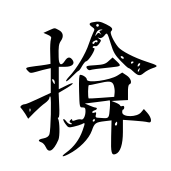
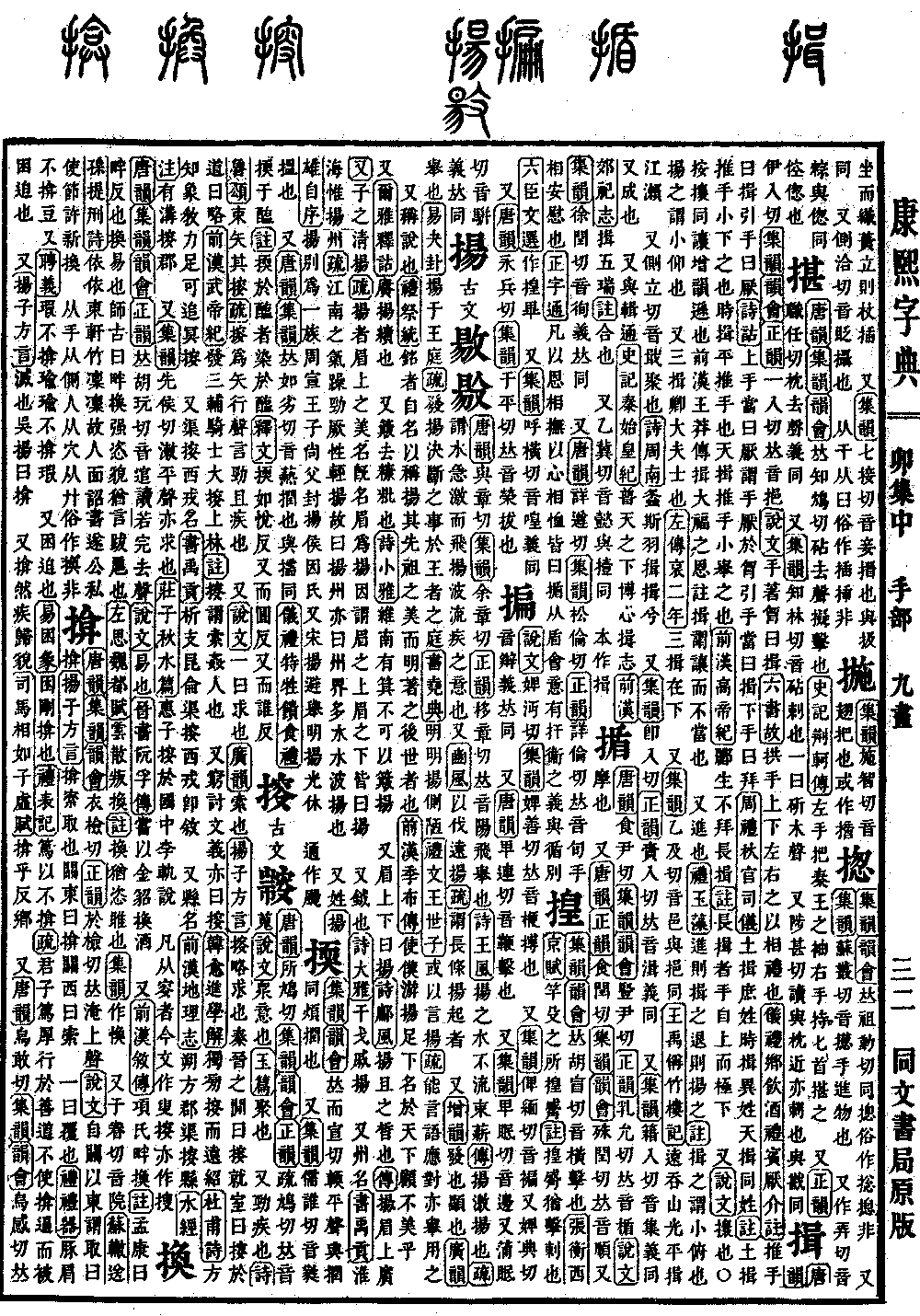
Mao Collection, Middle Volume. Radical: Hand (shǒu). Kangxi strokes: 13. Page 442, Entry 15.
Tangyun, Jiyun, Yunhui: Pronounced yan (rising tone); Zhengyun: Pronounced yan (rising tone).
Shuowen: In the regions east of the passes, the act of taking is called yan.
Yangzi: Fangyan (Regional Speech): Yan means to take. In the east of the passes it is called yan; in the west of the passes it is called [omitted]. Another interpretation is to cover.
Liji (Book of Rites), Liqi (Ritual Vessels): The foreleg of a piglet shall not fail to cover the sacrificial vessel.
Also, Pin Yi (Meaning of the Presentation of Gifts): Flaws do not cover the luster of a fine jade, and the luster of a fine jade does not cover flaws.
It also means to be constrained or pressured. Yi (Book of Changes), Kun Tuan (The Judgement on the Oppression Hexagram): The Oppression hexagram signifies that the yang-firm is constrained.
Liji (Book of Rites), Biaoji (Record on Example): To be sincere and loyal without being constrained. Commentary: A gentleman follows the virtuous path with loyalty and kindness, and will not fall into a state of distress due to pressure.
Also, Yangzi: Fangyan (Regional Speech): It means to extinguish. In the regions of Wu and Yangzhou, this is called yan.
Also, yanran, describing the appearance of returning home rapidly. Hanshu (Book of Han), Biography of Sima Xiangru: Returning to one's home region swiftly.
Also, Tangyun: Pronounced an (rising tone); Jiyun, Yunhui: Pronounced an (rising tone). To cover something with the hand.
Yunhui: Identical to the character yan. For detailed information, one may refer to the notes for the character yan.
Textual research: Regarding "yanran, describing the appearance of returning home rapidly," originally cited as Sima Xiangru: Zixu Fu (Rhapsody on Sir Fantasy). Note: The character yan appears as an in the Wenxuan (Selections of Refined Literature) and as an in the Shiji (Records of the Grand Historian). It is only in the Hanshu (Book of Han), Biography of Sima Xiangru, that it is written as yan. The explanation "yanran, appearance of returning swiftly" is also found only in the commentary to the Hanshu. Based on this research, the citation "Sima Xiangru Zixu Fu" has been corrected to "Hanshu, Biography of Sima Xiangru."