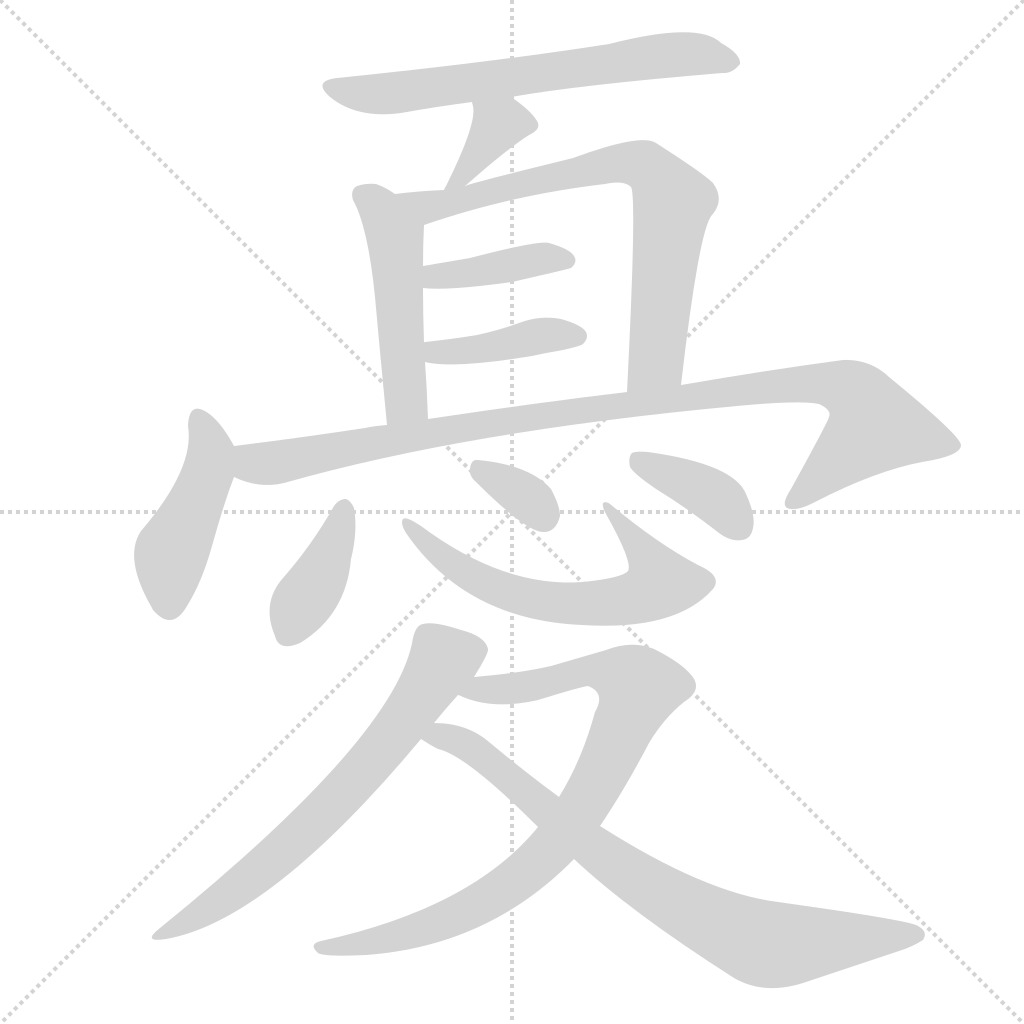
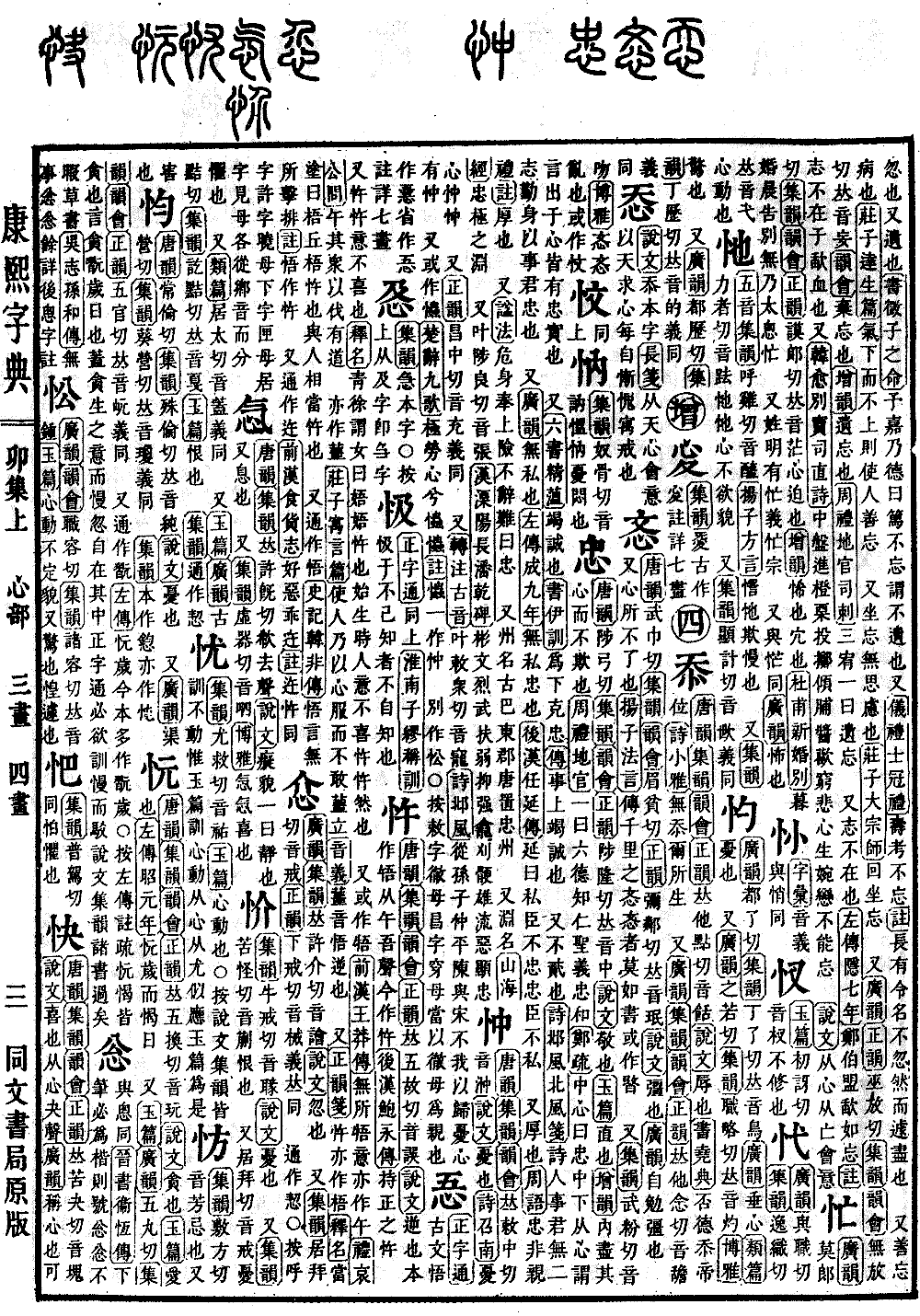
Mao Collection, Upper Volume
Radical: Heart (xīn)
15 strokes
Page 377, Entry 01
Archaic form. Pronounced you. Now written as you. In the Shuo Wen Jiezi (Shuowen), it means to be worried. In the Erya, a dictionary of standard definitions (Erya), it means to think. The commentary states that worry is anxious thought. In the Book of Documents (Shangshu), the Great Plan (Hongfan) chapter mentions the six extremes, the third of which is worry. It also means illness. In the Book of Rites (Liji), the chapter on minor rules of conduct mentions having the worry of carrying firewood, where the commentary notes that worry can mean illness. It also means to be hidden. In the Book of Changes (Yijing), the Qian hexagram notes that when one is worried, one should depart from it, with the commentary stating this refers to times when one should be in seclusion. It also means humiliation. In the Book of Changes (Yijing), the Great Treatise (Xici) states that the path of the petty man is one of worry. One who is in mourning is said to be in worry; the Book of Documents (Shangshu), the Charge to Yue (Shuoming) states the king dwells in worry. Pregnancy sickness is also called worry; in the Discourses of the States (Guoyu), it is said that King Wen did not cause worry while in his mother's womb. When people are worried, their heads hang low; the Book of Rites (Liji), the chapter on minor rules of conduct, states that if the sash hangs below the belt, it indicates worry, with the commentary noting that worry causes one to stoop. Deep worry is called shu you; the Book of Songs (Shijing), the Lesser Odes of the Kingdom (Xiaoya) mentions suffering from deep worry. The Rites of Zhou (Zhouli), in the Ministry of Rites (Chunguan), mentions using funeral rites to mourn the worries of the state. It is also a surname, as recorded in the Dictionary of Surnames (Xingyuan). Also pronounced ou. The meaning is the same. Pronounced you. The meaning is to contemplate. The preface to the Book of Songs (Shijing) mentions the common people seeing worry, which Xu Miao reads this way. Also follows the rhyme for yi. In the Forest of Changes (Yilin), it says: not seeing the younger sister of the Shu family makes the elder brother's heart worry. Also follows the rhyme for yu. In the Forest of Changes (Yilin), it says: entering and exiting, resting and dwelling, peaceful and staying without worry. The Yellow Court Classic (Huangtingjing) says: the joy of the three spirits comes from living in seclusion, wandering quickly without lingering worry. Also follows the rhyme for yao. The Three Strategies (Sanlue) states: scholars may be treated with humility but not arrogance, and generals may be treated with joy but not worry. Also follows the rhyme for yao. The Book of Songs (Shijing), the Odes of Wang (Wangfeng) states: at the beginning of my life, there was still no turmoil; after my life began, I encountered these hundred worries. Also, in the Odes of Tang (Tangfeng), it says: the river water rises, the white stones are bright; in plain robes and embroidered vermilion, I follow you to Hu. Having seen the gentleman, how could there be worry? Also follows the rhyme for you. The Discourses of the States (Guoyu) says: at the decline of the Shang dynasty, the inscription said: the virtue of the humble is not enough to be approached, it cannot be boasted of, and it only brings worry; the food of the humble is not enough to be enjoyed, it cannot produce richness, and it only brings blame. Originally written as, and sometimes as. The Shuo Wen Jiezi (Shuowen) says it is composed of heart and head, for when the heart is worried, the hair turns white. The Dictionary Supplement (Zihuibu) notes it is also the same as. The Shuo Wen Jiezi (Shuowen) states it means the appearance of harmony, citing the Book of Songs (Shijing) on spreading government with harmony. Later generations used the character for worry for the original term, and consequently used the character for harmony, gradually losing the original principles of the six categories of characters.