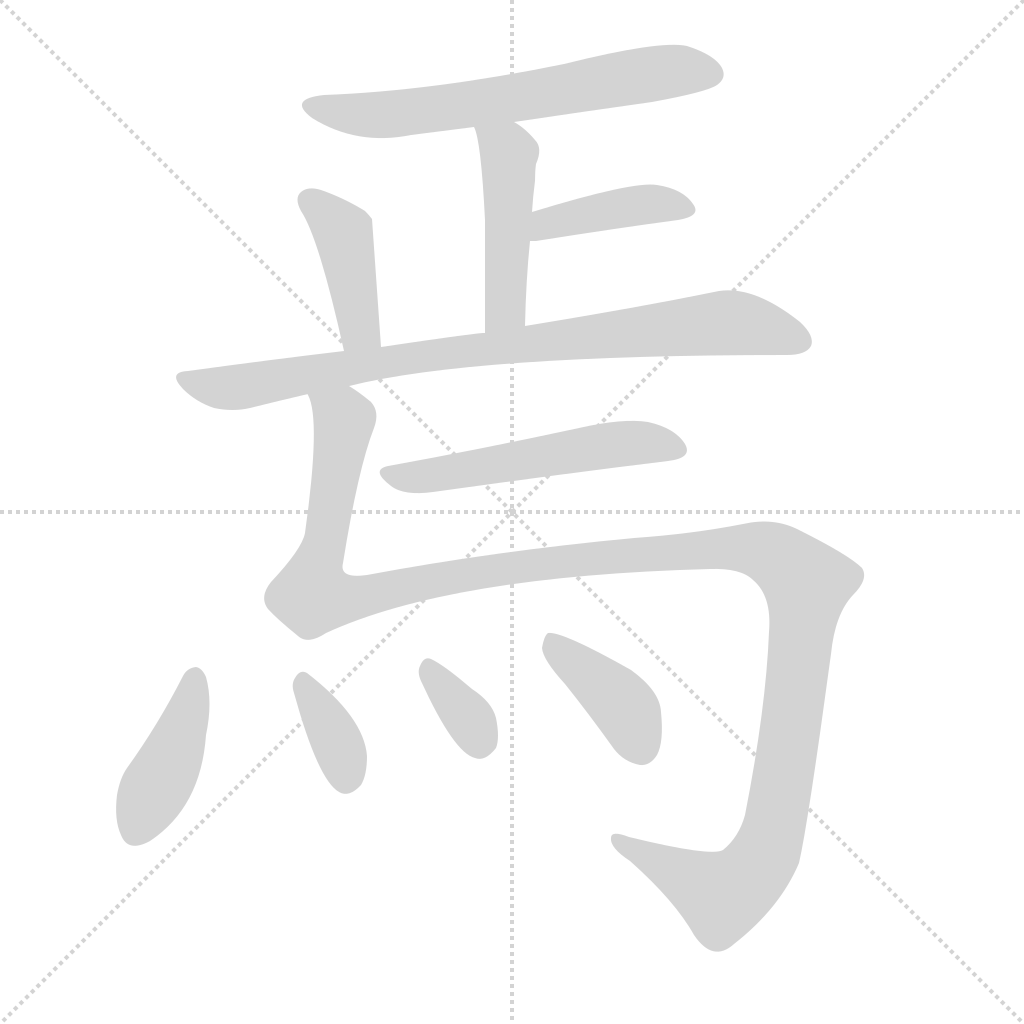
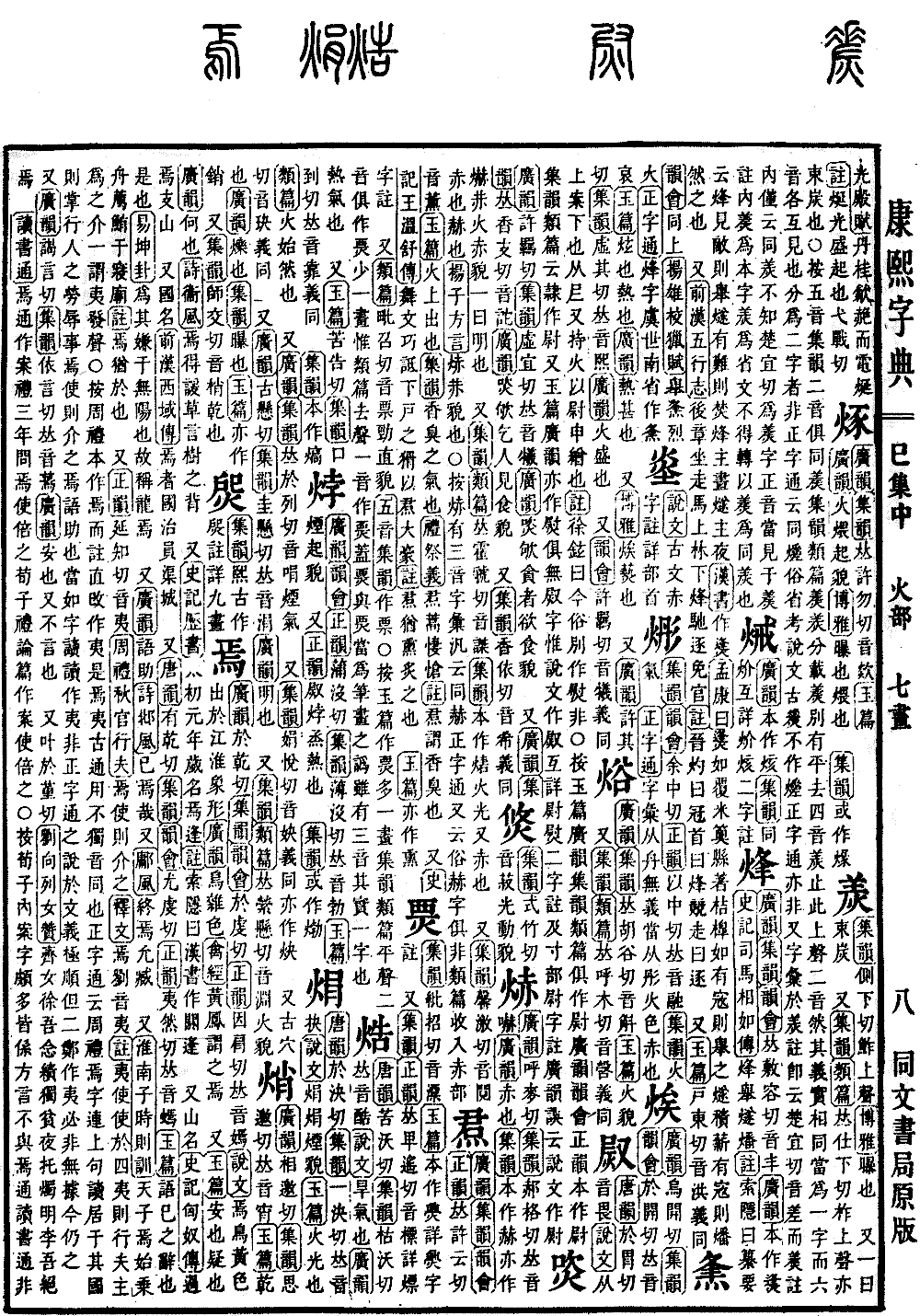
Si Collection, Middle Volume
Radical: Fire (huǒ)
Kangxi Strokes: 11
Page 672, Entry 21
Pronounced yan.
Shuowen Jiezi (Shuowen): A yellow bird, native to the Yangtze and Huai rivers. It is a pictograph.
Guangyun: A bird of many colors.
Qinjing (Classic of Birds): The yellow phoenix is called yan.
Also, Yupian: To be at ease; to doubt.
Guangyun: Why.
Book of Odes (Shijing), Wei Feng: How can one obtain the daylily (xuancao)? It is said to be planted on the north side.
Also, Records of the Grand Historian (Shiji), Treatise on the Calendar: In the first year of Taichu, the year was named Yanfeng. Commentary: The Book of Han writes this as Efeng.
Also, name of a mountain. Records of the Grand Historian (Shiji), Account of the Xiongnu: Passing by Yanzhi Mountain.
Also, name of a state. Book of the Later Han (Hou Hanshu), Account of the Western Regions: The state of Yanqi, with its capital at Yuanqu City.
Also, pronounced yi.
Yupian: A particle indicating the end of a statement.
Book of Changes (Yijing), Kun Hexagram: Because it would be suspected of lacking the yang quality, it is therefore referred to as a dragon.
Also, Guangyun: A modal particle.
Book of Odes (Shijing), Bei Feng: Stop it then (yi yan zai).
Also, Yong Feng: Ultimately, it is truly good.
Also, Huainanzi (Huainanzi), Shize Xun: The Son of Heaven then (yan) began to ride in boats and offered sturgeon in the ancestral temple. Commentary: Yan means at or in (yu).
Also, pronounced yi.
Rites of Zhou (Zhouli), Autumn Official, Xingfu: When making an envoy, serve as an attendant. Commentary: Regarding the pronunciation, Liu reads it as yi. Commentary: When the Yi serve as envoys to the four barbarian regions, the Xingfu acts as their attendant. Some say yi is a sound to initiate speech. Note: The original text of the Rites of Zhou uses yan, but the commentary changes it directly to yi, so yan and yi were used interchangeably in ancient times, not only in terms of sound. The Zhengzitong states: In the Rites of Zhou, the character yan should be read with the preceding clause; if one resides in that state, one is responsible for the labor and fatigue of the envoys, and when an envoy is sent, one acts as an attendant. Yan is a modal particle and should be read as is. To read it as yi is incorrect. The explanation in the Zhengzitong is very smooth regarding the meaning of the text. However, the two Zheng scholars wrote it as yi, which must not be without basis, so I keep it here.
Also, pronounced nian.
Guangyun: To be at ease. Also, not speaking.
Also, rhyme-variant pronounced jin.
Liu Xiang, Lienü Zan (Praise of Distinguished Women): The lady from Qi, Xu Wu, was poor and lonely, spinning through the night. She borrowed light from a candle, and Li Wu departed (yan).
Dushutong: Yan is interchangeable with an. In the Rites, Three-Year Mourning period: How (yan) can one double it? Xunzi, Ritual Theory chapter, writes it as an: How (an) can one double it? Note: In the inner chapters of Xunzi, there are many occurrences of the character an, all of which relate to regional dialects and are not interchangeable with yan; the Dushutong is incorrect. Regarding the yan-bird in Shuowen, Xu Xuan reads it as yan, and reads it like the character for the color. The Yunhui follows this. I now follow the reading from Yupian and Guangyun as yan.