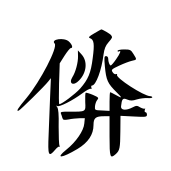
Zi Collection, Page Position: Upper
Radical: Person (rén)
Page 89, Entry 02
According to Tang Rhymes (Tangyun) and Collected Rhymes (Jiyun), the character is pronounced yun (falling-rising tone), with the same pronunciation as the word for pregnant. It refers to seeing someone off. In ancient times, when feudal lords took a wife, two states sharing the same surname would perform the act of accompanying the bride. It refers to the men and women who accompany a bride as part of her dowry.
Six Writings Rectified (Liushu zheng e) states: The character is formed by the radical for person and the radical for fire, because food and drink are the first necessities to be prepared; it also includes the radical for two hands, indicating the meaning of serving or presenting. This is the meaning of the character, which is an ideogram. Characters such as fan, tuo, and sheng all employ this component; the common form written as ying is incorrect.
Note: In Analytical Dictionary of Characters (Shuowen jiezi), the phonetic notation for this character is given as yi (falling-rising tone), classified under the yu initial. Currently, The Dictionary (Zihui) provides the phonetic notation as xing, classifying it under the xia initial, which is likely an error resulting from following the Sound Dictionary (Zhengyun). The right side of the character sheng is composed of the radical for fire and the radical for power. The right side of this character is composed of the radical for shell, though the original carved edition depicts it as composed of the radical for boat, the radical for fire, and the radical for shell.