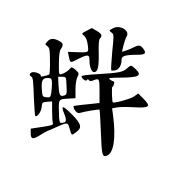
Pronounced yu (third tone) and liang (third tone) in "Tang Yun" (Tang Yun), and yi (first tone) and liang (third tone) in "Jiyun" (Jiyun), with the same pronunciation as "yang." "Shuowen Jiezi" (Shuowen Jiezi) explains it as a worm that causes itching.
Also, "Yangzi Fangyan" (Yangzi Fangyan) records: "Pi fu" (Pi fu), in the Yan region, is called "e zhan" (e zhan) and "tang lang" (tang lang). It is also called "zhan zhan" (zhan zhan).
Also, "Guangyun" (Guangyun) pronounces it as mian (third tone) and bi (third tone), with the same pronunciation as "mi." "Erya Shichong" (Erya Shichong) records: "Gu sao" (Gu sao) is also called "qiang zhan" (qiang zhan). "Yangzi Fangyan" (Yangzi Fangyan) records: "Gu sao" (Gu sao) is called "qiang zhan" (qiang zhan). "Guo Zhu" (Guo Zhu) explains it as a small black beetle found in rice. People in Jianping call it "qun zi" (qun zi), pronounced "qun" (qun). "Qun" (qun) is also a surname. "Zhengzitong" (Zhengzitong) states that the character "zhan" has two pronunciations, level tone and rising tone.
According to character records, the character "zhan" has two phonetic combinations, yu liang and mian bi, both belonging to the rising tone, with no level tone.
Verification: [Also in "Guangyun" pronounced mian bi, with the sound mi. "Erya Shichong" (Erya Shichong) records "Gu sao" (Gu sao) as "qiang zhan" (qiang zhan). "Yangzi Fangyan" (Yangzi Fangyan) records that "tang lang" (tang lang) is sometimes called "zhan zhan" (zhan zhan), and "gu sao" (gu sao) is called "qiang zhan" (qiang zhan). "Guo Zhu" (Guo Zhu) explains it as a small black beetle in rice. People in Jianping call it "qun zi" (qun zi), pronounced "qun" (qun), and "qun" (qun) is also a surname.]
Respectfully, "tang lang" (tang lang) is sometimes called "zhan zhan" (zhan zhan). "Guo Zhu" (Guo Zhu) does not provide the pronunciation "qun" (qun) for it. The surname "qun" (qun) should not be included under the mian bi pronunciation, and it is unrelated to "qiang zhan" (qiang zhan) in the context. Therefore, the seven characters from "tang lang" (tang lang) downwards are moved to be placed under "pi fu" (pi fu) which is called "e zhan" (e zhan) in the Yan region.