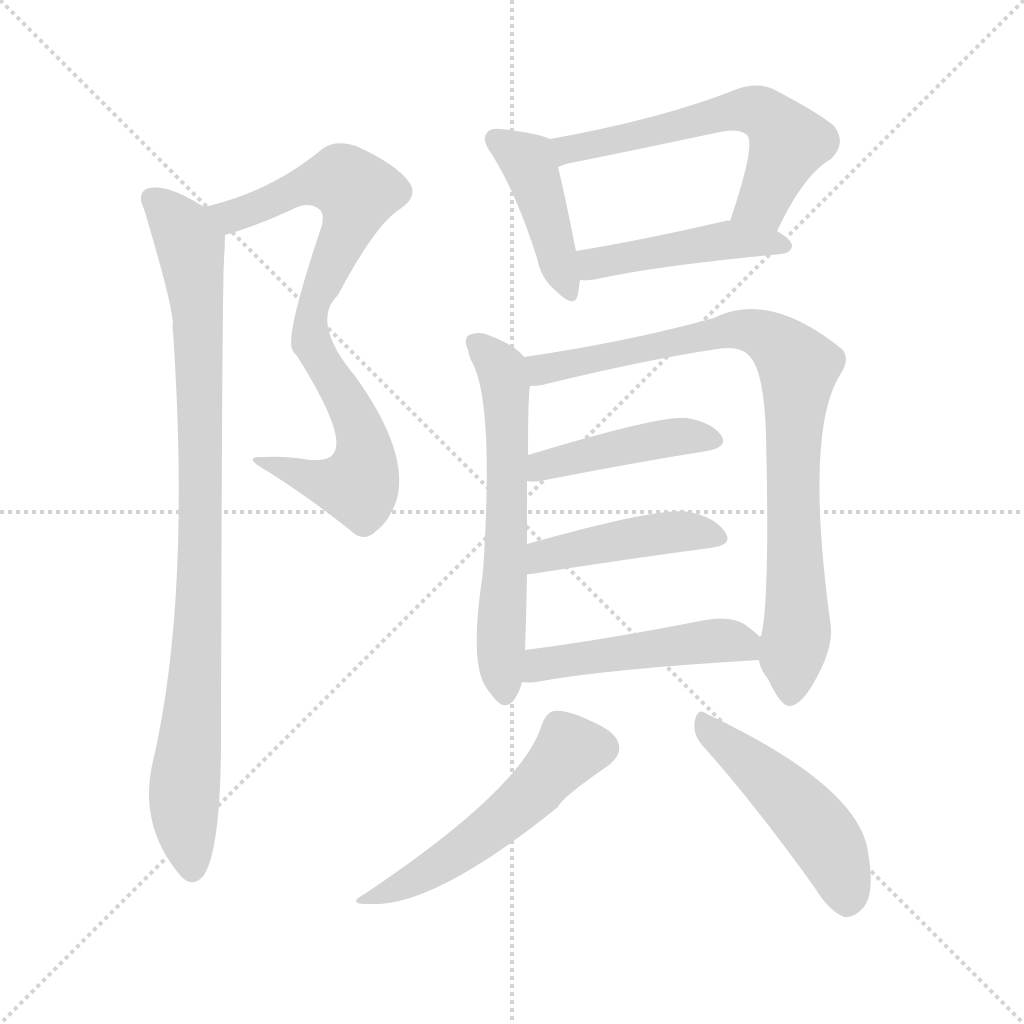
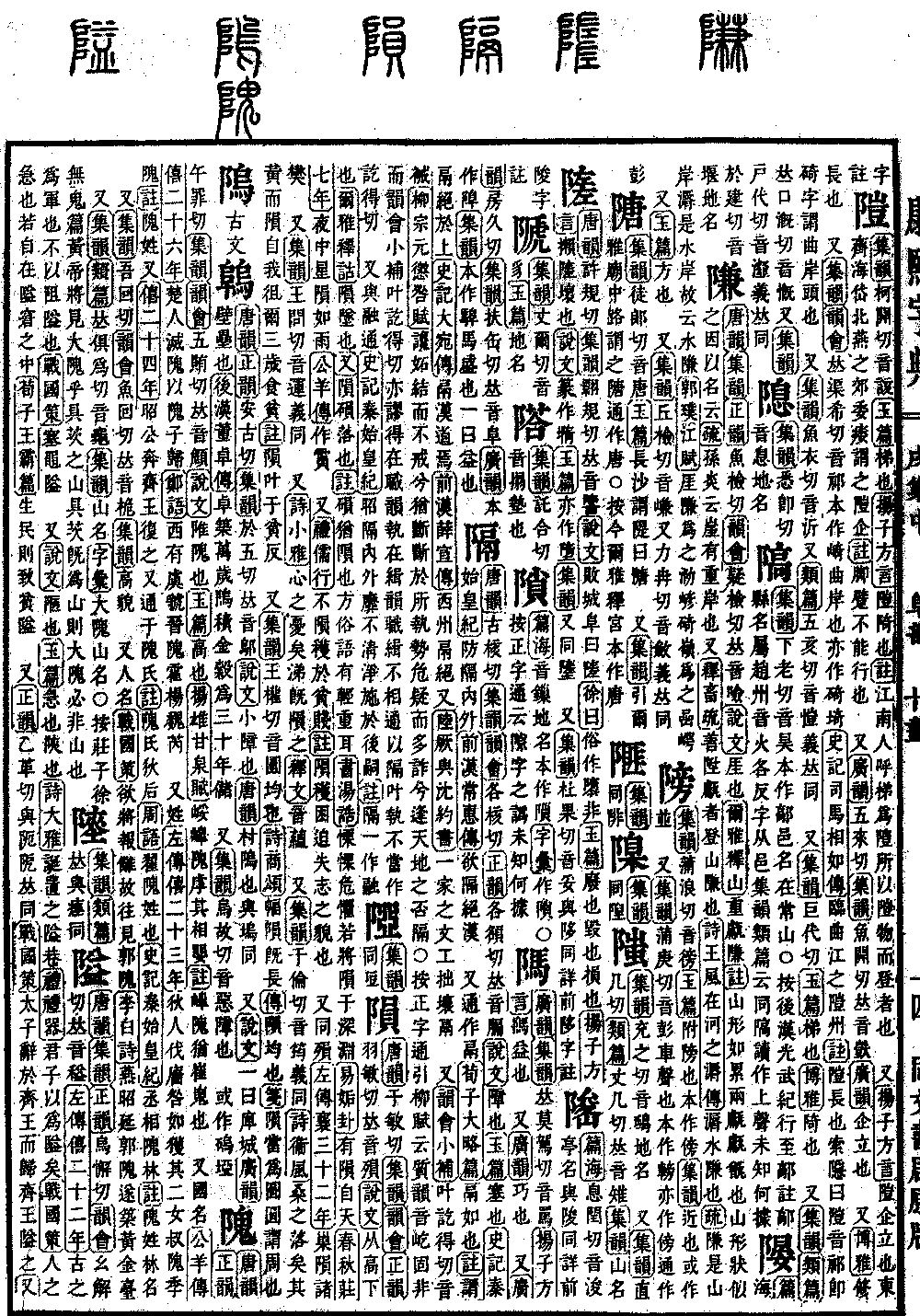
Xu Collection, Middle Volume; Radical: Mound (fù); Yǔn; Kangxi strokes: 18; Page number: 1358, entry 19
According to Tangyun (Tángyùn), pronounced yúmǐn qǐe. According to Jiyun (Jíyùn), Yunhui (Yùnhuì), and ZhengYun (Zhèngyùn), pronounced yǔmǐn qǐe, with the sound of yǔn (殒).
According to Shuowen (Shuōwén), it means "to fall from a height."
In Erya (Ěryǎ), Shigu section, yǔn means "to fall." Also, yǔn means "to drop like a meteor." The commentary states that gùn (磒) is similar to yǔn. Local dialects differentiate them by their degree of intensity.
In the Announcement of Tang (Tāng Gào) in the Book of Documents (Shàngshū), "trembling with fear, as if about to fall into a deep abyss."
In the Gua of Encountering (Gòu Guà) in the Book of Changes (Yìjīng), "something falls from heaven."
In the Spring and Autumn Annals (Chūnqiū), Duke Zhuang, Year 7, "At midnight, stars fell like rain." The Gongyang Commentary (Gōngyáng Zhuàn) writes it as yún (霣), a variant form.
Also, in the Rites of Zhou (Zhōulǐ), "the scholar will not be disheartened by poverty and lowliness." The commentary states that yǔnhuò (陨获) describes the appearance of being distressed and losing one's ambition.
Also synonymous with yǔn (殒), a character meaning "to perish." In the Zuo Zhuan (Zuǒzhuàn), Duke Xiang, Year 32, "The state of Cháo perished at Zhūfán."
Also, according to Jiyun (Jíyùn), pronounced wángwèn qǐe, with the sound of yùn. The meaning is the same.
Also, in the Minor Odes (Xiǎo Yǎ) of the Book of Odes (Shijing), "My heart is heavy with sorrow, and tears fall." According to Shiwen (Shìwén), pronounced yùn.
Also, according to Jiyun (Jíyùn), pronounced yúlún qǐe, with the sound of yún. The meaning is the same. In the Odes of Wei (Wèi Fēng) from the Book of Odes (Shijing), "The mulberries are falling, their leaves yellow and dropping. Since I came to you, for three years I have eaten poverty." The commentary states that yǔn here means leaves falling as a result of poverty or hardship.
Also, according to Jiyun (Jíyùn), pronounced wángquán qǐe, with the sound of yuán. It means "even" or "uniform." In the Hymns of Shang (Shāng Sòng) from the Book of Odes (Shijing), "The width is even and long." The commentary states that yǔn means "even." Another commentary states that yǔn should be interpreted as yuán (圆), which means "circular" or "all-encompassing."