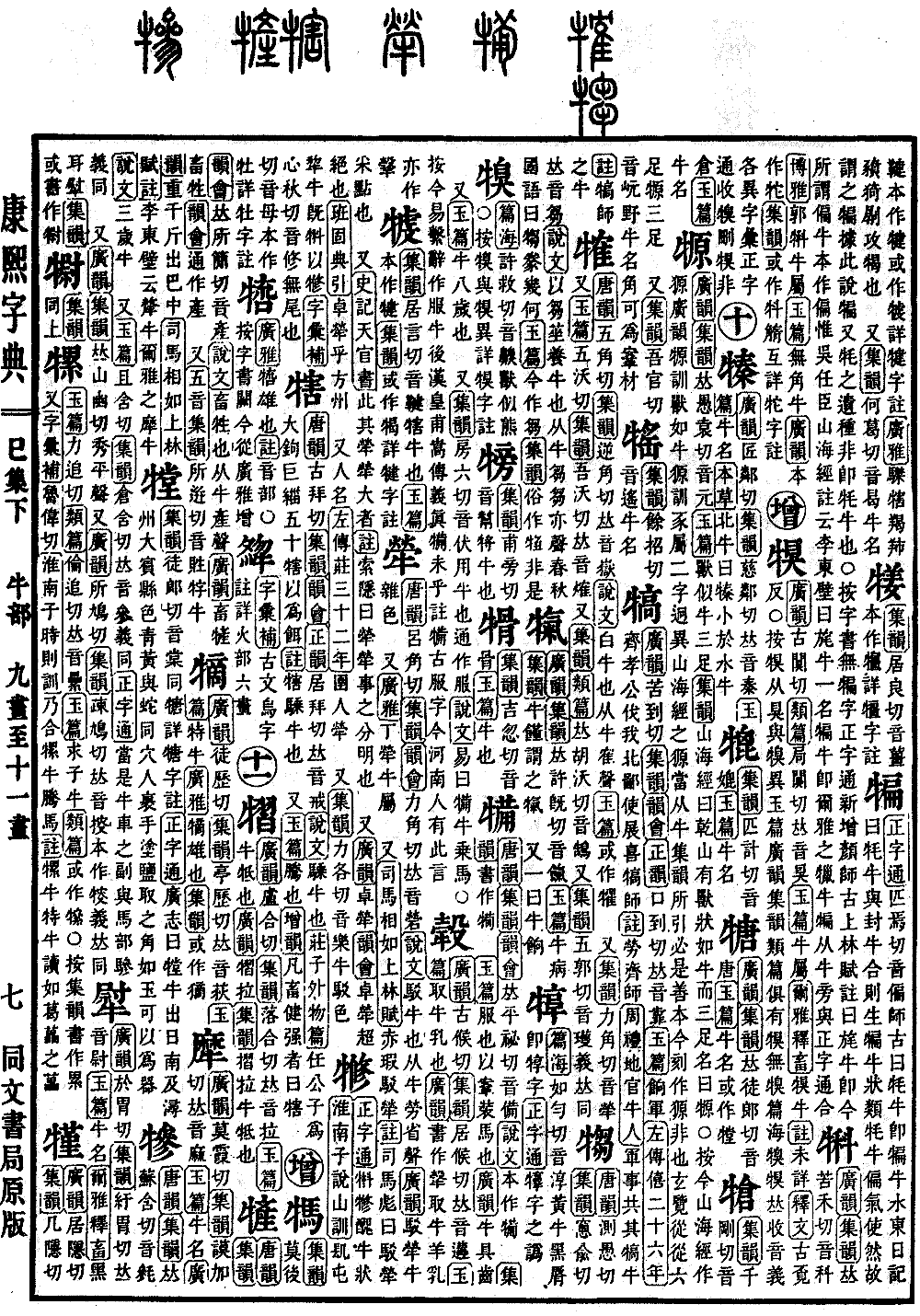
Zi Collection, Upper Volume, Page Position: Upper, Radical: Ox (niú), Page 15, Entry 07
According to the "Guangyun" and "Jiyun," using the fanqie of "yu" and "yuan," the pronunciation is the same as "yuan." The "Yupian" records: this wild beast resembles an ox and has three legs. The "Jiyun," quoting the "Classic of Mountains and Seas" (Shanhaijing), states: on Mount Qian, there is a wild beast shaped like an ox but with three legs, named "yan." Note: The currently circulated "Classic of Mountains and Seas" writes it as "huan." In the "Guangyun," "yan" is explained as a beast resembling an ox, while "huan" is explained as a type of pig; the two characters are completely different. The "huan" in the "Classic of Mountains and Seas" should have the "ox" radical. The version quoted in "Jiyun" must be a superior edition. The current printed version writes it as "huan," which is incorrect. "Lan" is a beast with six legs, while "yan" has three legs.
Furthermore, the "Jiyun" uses the fanqie of "wu" and "guan," pronounced the same as "wan." It is the name of a wild ox. Its horns can be used as material for making saddles.