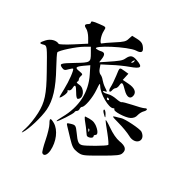
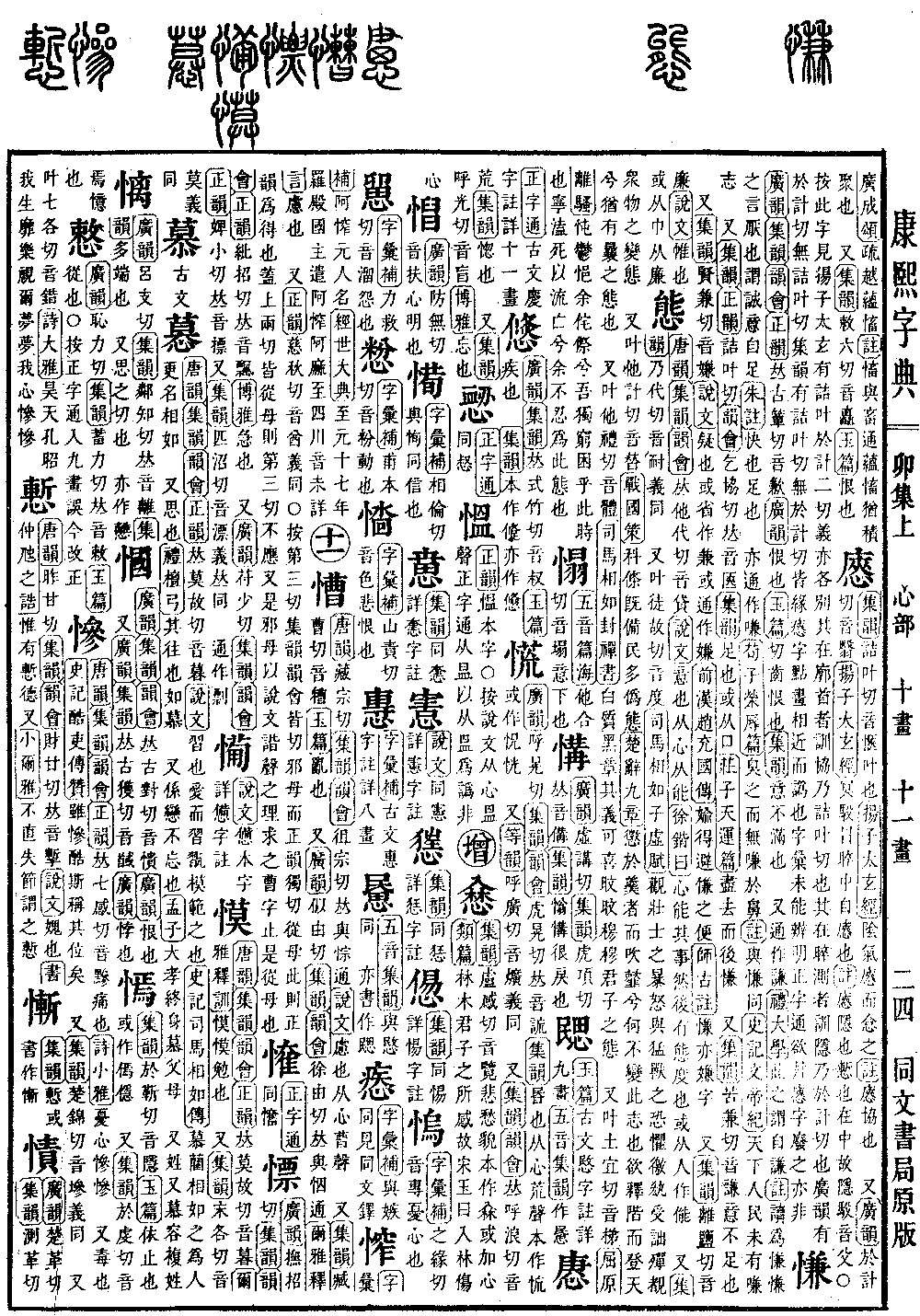
"Jiyun" (集韵), qie ye qie, pronounced the same as "qie" (惬). It means "leaf." "Yangzi, Tai Xuan Jing" (扬子·太玄经): "Yin qi ta er zhi." "Note": "Ta" means harmony.
Also, "Guangyun" (广韵), yu ji qie, pronounced the same as "yi" (翳). "Yangzi, Tai Xuan Jing" (扬子·太玄经): "Ming ta mao, zhong zi ta ye." "Note": "Ta" means hidden, ashamed. It is in the heart, hence hidden. "Ta" is pronounced the same as "fu."
Observation: This character appears in Yangzi's "Tai Xuan Jing" (扬子《太玄经》) with two pronunciations, qie ye qie and yu ji qie, and different meanings. In the "Kuo" (廓) chapter, it is explained as "harmony," which corresponds to qie ye qie. In the "Zui" (晬) chapter, it is explained as "hidden," which corresponds to yu ji qie. "Guangyun" (广韵) has yu ji qie but not qie ye qie, and "Jiyun" (集韵) has qie ye qie but not yu ji qie. These are errors arising from the similarity of strokes to the character "ta" (瘱). "Zihui" (字汇) failed to distinguish clearly, and "Zhengzitong" (正字通) attempted to abolish it along with the character "ta" (㥷), which is also incorrect.