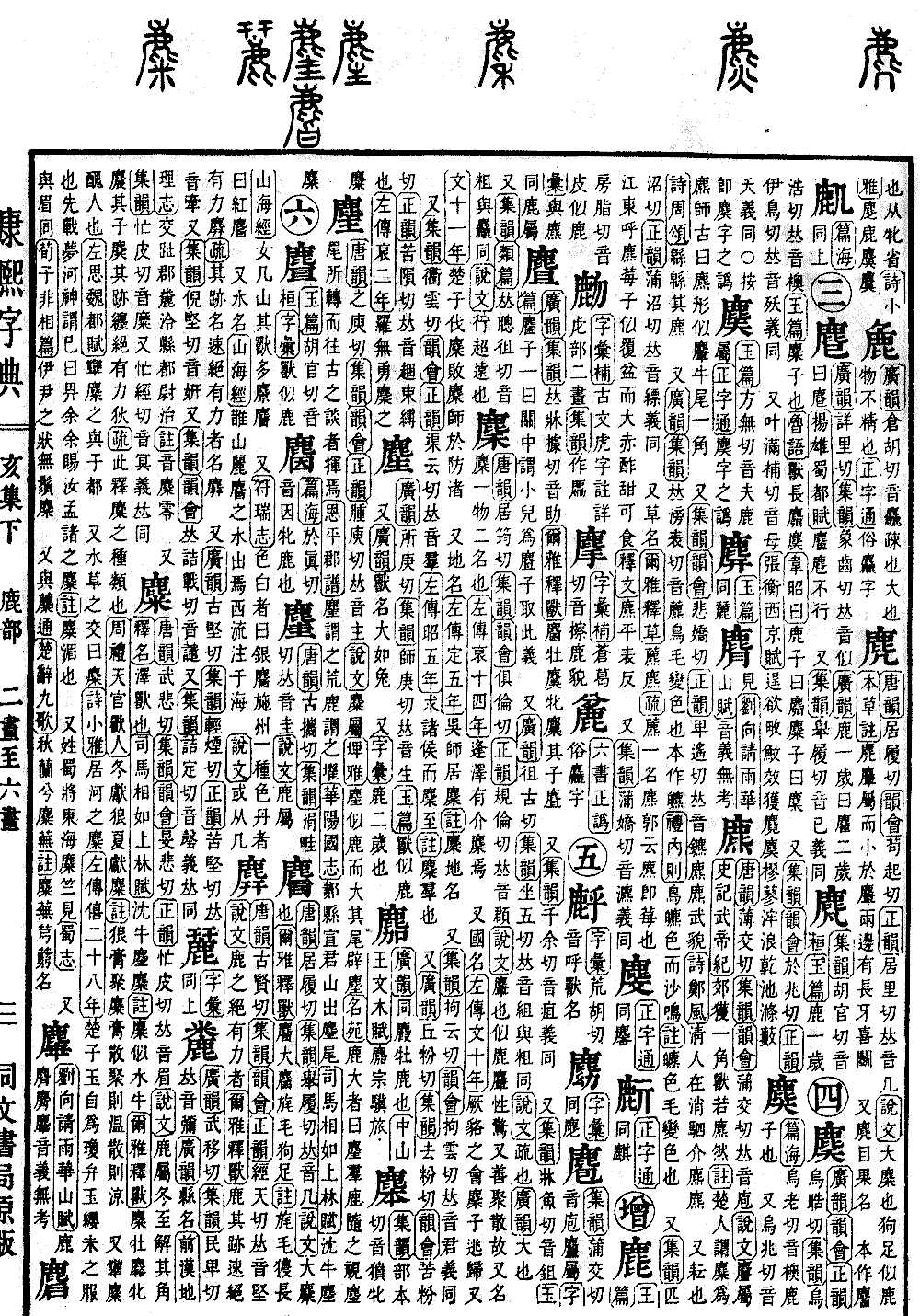
Zi Collection, Upper Volume, Page 24, Entry 01
Pronounced ǎo (falling tone). From *Guangyun* (Guangyun), *Yunhui* (Yunhui), and *Zhengyun* (Zhengyun) as wū hào (entering tone); from *Jiyun* (Jiyun) as wū hào (entering tone). The pronunciation is the same as "ǎo". *Yupian* (Yupian) explains it as a young elk or deer. *Luyu* (Luyu) records "Beasts grow into young elk and deer." Wei Zhao's commentary states: a young deer is called a 麛 (mí), and a young elk is called a 麇 (jūn).
Zi Collection, Upper Volume, Page 24, Entry 02
Also from *Jiyun* (Jiyun) and *Yunhui* (Yunhui) as yú zhào (falling tone); from *Zhengyun* (Zhengyun) as yī niǎo (falling tone). The pronunciation is the same as "yāo". The meaning is the same.
Zi Collection, Upper Volume, Page 24, Entry 03
Also rhymes with mǎn bǔ (falling tone), pronounced the same as "mǔ". Zhang Heng's "Xijing Fu" (Xijing Fu) writes: "Indulging in hunting and seeking young deer, to obtain young elk and deer. Thorny reeds and muddy waters, dry ponds and washed-out thickets." (Textual research: Zhang Heng's "Xijing Fu" has "逞欲畋魰".) Following the original text, "魰" has been changed to "䰻".