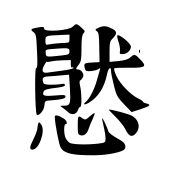
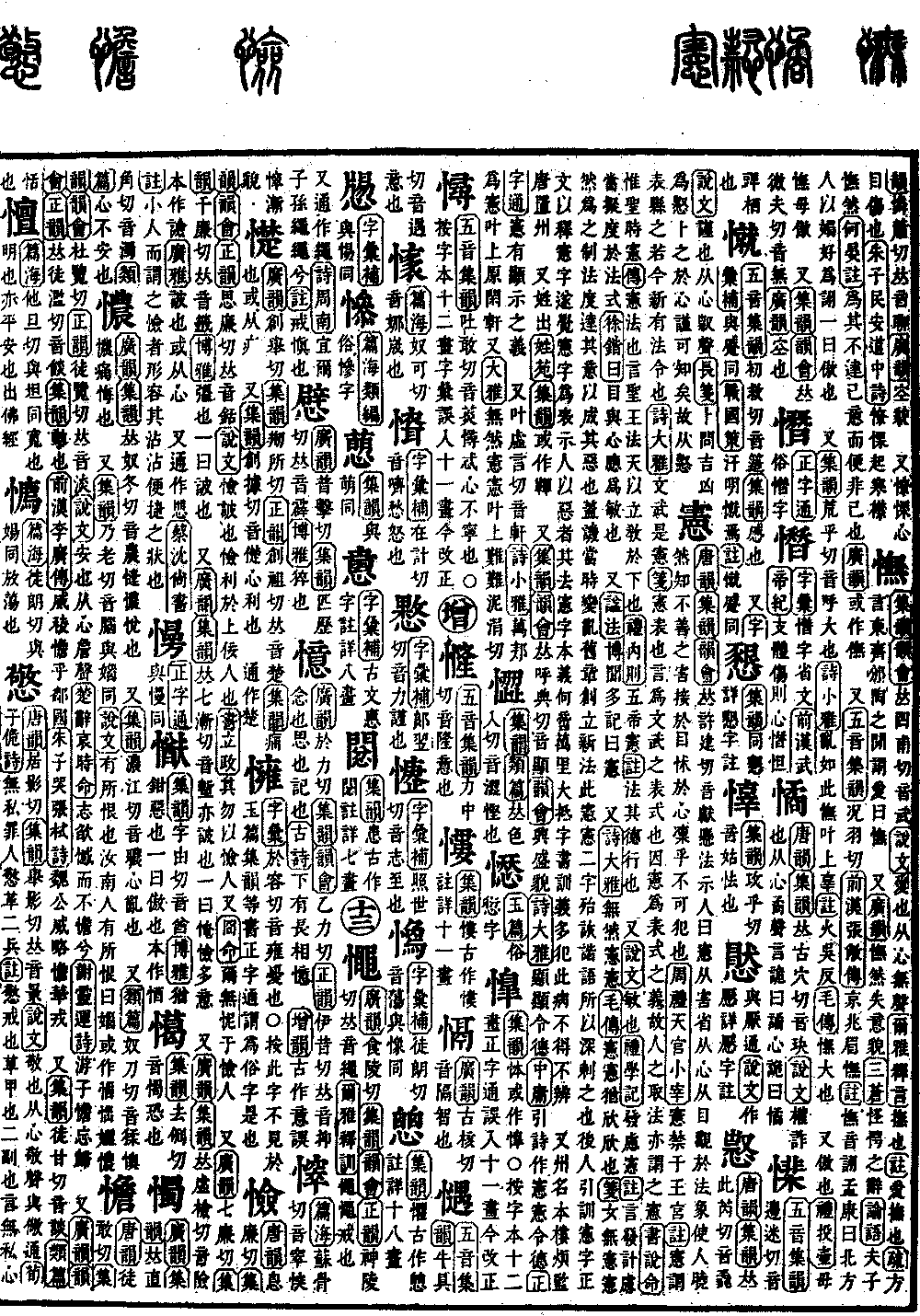
Zi Collection, Page Position: Lower
Radical: Cliff (hǎn)
Yàn
Kangxi Stroke Count: 14
Page 162
Pronunciation: yè (entering tone) - from Tang Yun
Pronunciation: yì shè (entering tone) - from Jiyun, Yunhui
Definition:
To press down, to oppress. From the cliff radical and the phonetic component.
Commentary by Xu: To press down, to suppress. Also, to be subdued.
Example: "to pacify the masses" — Zuo Zhuan, 26th Year of Duke Zhao
Example: "to overcome difficulties" — Former Han, Biography of Du Ye
Note: Yàn means to press down. To suppress difficulties, causing them to disappear.
Also:
A state of compliance or obedience.
Example: "The world is in a state of unified compliance" — Xunzi, Chapter on the Efficacy of the Learned
Also: To ward off evil, to bear.
Example: "Therefore, he traveled east to ward it off" — Shiji, Biography of Emperor Gaozu
Also: To join together.
Example: "The Queen's chariot was adorned with pheasant feathers" — Zhou Li, Chapter on Court Attendants
Note: To arrange its feathers so they are close together.
Also: To diminish.
Example: "They made a pact with Jin Chufu to diminish it" — Zuo Zhuan, 2nd Year of Duke Wen
Note: Yàn means to diminish.
Also: To push hands.
Example: "The guest pushed hands upon entering the left" — Yi Li, Chapter on Village Drinking Ceremony
Note: Pushing hands is called yi, drawing back hands is called yàn.
Commentary: To draw back hands is called yàn, meaning to draw the hands towards oneself.
Also: A bad dream. — Guangyun
Also: Yànci, a place name. — Jiyun
Also written as 壓 (yā).
Pronunciation: yàn (departing tone) - from Tang Yun
Pronunciation: yì shè (departing tone) - from Jiyun, Yunhui
Definition:
To be sufficient, to be full.
Example: "having enough of its excellence" — Shi Jing, Odes of Zhou
Note: Yàn means to be full.
Example: "to satisfy the heart of the Emperor of Heaven" — Former Han, Biography of Wang Mang
Note: Yàn means to be full.
Also: To be weary of, to be disgusted with. — Yunhui
Example: "to wear it without disgust" — Shi Jing, Chapter on Ge Tan
Note: Yàn means to be disgusted with.
Also used interchangeably with 饜 (yàn).
Example: "There are yin yàn and yang yàn" — Li Ji, Chapter on Zengzi Wen
Note: Yàn is the meaning of being full and satisfied.
Pronunciation: yàn (departing tone) - from Tang Yun
Pronunciation: yǎn (departing tone) - from Jiyun
Pronunciation: yǎn (departing tone) - from Zheng Yun
Definition:
To look askance, to squint.
Example: "looking with eyes that are closed and squinting, one sees one thing as two" — Xunzi, Chapter on Blocking Light
Also: To hate, to detest. — Zheng Yun
Example: "Heaven detests him." — Analects
Note: This is a quote from the Analects.
Also: A ghost, a demon. — Guangyun
Also written as 魘 (yǎn).
Example: "fearful dreams become nightmares" — Han Yu, Poem on Visiting West Temple of Xiang
Also: Same as 黶 (yǎn). Same pronunciation as 掩 (yǎn), to conceal.
Example: "Upon seeing a gentleman, one is then closed and concealed." — Li Ji, Great Learning
Note: Yàn is read as 黶 (yǎn). Yàn means to be closed and concealed.
Pronunciation: yàn (departing tone) - from Jiyun
Pronunciation: yàn (departing tone) - from Zheng Yun
Definition:
To be peaceful, tranquil.
Example: "peacefully drinking at night" — Shi Jing, Odes of Xiao
Example: "a peaceful good man" — Shi Jing, Odes of Qin
Note: Peaceful and tranquil.
Also: To be satisfied. — Zheng Yun
Example: "the small-minded person is satisfied" — Zuo Zhuan, 28th Year of Duke Zhao
Note: Du Yu's commentary: meaning that the small-minded person is satisfied.
Pronunciation: yā (entering tone) - from Jiyun
Pronunciation: yā (entering tone) - from Zheng Yun
Definition:
To suppress, to restrain.
Example: "suppressed and thus retreated" — Former Han, Biography of Liu Xiang
Note: Shigu's commentary: Yàn is pronounced yi jia fan, meaning not to extend.
Also: To approach, to be about to. — Zheng Yun
Example: "approaching dawn in the fields of Mu." — Xunzi, Chapter on the Efficacy of the Learned
Note: Yàn means to approach, meaning before dawn.
Also used interchangeably with 壓 (yā).
Pronunciation: yì (entering tone) - from Jiyun
Definition: Yàn yì, dampness.
Pronunciation: àn (entering tone) - from Jiyun
Definition: To sink, to be submerged.
Example: "its submersion is like being sealed." — Zhuangzi, Chapter on Free and Easy Wandering