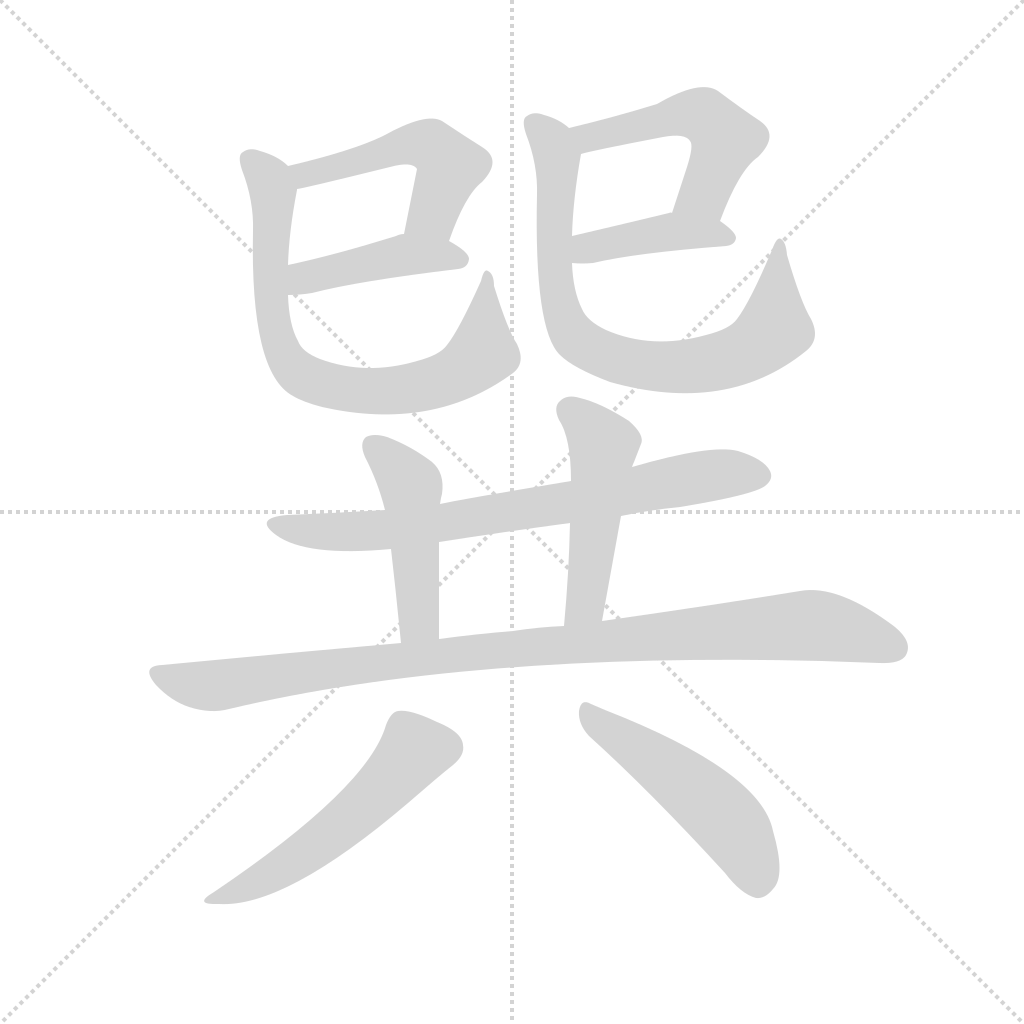
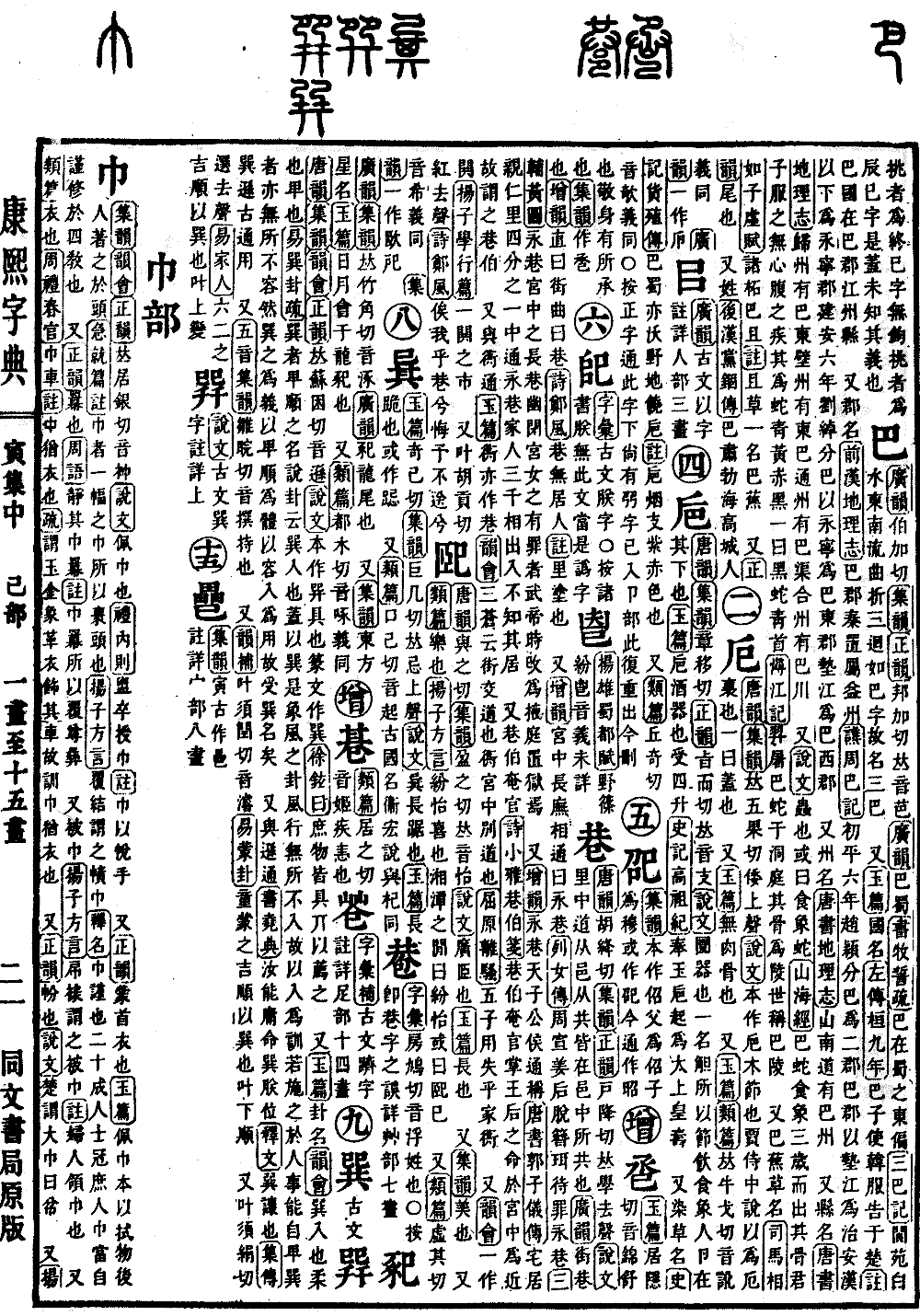
Yin Collection, Middle Volume. Radical: Self (jǐ). Kangxi stroke count: 12. Page 327, Entry 16.
Ancient text:
According to the Tang Rhyme (Tangyun), Collection Rhyme (Jiyun), Rhyme Meetings (Yunhui), and Orthodox Rhymes (Zhengyun), it is pronounced xùn.
According to the Explaining Graphs and Analyzing Characters (Shuowen), the original character was written as a variation, meaning to be fully prepared. The seal script form is written as xùn. Xu Xuan stated that when all things are fully prepared, one uses the character for a pedestal (qí) to present them.
According to the Jade Chapters (Yupian), it is the name of a hexagram.
According to the Rhyme Meetings (Yunhui), xùn means to enter. It signifies gentleness and humility.
The Commentary on the Hexagram of Submission (Yi Xungua Shu) states: Xùn is the name for compliance. The Discussion of Hexagrams states: Xùn means to enter. Because Xùn symbolizes the hexagram of wind, and wind flows everywhere, entering every place, it is interpreted as entry. When applied to human affairs, one who is capable of self-humility can likewise tolerate all things. However, the meaning of Xùn takes compliance as its essence and the act of entering as its function; hence, it received this name.
It is also used interchangeably with the character for modesty (xùn). In the Book of Documents (Shujing), specifically the Canon of Yao (Yaodian): You are able to follow the commands and defer my imperial throne. The Explication of Text (Shiwen) states: Xùn means humility. The Collected Commentaries (Jichuan) states: Xùn and the character for modesty were used interchangeably in ancient times.
According to the Five Sounds Collection of Rhymes (Wuyin Jiyun), it is pronounced zhuàn, meaning to hold or grasp.
According to the Rhyme Supplements (Yunbu), it is also pronounced jùn. In the Book of Changes (Yijing), regarding the Hexagram of Youthful Inexperience (Menggua): The good fortune of the youthful and ignorant comes from being compliant and humble. It rhymes with the following word, shun.
It is also pronounced xuàn (falling tone). In the Book of Changes (Yijing), regarding the Hexagram of the Family (Jiagu): The good fortune of the second line is due to being compliant and humble. It rhymes with the preceding word, bian.