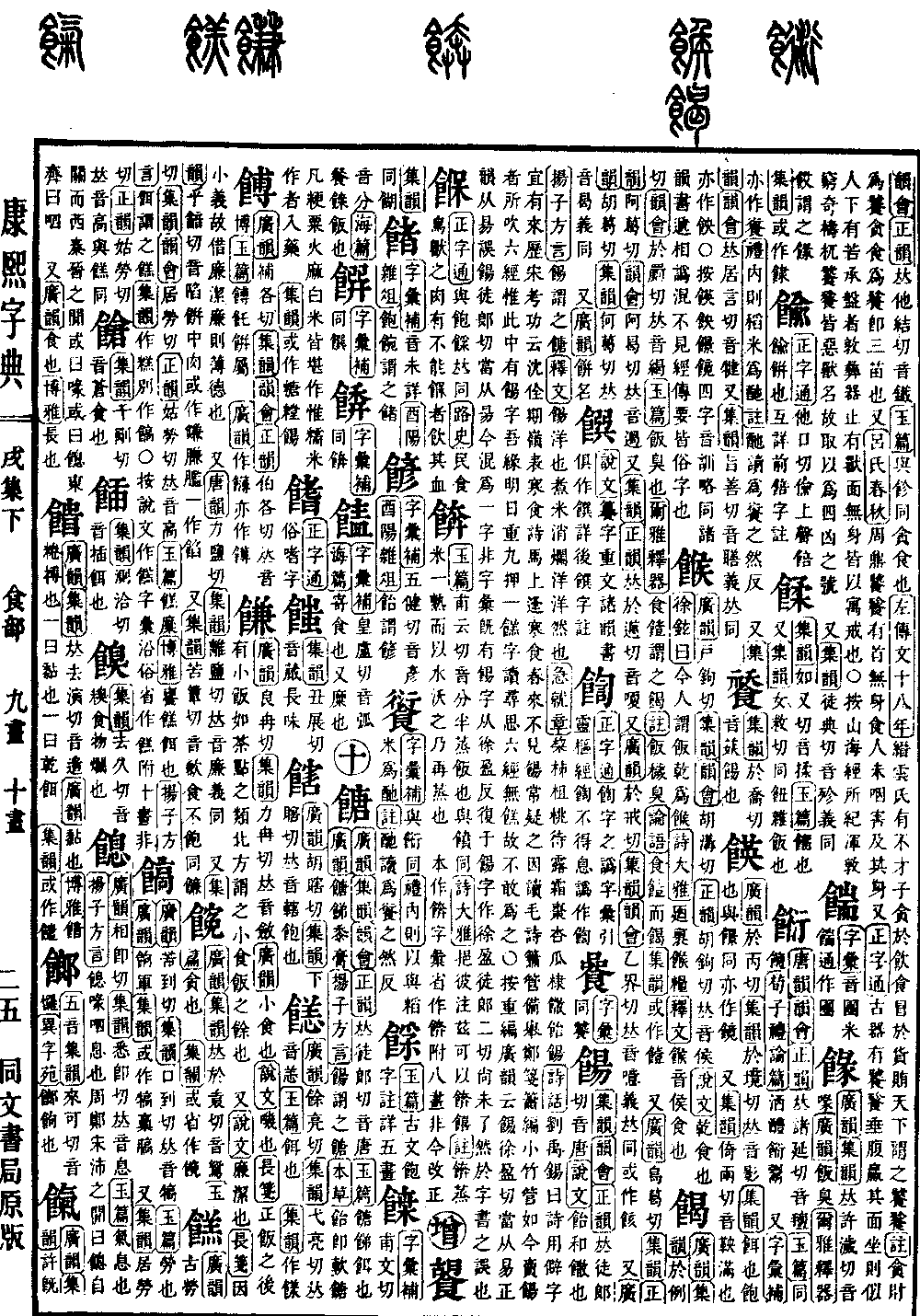
Xu Collection, Lower Volume
Radical: Food (shí)
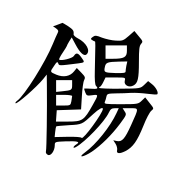
Character: tang
Kangxi Strokes: 18
Page 1423, Entry 13
Jiyun (Collection of Rhymes), Yunhui (Collection of Rhymes), and Zhengyun (Correct Rhymes) state the pronunciation is tang.
Shuowen (Explaining Graphs and Analyzing Characters) defines it as maltose and deep-fried dough twists.
Fangyan (Regional Dialects) by Yangzi states that tang is called tang.
Shiwen (Explication of Text) states: tang means flowing. It refers to boiling rice until it is thoroughly cooked, resulting in a flowing, viscous state.
Jijiuzhang (Urgent Instruction Chapter) records: Pears, crabapples, peaches waiting for the dew and frost; dates, apricots, melons, and cherries, along with fried dough twists, maltose, and maltose candy.
Shihua (Discussions on Poetry) records: Liu Yuxi said that if one uses obscure characters in poetry, they should have a classical source. Song Kaogong said: Shen Quanqi wrote in his poem Cold Food Festival in the South: Encountering the Cold Food Festival on horseback, spring comes but I do not see the tang. I often have doubts about this. Because while reading the Mao Odes (Maoshi), I saw the phrase the xiao and guan flutes are all prepared, and Zheng Xuan’s commentary says that a xiao is a series of small bamboo pipes, like those used by people selling maltose candy today. This is the only place in the Six Classics where the character tang appears. Because tomorrow is the Double Ninth Festival, I wanted to use the character gao to rhyme, but realized that gao does not appear in the Six Classics, so I did not dare to do so. According to the re-edited Guangyun (Broad Rhymes): it should be written with the phonetic element yang, and the Zhengyun is incorrect to use the phonetic element yi. Tang should be written with the phonetic element yi; currently, they are confused as one character, which is incorrect. Since the Zihui (Collection of Characters) contains the character and notes the pronunciation as xu ying, and also provides both xu ying and tu lang pronunciations under the character tang, the errors in the character dictionaries have not yet been fully clarified.
Verification: In the Jijiuzhang, the text Pears, crabapples, peaches waiting for the dew and frost; dates, apricots, melons, and cherries, along with fried dough twists, maltose, and maltose candy has been corrected from the original text by changing the reference to peaches.