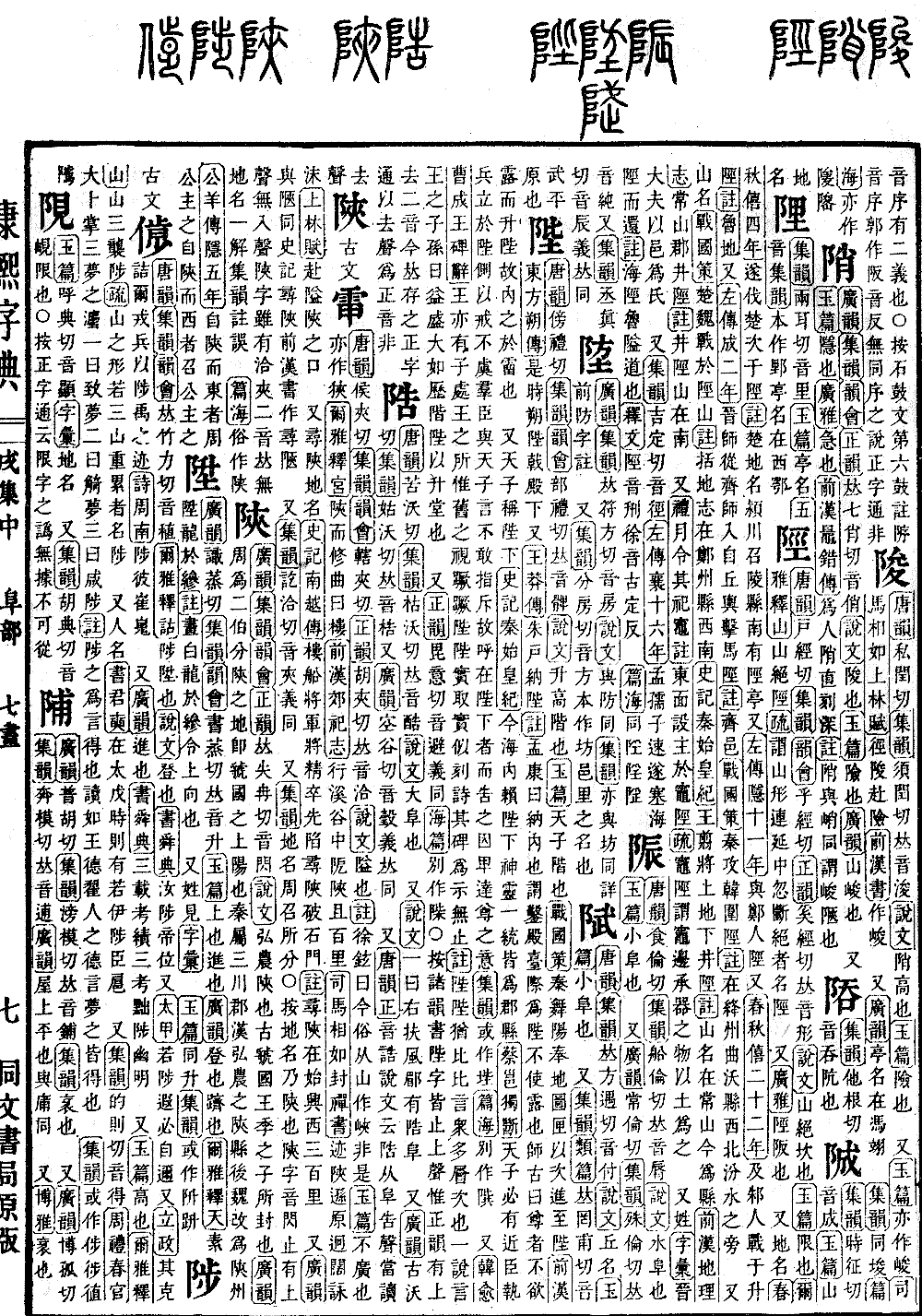
Xu Collection, Middle Volume
Radical: Mound (fù)
Xíng; Kangxi Strokes: 15; Page: 1351, Entry 06
According to the Tang Rhyme dictionary, it is pronounced like hùjīngqiè. According to the Jiyun and Yunhui dictionaries, it is pronounced like hūjīngqiè. According to the Zhengjing dictionary, it is pronounced like xījīngqiè, phonetically resembling xíng.
The Explanations of Characters (Shuowen Jiezi) defines it as a deep valley where a mountain range is interrupted.
The Yupian defines it as a boundary.
In the Explanations of Elaborations (Erya), Chapter on Mountains, it states: "A place where a mountain range is interrupted is called xíng." The commentary explains: "This refers to a location where a continuous mountain range suddenly breaks, and it is named xíng."
Further, the Guangyun states that xíng also refers to a hillside.
It also refers to place names:
In the Spring and Autumn Annals (Chunqiu), Duke Xi, Year 4: "Then they attacked the state of Chu and encamped at Xíng." The commentary notes: "Xíng is a place name in the state of Chu, situated at Xíngtíng, south of Zhaoling County in Yingchuan."
The Commentary of Zuo (Zuozhuan), Duke Yin, Year 11: "They engaged in battle with the people of Zheng in the land of Xíng."
In the Spring and Autumn Annals, Duke Xi, Year 22: "They fought with the people of Zhu at Shēngxíng." The commentary notes: "Shēngxíng is a place name in the state of Lu."
In the Commentary of Zuo, Duke Cheng, Year 2: "The Jin army pursued the Qi army, entered from Qiuyú, and attacked Mǎxíng." The commentary notes: "Mǎxíng is a city in the state of Qi."
The Strategies of the Warring States (Zhanguo Ce) records: "The state of Qin attacked the state of Han and besieged the area of Xíng." The commentary notes: "Xíng is located northwest of Quwo County in Jiangzhou, beside the Fen River."
It also refers to mountain names:
The Strategies of the Warring States records: "The states of Chu and Wei engaged in battle at Mount Xíng." The commentary notes: "According to the Records of Geography (Kuodizhi), Mount Xíng is located southwest of Zhengzhou County."
The Records of the Grand Historian (Shiji), Annals of Qin Shi Huang: "Wang Jian led the Shangdi army to conquer Jǐngxíng." The commentary notes: "Jǐngxíng is a mountain, located in Changshan Commandery, and is now established as a county."
The Book of Han (Qian Hanshu), Treatise on Geography: "Changshan Commandery has Jǐngxíng County." The commentary notes: "Mount Jǐngxíng is south of the county."
Further, the Book of Rites (Liji), Monthly Ordinances, commentary on the Stove Sacrifice states: "On the east side, set up the spirit tablet at zàoxíng." The sub-commentary explains: "Zàoxíng refers to an earthen platform built beside the stove to hold utensils, constructed from earth."
It also serves as a surname:
The Character Compendium (Zihui) states: "A grandee of the state of Jin adopted Xíng as his surname, based on his enfeoffment."
Further, the Jiyun states its pronunciation as jídìngqiè, phonetically resembling jìng.
In the Commentary of Zuo, Duke Xiang, Year 16: "Meng Rúzi led the army to block Hǎixíng and then returned." The commentary notes: "Hǎixíng is a strategic pass in the state of Lu." The Exegesis clarifies: "Xíng is pronounced like jìng. Xu Máo pronounced it as gǔdìngfǎn."
The Sea of Characters (Pianhai) states that its character form is the same as the variant character zhuàn.