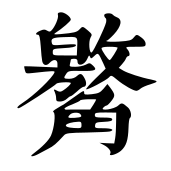
"Tang Yun" states this character is pronounced hu (low tone) di (entering tone) cut. "Ji Yun" states it is pronounced di (entering tone) cut, with a sound similar to the character "xi". "Shuowen Jiezi" explains it as: the end of a staff decorated with horn. "Guang Yun" states: decorating the head of a staff or whip with horn. "Yu Pian" states: decorating both ends of implements such as whips and goads with horn.
Additionally, "Guang Yun" also annotates the pronunciation as gu (low tone) yue (entering tone) cut, and "Ji Yun" annotates it as qi (entering tone) yue (entering tone) cut, with a sound similar to the character "jue". The meaning is the same.
Furthermore, "Ji Yun" also annotates the pronunciation as niu (low tone) jiao (low tone) cut, with a sound similar to the character "rao". The meaning is to strike. It has the same meaning as "" and "".