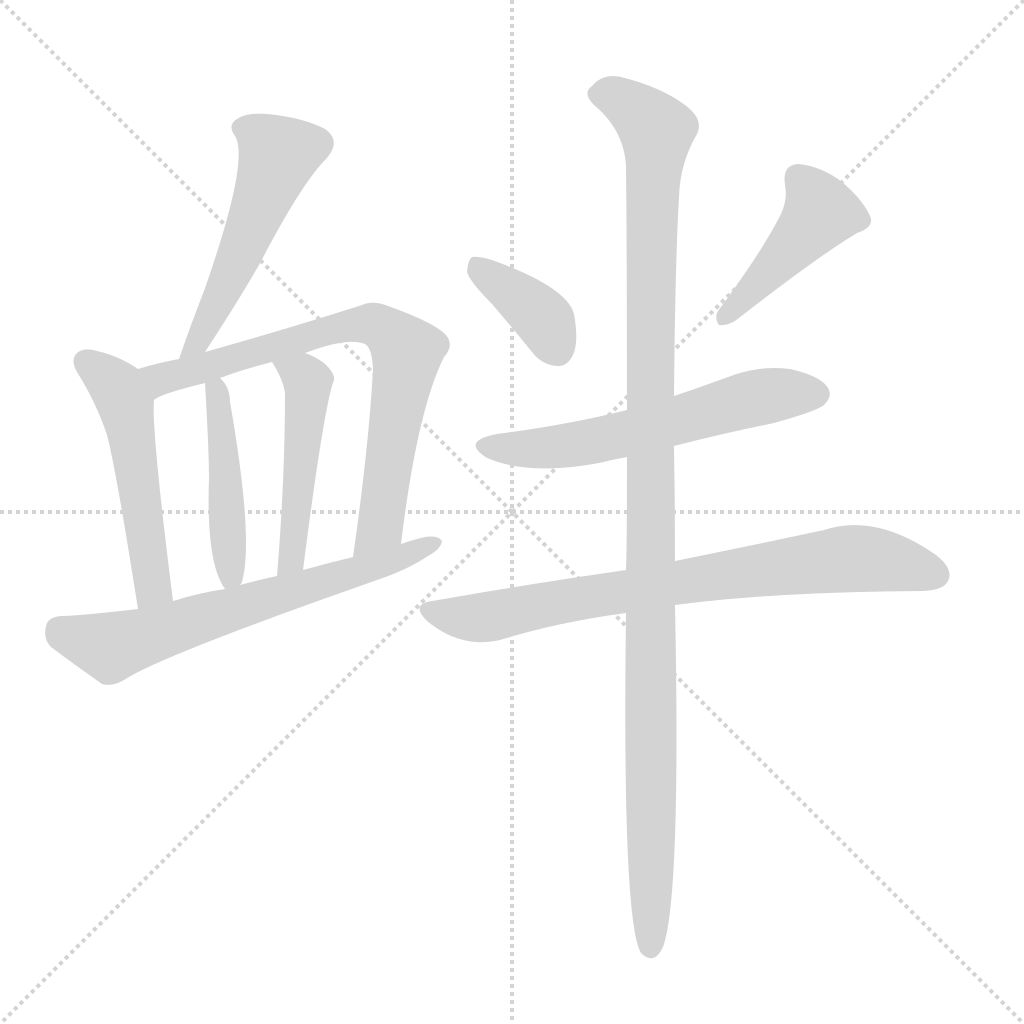
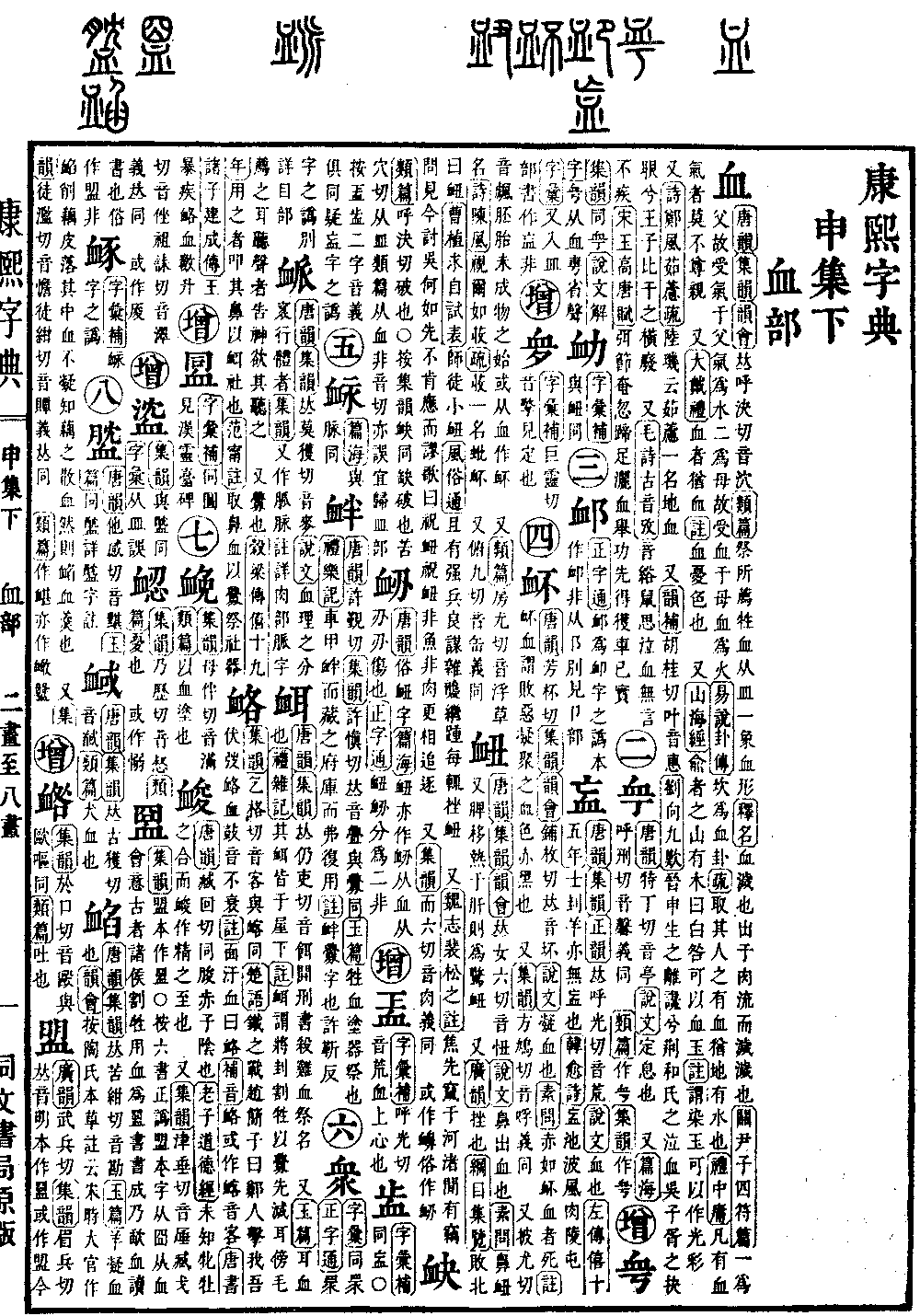
Shen Collection, Lower Volume
Radical: Blood (xuè)
Kangxi Strokes: 25
Page 1107, Entry 15
Pronounced xin.
The same as xin (a variant form).
In the Yu Pian (Book of Jade), it is defined as smearing the blood of a sacrificial animal on an object as an offering.
From the Book of Rites (Liji), record of music: "The chariots and armor were smeared with blood and stored in the treasury, not to be used again."
The commentary states: This refers to the character xin. Pronounced xin.
Xin
Pronounced xin.
According to the Shuo Wen (Explanation of Simple and Compound Characters), it means a blood sacrifice. It depicts the sacrifice to the kitchen god.
In the Guang Yun (Broad Rhymes), it is defined as smearing the blood of a sacrificial animal on an object as an offering.
From the Book of Rites (Liji), monthly ordinances: "In the first month of winter, the Grand Historian is commanded to smear the tortoise shell and yarrow stalks with blood."
The commentary states: This refers to killing an animal and using its blood to smear the tortoise shell and stalks.
Also, from the Book of Rites (Liji), miscellaneous records: "When the ancestral temple is completed, it is smeared with blood."
The commentary states: This refers to the completion of an ancestral temple, where an animal is killed and its blood is taken to smear the temple, honoring and spiritualizing it.
From the Records of the Grand Historian (Shiji), annals of Emperor Gaozu: "He sacrificed to Chiyou in the courtyard at Pei and smeared the drum with blood."
The commentary states: Xin means to sacrifice. Killing an animal and smearing its blood on a drum is called xin.
Also, it means a crime.
From the Zuo Commentary (Zuozhuan), 12th year of Duke Xuan: "Observing the crime and then acting."
The commentary states: Xin means crime.
Also, it means a crack or flaw.
From the Zuo Commentary (Zuozhuan), 8th year of Duke Huan: "The enemy has a flaw, it cannot be lost."
The commentary states: Xin means a crack or gap.
From the Records of the Grand Historian (Shiji), biography of Li Si: "One who achieves great merit relies on taking advantage of flaws and cracks and then acts ruthlessly."
The commentary states: The explainer says this means relying on the flaws and cracks of the feudal lords, then acting with a ruthless heart to eliminate them.
Also, it means a sign or omen.
From the Discourses of the States (Guoyu), records of Lu: "If the Bao clan has an omen, I will not plan for it."
The commentary states: Xin means an omen.
From Lu Ji's Poem in Reply to Jia Changyuan: "Heaven is tired of the virtue of the hegemon, and the yellow mandate announces an omen."
Also, it means to smear. In one sense, it means to fumigate.
From the Discourses of the States (Guoyu), records of Qi: "Upon arrival, he was smeared with fragrant herbs and bathed three times."
The commentary states: Smearing the body with fragrance is called xin.
From the Rites of Zhou (Zhouli), office of spring, the functionary of sacrifices: "Providing the fragrant wine for the smearing ritual."
The commentary states: Using fragrant wine to smear a corpse to make it smell pleasant.
From the Rites of Zhou (Zhouli), office of spring: "The female shaman is in charge of the seasonal purification and smearing bath."
The commentary states: The smearing bath refers to bathing with fragrant medicinal herbs.
From the History of the Former Han (Qianhan), biography of Jia Yi: "Smeared his face and swallowed charcoal."
The commentary states: Lacquering the face to change one's appearance. In one sense, it means to fumigate, using poison to make it enter the body.
Also, it means to move.
From the Zuo Commentary (Zuozhuan), 26th year of Duke Xiang: "The nature of the base person is stirred to bravery."
The commentary states: Xin means to move.
Also, from the Erya (Approaching Elegance), interpretation of animals: "For beasts, it is called xin."
The commentary states: The beast exerting itself and moving rapidly is called xin.
Also, a surname.
From the Zheng Zi Tong (Correct Character Mastery): There was a Xin Xia during the Zhou dynasty.
Also, from the Zheng Zi Tong (Correct Character Mastery): Commonly written as the variant form (xin).
From the Han Feizi: "Having already accumulated royal resources and taking on the cracks of an enemy state."
From the History of the Former Han (Qianhan), annals of Emperor Gaozu: "Taking advantage of the cracks and maneuvering."
Also, perhaps written as (xin).
From the Book of Rites (Liji), record of music: "The chariots and armor were smeared with blood and stored in the treasury."
The commentary states: Xin is the character xin. Wrapping weapons with tiger skin indicates the ability to subdue arms through martial power.
Also, perhaps written as (xing).
From the Book of Rites (Liji), records of rites: "After the vessels were smeared and used for offerings."
The commentary states: Xing is a mistake for the character xin.