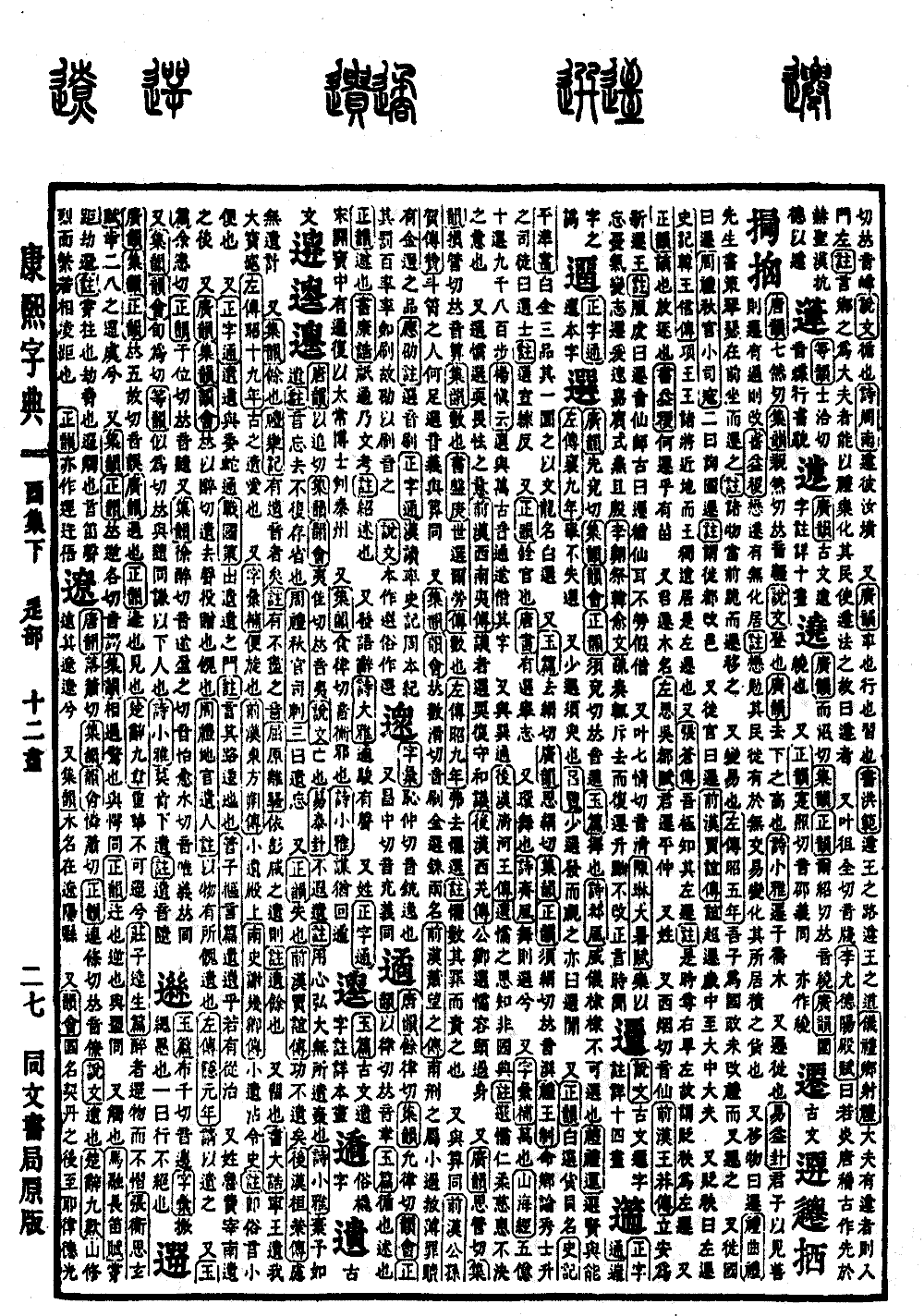
You Collection, Lower Volume
Radical: Walk (chuò)
Kangxi strokes: 19
Page 1265, Entry 06
Pronounced xuan.
Universal Dictionary (Guangyun): To choose.
Book of Odes (Shijing): Dignified demeanor is composed, one must not choose carelessly.
Book of Rites (Liji): To select the virtuous and elevate those with capability.
Zuo Commentary (Zuo Zhuan): Recommending talent does not overlook suitable candidates.
Also means a short moment in time.
Lushi Chunqiu (Lülan): After a moment, he opened it to look. Also called xuanjian.
Also, in Orthodox Rhymes (Zhengyun), Baixuan is a type of currency.
Records of the Grand Historian (Shiji): White gold was divided into three ranks; the type that was circular and engraved with dragon patterns was called baixuan.
Also, pronounced xun.
Book of Rites (Liji): An order for the village to evaluate excellent scholars and report them to the Minister of Education is called xuanshi.
Commentary: Xuan is read as xuanlian.
Also, in Orthodox Rhymes (Zhengyun), refers to the position responsible for selecting officials.
History of Tang (Tangshu): Contains the Treatise on Selection.
Also, to circle and dance.
Book of Odes (Shijing): Circling and moving while dancing.
Also, in Dictionary Supplement (Zihuibu), means ten thousand.
Classic of Mountains and Seas (Shanhaijing): Five hundred million ten thousand nine thousand eight hundred steps.
Yang Shen states: Xuan and wan (ten thousand) had identical ancient pronunciations, so this character was borrowed.
Also, xuannuo refers to being benevolent and weak.
Book of Later Han (Houhanshu): This kind of benevolent but weak favor is known to be contrary to state law.
Commentary: Xuannuo refers to a state of benevolent, weak, and lingering attachment, unable to make a firm decision.
Also, xuannuo and xuanshuo both refer to being fearful and timid.
Book of Han (Qianshanshu): Those debating were fearful and retreating, yet persisted in advocating for peace.
Book of Later Han (Houhanshu): The ministers were fearful and retreating, only concerned with getting by in the present.
Also, pronounced suan.
Dictionary (Jiyun): Means to calculate.
Book of Documents (Shujing): Generations calculating your merits.
Commentary: To calculate.
Zuo Commentary (Zuo Zhuan): Not leaving is for fear of being reckoned for sins.
Commentary: Fearing he would calculate his sins and reproach him.
Also the same as suan (to count).
Book of Han (Qianshanshu): How could a person of shallow talent and small measure be worth calculating? The sound and meaning are the same as suan.
Also, pronounced shua.
Jinxuan is a unit of weight.
Book of Han (Qianshanshu): Regarding minor offenses like those of Song Chou, amnesty is granted, and light crimes can be redeemed with wealth, according to the jinxuan rank.
Ying Shao Commentary: Xuan is read as shua.
Correction of Characters (Zhengzitong): In the Han dynasty, it was read as shuai. In the Records of the Grand Historian (Shiji), that type of fine was one hundred shuai. Shuai is read like shua. Therefore, Ying Shao used shua for the pronunciation.
Explanation of Simple and Compound Characters (Shuowen): Originally written as the base character for xuan. Commonly written as the current form.
Textual Research: In Records of the Grand Historian (Shiji), white gold has three grades, one being circular with dragon patterns called baixuan.
Also, regarding xuannuo, it refers to being benevolent and weak.