Xu Collection, Upper Volume
Radical: Gate (mén)
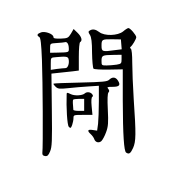
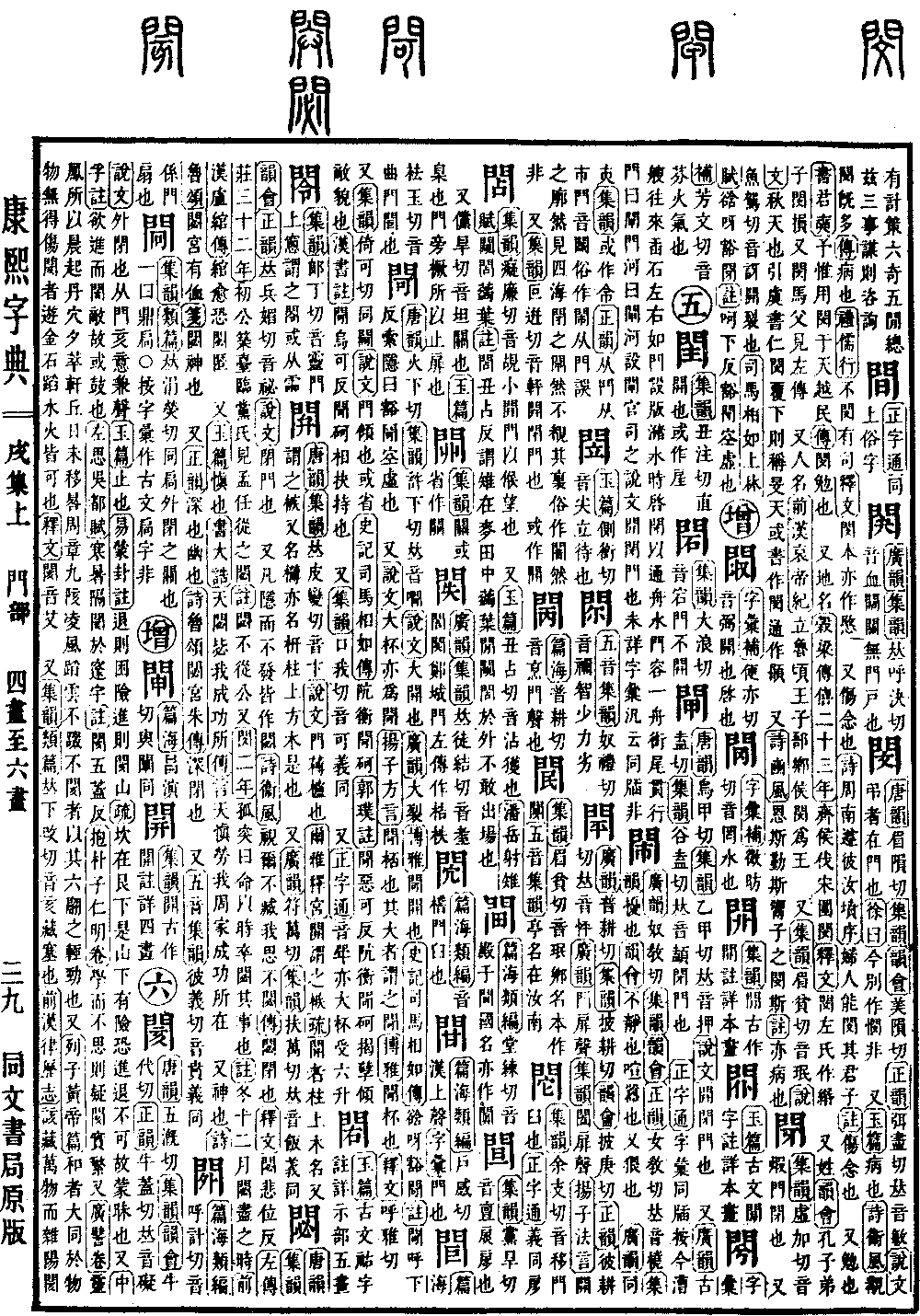
Entry: 閜
Kangxi strokes: 13
Page 1333, Entry 28
Tang Rhymes (Tangyun): Pronounced xia (falling tone)
Collected Rhymes (Jiyun): Pronounced xu (falling tone)
Pronounced xia
Explication of Writing (Shuowen): To open wide.
Broad Rhymes (Guangyun): To split open widely.
Broad Elegance (Boya): Open.
Records of the Grand Historian (Shiji), Biography of Sima Xiangru: Spaced and open.
Commentary: Pronounced hu (falling tone).
Records of the Hidden (Suoyin): Spaced and open, meaning empty and vacant.
Also according to Explication of Writing (Shuowen): A large cup is also called this.
Yangzi's Regional Speech (Fangyan): This is a cup; the large ones are called this.
Broad Elegance (Boya): A cup.
Explanation of Texts (Shiwen): Pronounced hu (rising tone).
Also, Collected Rhymes (Jiyun): Pronounced yi (rising tone). Same as this.
Explication of Writing (Shuowen): A gate leaning to one side. Sometimes written in a simplified form.
Records of the Grand Historian (Shiji), Biography of Sima Xiangru: Uneven and leaning.
Guo Pu's Commentary: Pronounced e (rising tone). Uneven and leaning is the appearance of reaching up and threatening to collapse.
Book of Han (Hanshu) Commentary: Pronounced wu (rising tone). Uneven and leaning refers to interlocking or holding onto one another.
Also, Collected Rhymes (Jiyun): Pronounced kou (rising tone). The meaning is the same.
Also, Correct Character Mastery (Zhengzitong): Pronounced jia (rising tone). Also a large cup, holding six liters.