You Collection, Upper Volume
Radical: Speech (yán)
Kangxi Strokes: 13
Page 1160, Entry 02
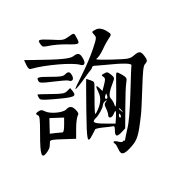
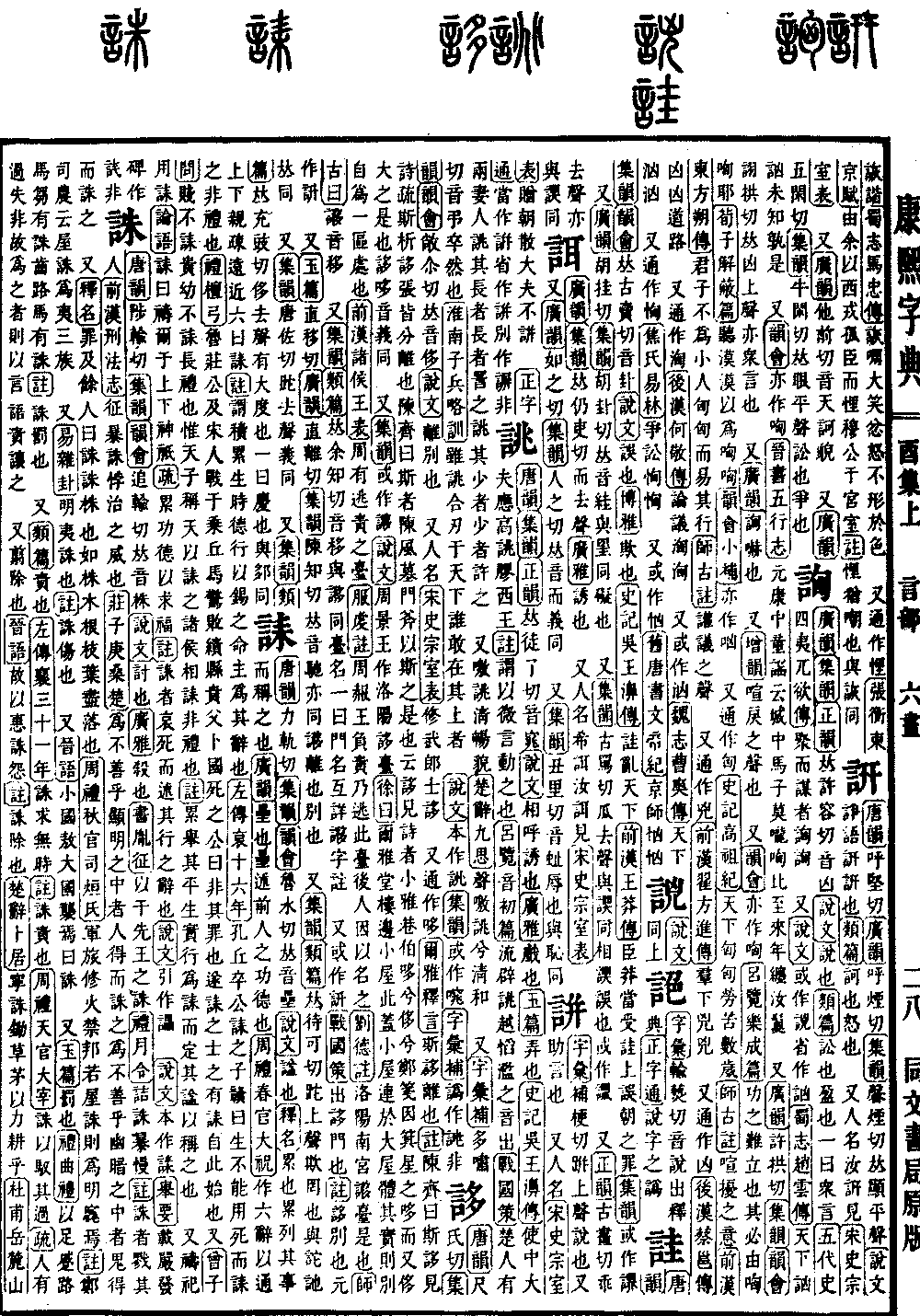
Pronounced xiong. According to the Wide Rhymes (Guangyun), Collection of Rhymes (Jiyun), and Correct Rhymes (Zhengyun), the pronunciation is the same as xiong. Explanation in the Explaining Graphs and Analyzing Characters (Shuowen Jiezi) is to speak. Classified Compilation (Leipian) defines it as litigation (arguing), and it also carries the meaning of being full. Another interpretation is the speech of a crowd. Recorded in the History of the Five Dynasties, Biography of Wuyu of the Four Barbarians: People gathered together to scheme and discussed matters noisily.
Furthermore, the Explaining Graphs and Analyzing Characters (Shuowen Jiezi) states this character is sometimes written in a variant form or abbreviated as xiong. Recorded in the Records of Shu, Biography of Zhao Yun: The world was full of rumors and discussions, and it was unclear who was right.
Also, the Rhyme Collection (Yunhui) notes it is written as xiong. Recorded in the Book of Jin, Treatises on the Five Elements: During the Yuankang period, there was a nursery rhyme that said: Horses in the city, do not make noise; wait until next year to tangle your mane.
Pronounced xiong (rising tone). According to the Wide Rhymes (Guangyun), Collection of Rhymes (Jiyun), and Rhyme Collection (Yunhui), it shares the same tone as the rising tone of xiong. It also carries the meaning of the speech of a crowd.
According to the Wide Rhymes (Guangyun), it carries the meaning of to intimidate or threaten.
According to the Supplemented Rhymes (Zengyun), it refers to a noisy, violent, or aggressive sound.
According to the Rhyme Collection (Yunhui), it is also written as xiong. The Spring and Autumn of Master Lu (Lushi Chunqiu), Section on Accomplishing Music, says: Achievements are difficult to establish, likely because of noise and disturbance. The Xunzi, Section on Dispelling Blindness, says: Hearing indistinct sounds and mistaking them for noisy clamor. The Supplemented Rhyme Collection (Yunhui Xiaobu) also notes it is written as a variant form.
It is also used interchangeably with xiong. Recorded in the Records of the Grand Historian, Annals of Emperor Gaozu: The world was in a state of noisy disturbance, with years of hardship. The Commentary of Shigu defines this as meaning noisy and restless. Recorded in the History of the Former Han, Biography of Dongfang Shuo: A gentleman does not change his conduct because of the noisy discussions of petty people. The Commentary of Shigu defines this as the sound of noisy discussion.
It is also used interchangeably with xiong. Recorded in the History of the Former Han, Biography of Zhai Fangjin: Subordinates were noisy and restless.
It is also used interchangeably with xiong. Recorded in the History of the Later Han, Biography of Cai Yong: The roads were noisy and restless.
It is also used interchangeably with xiong. Recorded in the History of the Later Han, Biography of He Jing: Discussions were noisy and clamorous.
It is sometimes written as xiong. Recorded in the Records of Wei, Biography of Cao Shuang: The world was noisy and restless.
It is also used interchangeably with xiong. Recorded in the Jiao Shi Yilin: Disputes and litigation caused noisy and restless conditions.
It is sometimes written as xiong. Recorded in the Old Book of Tang, Annals of Emperor Wendi: The capital was noisy and restless.