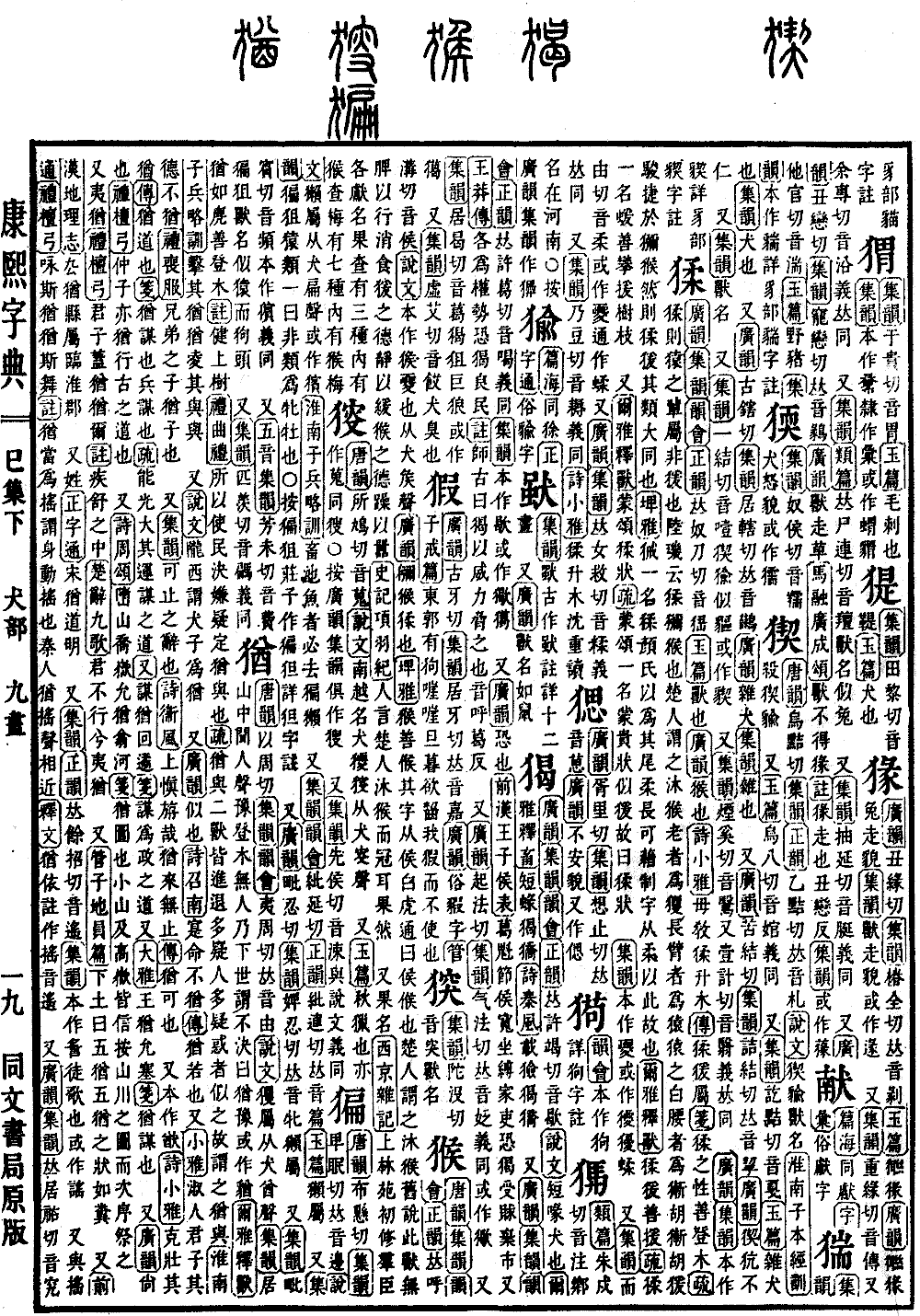
Si Collection, Lower Volume
Radical: Dog (quǎn)
13 strokes
Page 715, Entry 14
According to Broad Rimes (Guangyun), Collected Rimes (Jiyun), Dictionary of Rimes (Yunhui), and Correct Rimes (Zhengyun), the character is pronounced xie. According to Explaining Graphs and Analyzing Characters (Shuowen), it refers to a short-snouted dog. In the Explication of Domestic Animals (Shi chu) section of the Literary Expositor (Erya), it is described as a short-snouted dog. In the Odes of Qin (Qin feng) of the Book of Odes (Shijing), it appears in the phrase "carrying the short-snouted dog."
Also, according to Broad Rimes (Guangyun), Collected Rimes (Jiyun), Dictionary of Rimes (Yunhui), and Correct Rimes (Zhengyun), it is pronounced he. The meaning is the same. Collected Rimes (Jiyun) notes it as the original form of the character pronounced xie. It is sometimes also written in a variant form (ge).
Also, according to Broad Rimes (Guangyun), it means to frighten. In the Tables of Princes and Marquises (Wangzihou biao) of the History of the Former Han (Qianhan shu), it mentions the Marquis of Gekui, Kuan, who bound his household officials in fear, was coerced, and was executed in the marketplace for taking bribes. In the Biography of Wang Mang (Wang mang zhuan), it mentions using authority and power to frighten good people. The commentator Shigu states that the character means to coerce someone with power or force. It is pronounced he.
Also, according to Broad Rimes (Guangyun) and Collected Rimes (Jiyun), it is pronounced fa. The meaning is the same. It is sometimes also written in a variant form (he).
Also, according to Collected Rimes (Jiyun), it is pronounced ge. The term refers to a giant wolf. It is sometimes also written in a variant form (ge).
Also, according to Collected Rimes (Jiyun), it is pronounced hai. It refers to the smell of a dog.