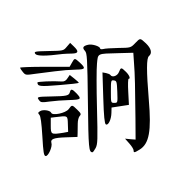
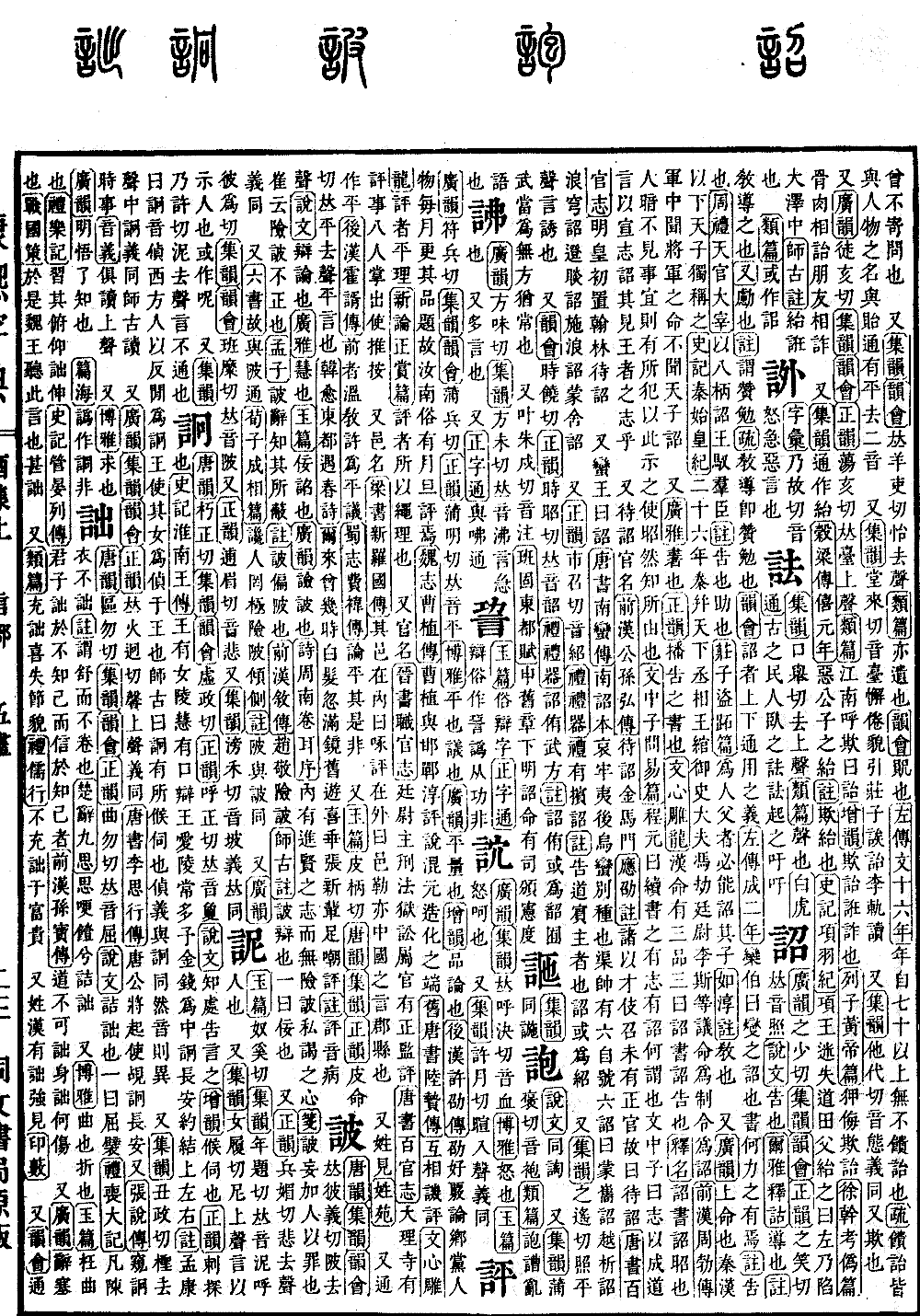
You Collection, Upper Volume
Radical: Speech (yán)
Jiong
Kangxi strokes: 12
Page 1155, Entry 12
Tang Rhymes (Tangyun) and other sources indicate the pronunciation is jiong (falling tone).
Shuowen Jiezi states: To inform after learning of a situation.
Zeng Yun states: To spy.
Zheng Yun states: To scout or investigate.
Records of the Grand Historian (Shiji), Biography of the King of Huainan: The King had a daughter named Ling, who was intelligent and eloquent. The King favored Ling and often gave her extra money, sending her to Chang'an as a spy to cultivate relationships with those in the Emperor's inner circle.
Commentary: Meng Kang stated: Jiong is pronounced like zhen. People of the west refer to counter-espionage as jiong; the King sent his daughter to act as a scout for him near the Emperor. Shigu stated: Jiong refers to peering or spying. The meaning of zhen is the same as jiong, though the pronunciation differs.
Also, Jiyun states: Pronounced cheng (falling tone). Zhong-jiong has the same meaning. Shigu provides this reading.
Also, Guangyun, Jiyun, Yunhui, and Zheng Yun state: Pronounced xing (rising tone). The meaning is the same.
Old Book of Tang (Tangshu), Biography of Li Sixing: When the Duke of Tang was about to raise an army, he sent him to spy on the situation in Chang'an.
Biography of Zhang Yue: To spy on current affairs.
Phonetics and Semantics (Yinyi): Both are read in the rising tone.
Also, Guangya states: To seek.
Guangyun states: To understand clearly.
Pianhai states: It is incorrectly written as a variant character, which is wrong.