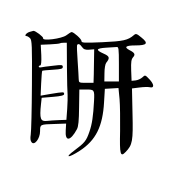
Zhengzitong (Zhengzitong) states that this character is the same as "kāi." The original form of "kāi" comes from the "kāi" radical. Tangyun (Tangyun) annotates the pronunciation as "kǔ xī qiè," and Jiyun (Jiyun) annotates it as "qiān xī qiè," with a pronunciation the same as "xī." Shuowen Jiezi (Shuowen Jiezi) explains it as blocking another's line of sight. Another interpretation is the appearance of looking directly.
Furthermore, Jiyun (Jiyun) annotates the pronunciation as "jiān xī qiè," with a pronunciation the same as "jī," meaning to look impatiently.
Furthermore, Guangyun (Guangyun) annotates the pronunciation as "hù guī qiè," with a pronunciation the same as "xié," meaning to be able to see. It also refers to the appearance of looking directly.
Furthermore, Jiyun (Jiyun) annotates the pronunciation as "jié jì qiè," with a pronunciation the same as "qì." The meaning is the same as previously described. In Shuowen Jiezi (Shuowen Jiezi), it is sometimes written in another form. In Jiyun (Jiyun), it is sometimes written in another form. The original form of "kāi" comes from the "kāi" radical.