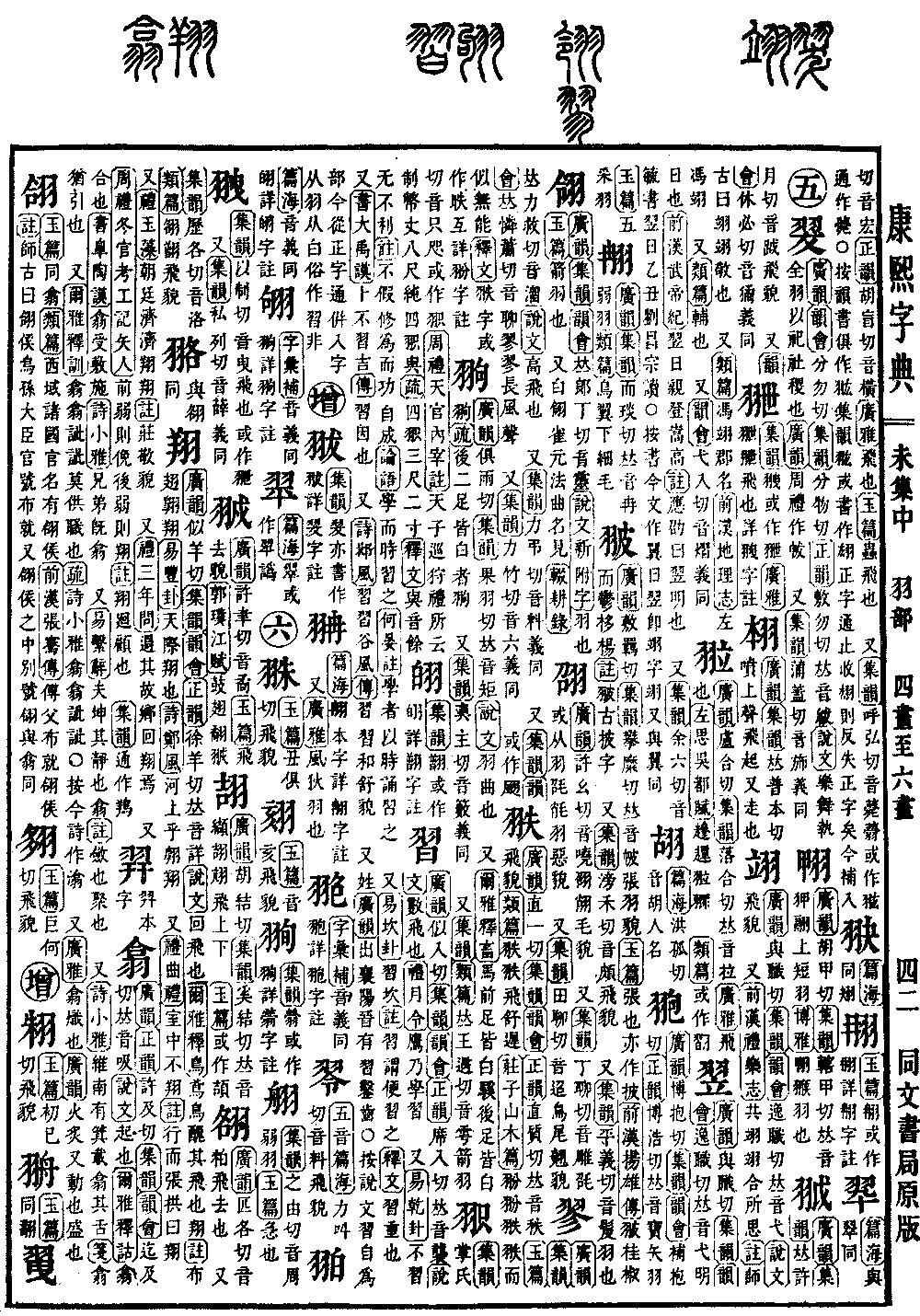
Wei Collection, Middle Volume
Radical: Feather (yǔ)
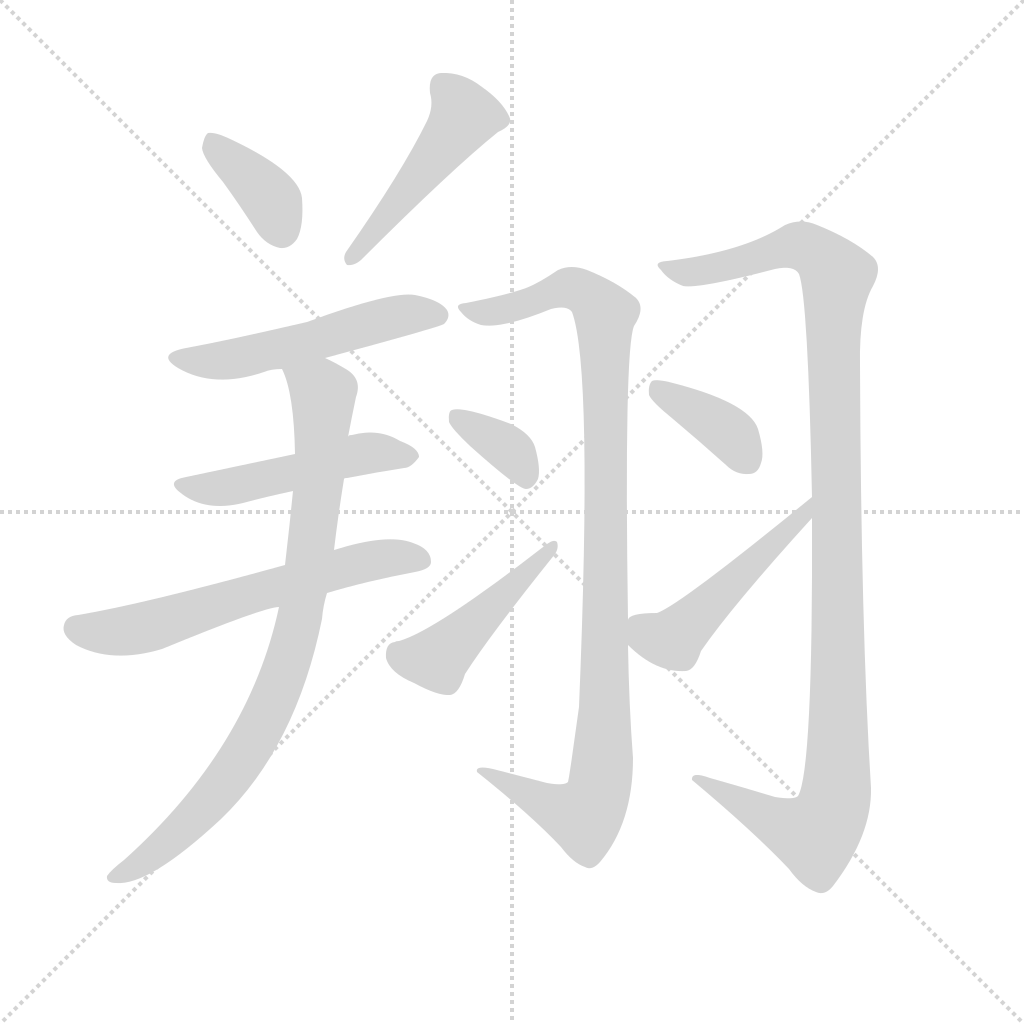
翔
Kangxi stroke count: 12
Page 956, Entry 40
Pronounced xiáng.
In the Shuowen Jiezi (Shuowen), it means to fly in circles. In the Erya (Erya), entry on birds: the kite and crow family, their flight is called xiang. Commentary: to spread wings and soar. In the I Ching (Yijing), Hexagram Feng: to soar in the sky. In the Book of Odes (Shijing), Zheng Feng: soaring above the river. Also, in the Book of Rites (Liji), Qu Li: one should not soar (walk with exaggerated arm movements) while inside a room. Commentary: walking with arms spread is called xiang. Also, in the Book of Rites (Liji), Yu Zao: in the imperial court, all is dignified and soaring. Commentary: an appearance of solemn respect. Also, in the Book of Rites (Liji), San Nian Wen: to circle and soar when passing one's former hometown. Also, in the Rites of Zhou (Zhouli), Winter Official, Artificer's Record, Arrow Maker: if the front is weak then it bows, if the back is weak then it soars. Commentary: xiang means to look back. In the Jiyun (Jiyun), also written as the variant form (yang).
Textual research: In the Erya, entry on birds: kite and crow family, their flight is called xiang. The original text has been corrected to read kite and crow family.