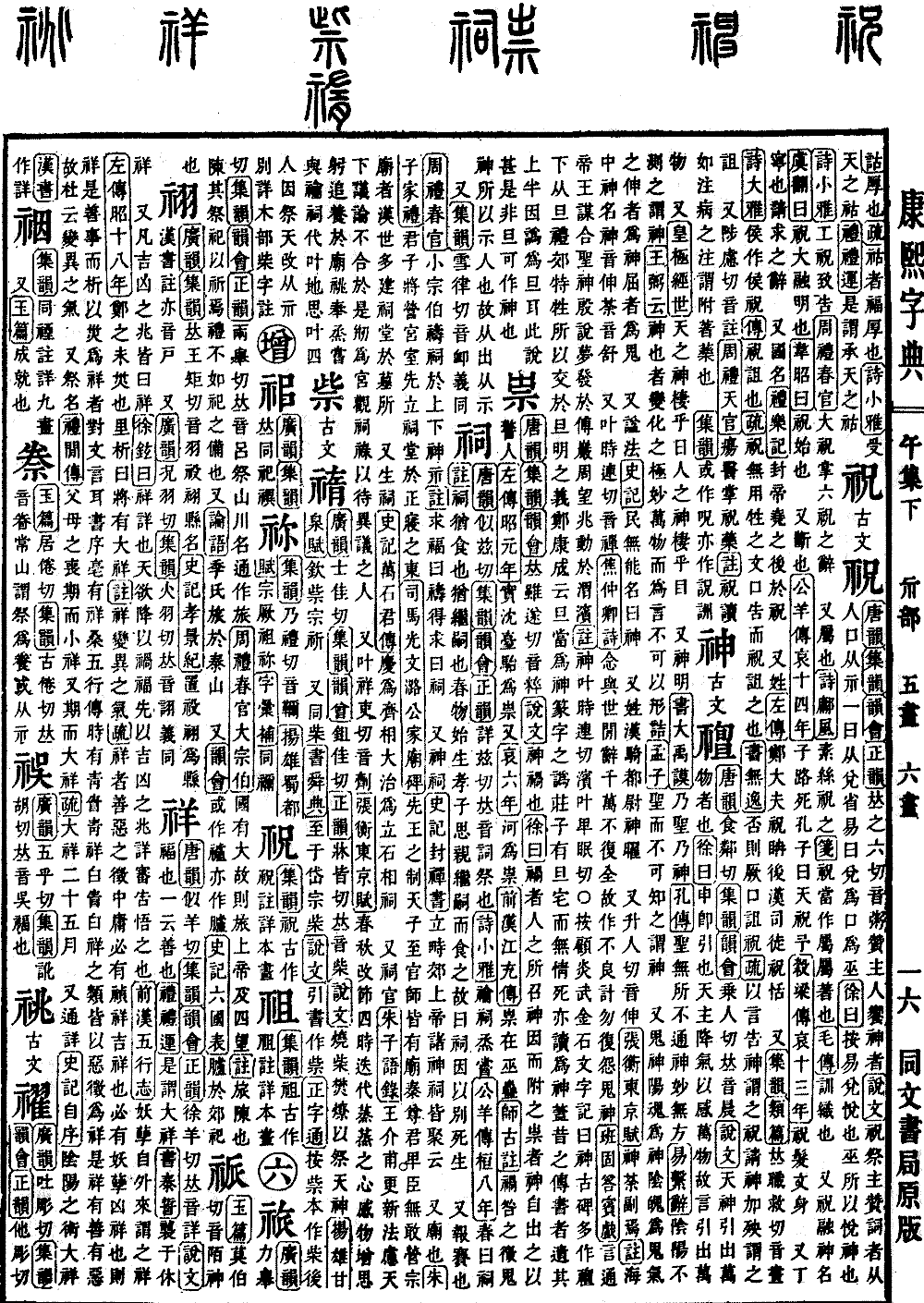
Wu Collection, Lower Volume
Radical: Spirit (shì)
Kangxi stroke count: 11
Page 842, Entry 16
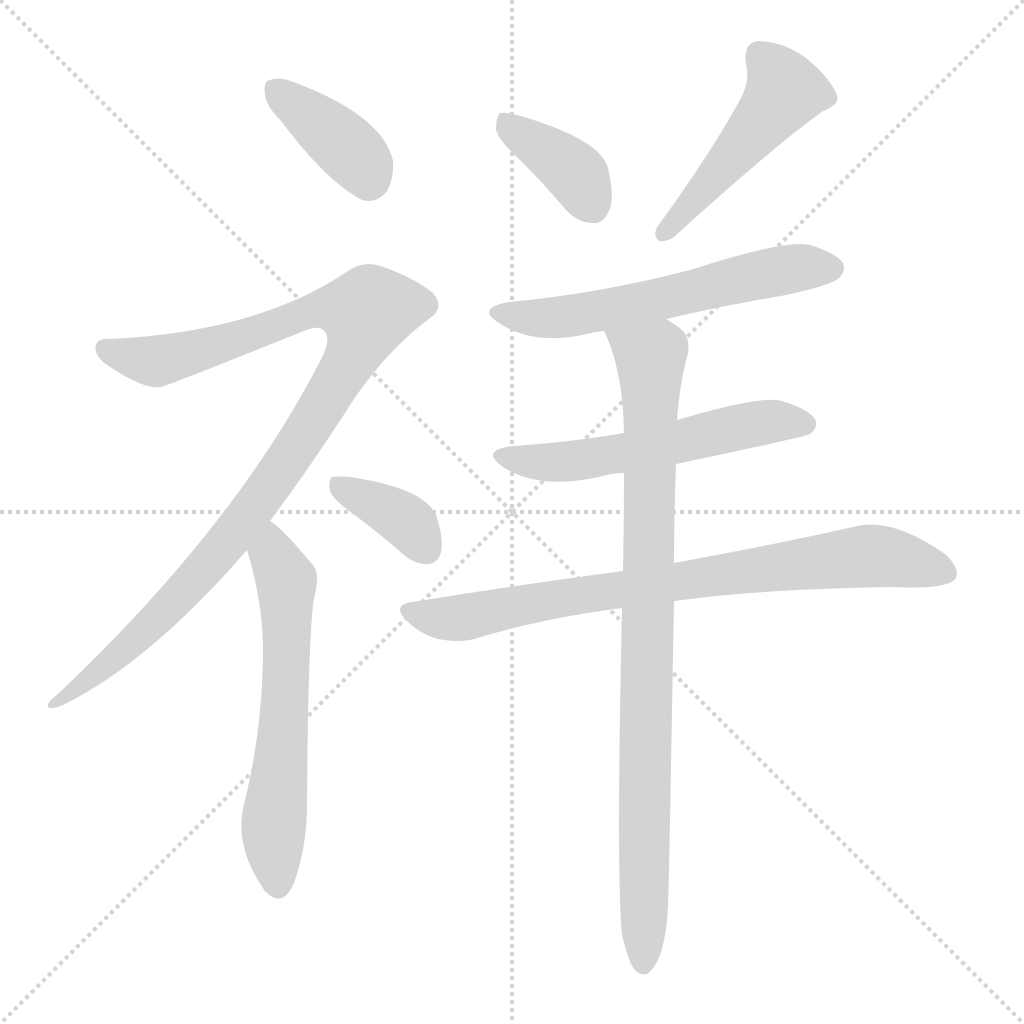
Pronounced xiáng.
In the Explanation of Characters (Shuowen), it means good fortune. Another source states it means goodness.
Book of Rites (Liji), Rites of the Operational Cycle (Liyun): This is called the great auspicious event.
Book of Documents (Shangshu), Great Declaration (Taishi): Inherited by auspicious signs.
Also, all signs of good or bad fortune are called xiáng.
Xu Xuan says: Xiáng means to examine. When Heaven is about to send down disaster or fortune, it first informs and awakens through signs of good or bad omens to be carefully examined.
History of the Former Han Dynasty (Qianhanshu), Treatise on the Five Phases (Wuxingzhi): Portents arriving from the outside are called xiáng.
Zuo Tradition (Zuozhuan), Year 18 of Duke Zhao: Before the disaster in Zheng, Li Xi said: There will be a great xiáng.
Commentary: Xiáng is the energy of anomalous changes.
Sub-commentary: Xiáng is the manifestation of good or evil. The Doctrine of the Mean (Zhongyong) states there must be auspicious omens, which refers to good fortune. There must be evil omens, which refers to bad fortune. Therefore, xiáng is a good event, and Li Xi referring to a disaster as xiáng is merely speaking in terms of contrast. In the Preface to the Book of Documents, there is the mention of the auspicious mulberry tree in Bo. The Treatise on the Five Phases mentions blue disasters and blue xiáng, white disasters and white xiáng; these all refer to evil manifestations as xiáng. Thus, xiáng can be good or evil, which is why Du Yu describes it as the energy of anomalous changes.
Also the name of a sacrifice.
Book of Rites (Liji), Miscellaneous Records (Xianzhuan): For the mourning of parents, after one year is the small xiáng, and after another year is the great xiáng.
Sub-commentary: The great xiáng takes place in the twenty-fifth month.
Also commonly written as xiáng (to examine).
Records of the Grand Historian (Shiji), Authorial Preface: The arts of Yin and Yang are of great xiáng. The History of the Han Dynasty (Hanshu) uses the character for examine.