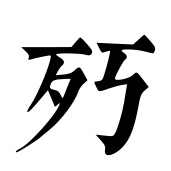
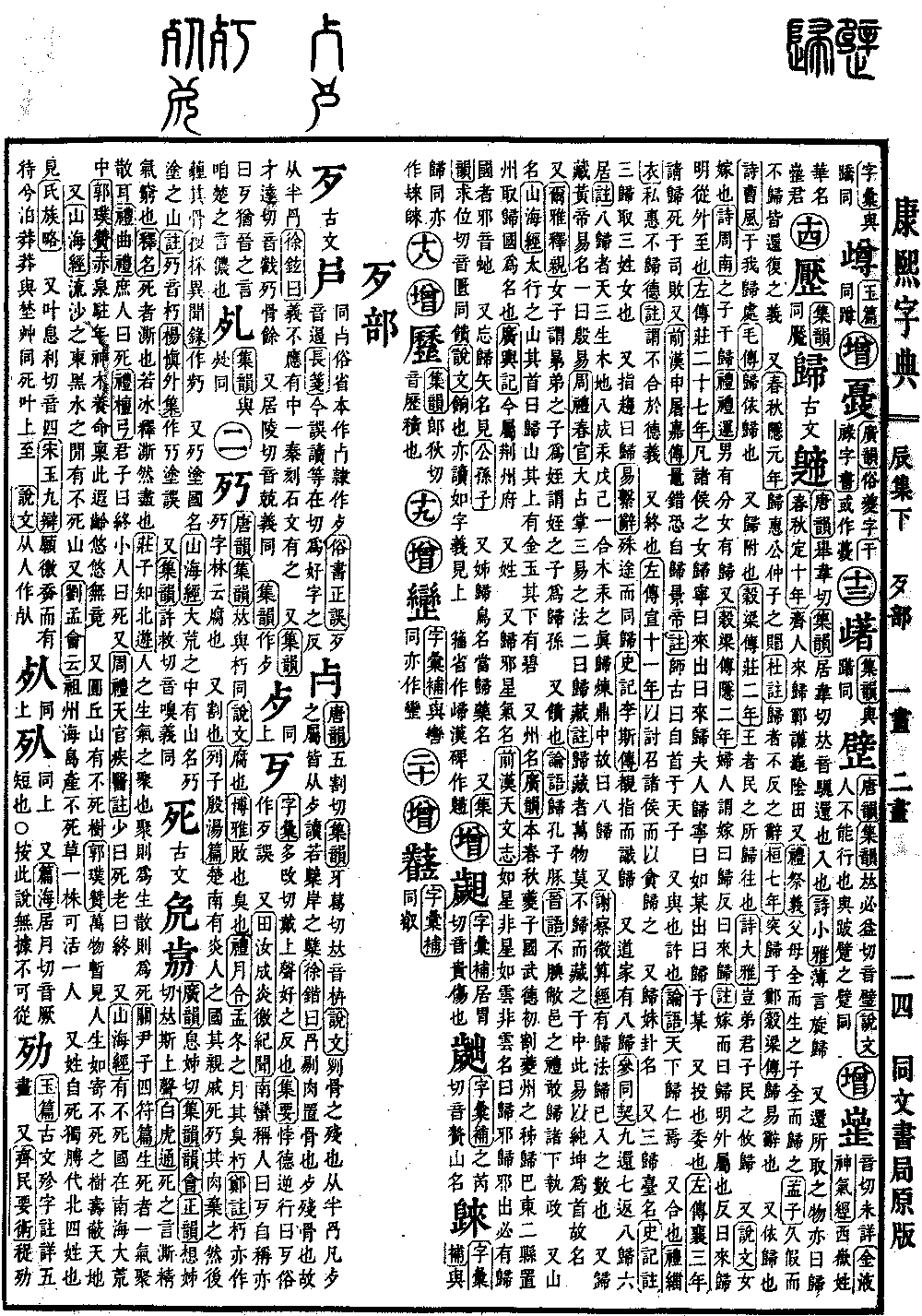
Zi Collection, Upper Volume, Page 14, Entry 01
Same as "xiu" in "Tang Yun" and "Ji Yun". "Shuowen Jiezi" explains it as rotten. "Boyao" explains it as decayed or rotten. "Book of Rites (Liji), Monthly Ordinances" records: In the month of Mengdong, its smell is rotten. "Zheng Xuan's Commentary" states that "xiu" is also written as "ku". "Zilin" explains it as rotten.
Also explained as to cut. "Liezi, Chapter Yin Tang" records: In the south of the Chu state, there is a country of the Yan people. After their relatives die, they cut off the flesh of the deceased and discard it, then bury their bones. "Sou Cai Yi Wen Lu" writes it as "ku".
Also there is "Ku Tu", which is the name of a country. "Classic of Mountains and Seas (Shanhaijing)" records: In the Great Wilderness, there is a mountain named Ku Tu Mountain. The commentary states that the pronunciation of "ku" is "xiu". "Yang Shen Wai Ji" writes it as "kāo tú", which is incorrect.
Also "Ji Yun" annotates the pronunciation as "xu jiù qiè", pronounced "xiù". The meaning is the same. The left side of the character "ku" is written as "kuài".