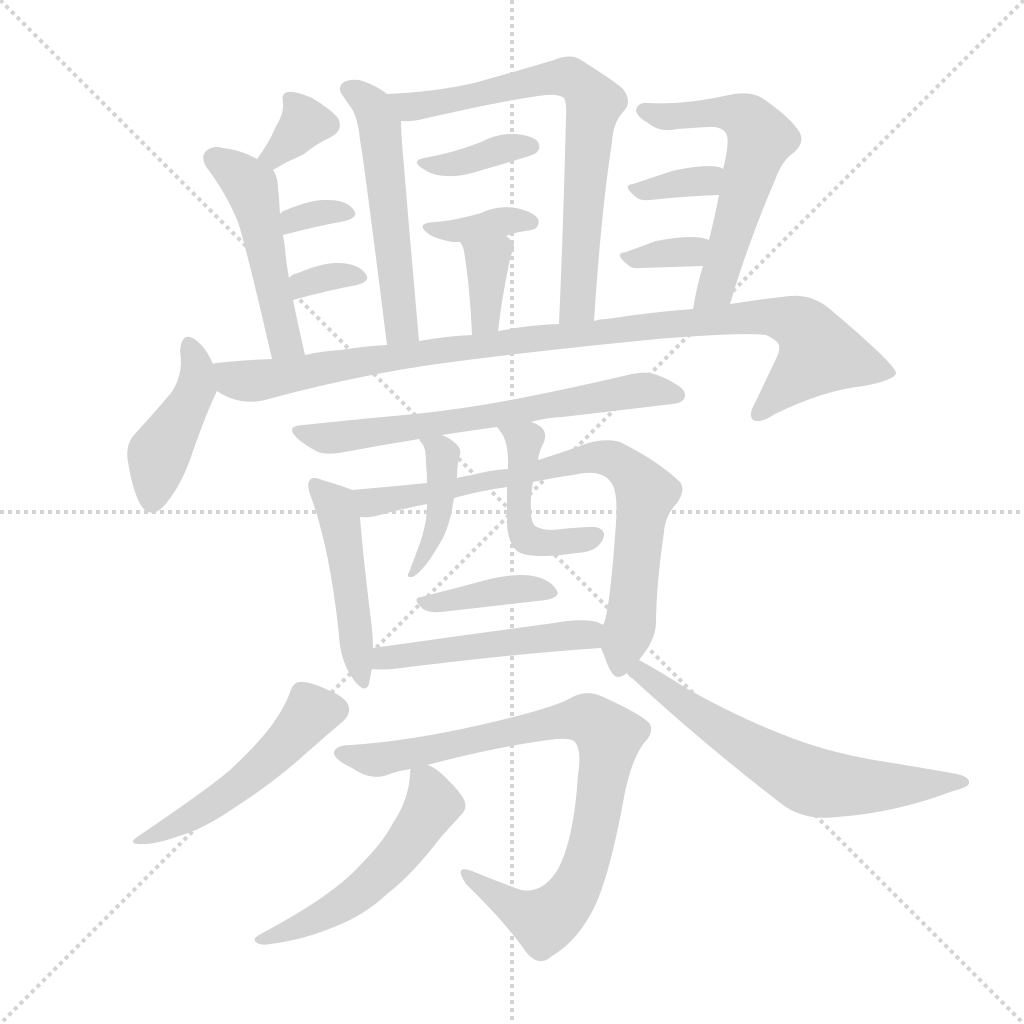
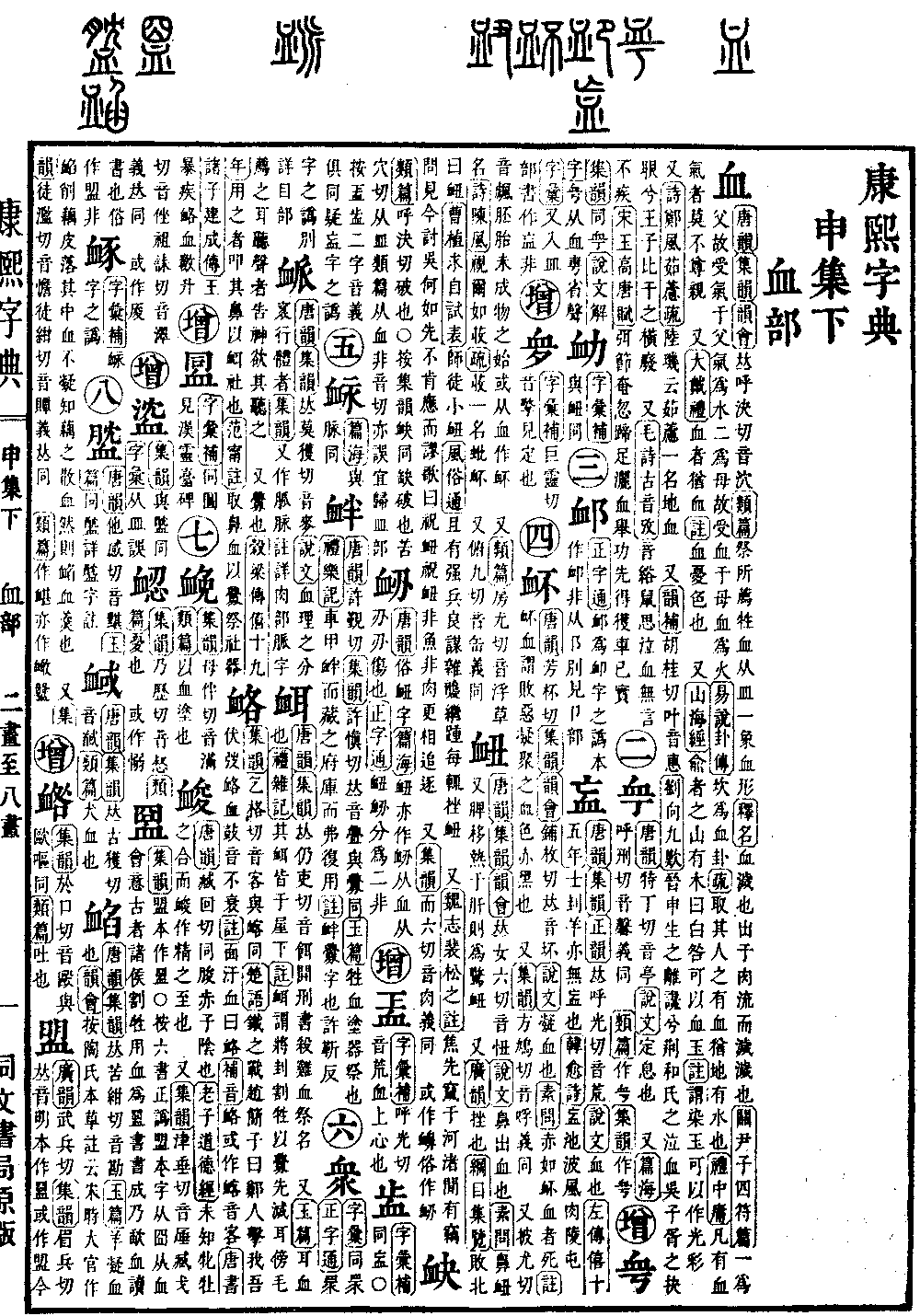
You Collection, Lower Volume
Radical: Wine (yǒu)
Kangxi Strokes: 25
Page 1107, Entry 01
Pronounced xin (falling tone).
Shuowen Jiezi (Shuowen): Refers to blood sacrifices. The shape resembles a sacrifice to the kitchen god.
Guangyun: Refers to smearing blood from livestock on vessels or objects as a sacrifice.
Book of Rites (Liji), Monthly Ordinances (Yueling): In the first month of winter, the grand scribe is ordered to smear blood on turtle shells and yarrow stalks. Commentary: This refers to slaughtering livestock and using the blood to smear turtle shells and yarrow stalks.
Book of Rites (Liji), Miscellaneous Records (Zaji): When a new ancestral temple is completed, a consecration rite must be performed. Commentary: This refers to slaughtering livestock upon the completion of an ancestral temple and using the blood to smear it, showing reverence and imbuing it with spiritual nature.
Records of the Grand Historian (Shiji), Annals of Gaozu: In the courtyard at Pei, Chi You was sacrificed to and war drums were smeared with blood. Commentary: Xin refers to sacrifice. Slaughtering livestock and using their blood to smear drums is called xin.
Also refers to transgression. Zuo Zhuan, 12th Year of Duke Xuan: Observe the opponent's transgressions before acting. Commentary: Xin refers to transgression.
Also refers to defects or gaps. Zuo Zhuan, 8th Year of Duke Huan: If an enemy has an exploitable gap, it must not be missed. Commentary: Xin refers to defects or gaps.
Records of the Grand Historian (Shiji), Biography of Li Si: Those who achieve great merit are able to seize the opponent's defects and gaps and ruthlessly exploit them. Commentary: The Suoyin commentary states: This means taking advantage of the defects and gaps of the feudal lords to ruthlessly eliminate them.
Also refers to omens. Discourses of the States (Guoyu), Sayings of Lu: If the Bao clan has an omen of collapse, I will make no plans. Commentary: Xin refers to an omen.
Lu Ji, Reply to Jia Changyuan: Heaven has grown weary of hegemony, and the fortunes of the Liu Han dynasty reveal omens of decline.
Also refers to smearing. One interpretation suggests it refers to fumigation.
Discourses of the States (Guoyu), Sayings of Qi: When Guan Zhong arrived, he repeatedly smeared his body with aromatic spices and bathed. Commentary: Smearing the body with aromatic spices is called xin.
Rites of Zhou (Zhouli), Spring Officials, Officer of Rituals (Sishi): Providing the fragrant wine used in the consecration rite. Commentary: Smearing a ritual object or body with fragrant wine to make it aromatic.
Rites of Zhou (Zhouli), Spring Officials: The female shamans are in charge of seasonal disaster-averting and fortune-seeking rites, as well as the consecration bath. Commentary: The consecration bath refers to bathing using herbs and medicinal fragrances.
Book of Han (Qian Hanshu), Biography of Jia Yi: Smearing the face with lacquer and swallowing charcoal to alter the voice. Commentary: Smearing the face with lacquer to change one's appearance.
One interpretation suggests it refers to fumigation, using toxic fumes to affect people.
Also refers to impulsiveness or agitation. Zuo Zhuan, 26th Year of Duke Xiang: The nature of petty men is easily agitated by bravado. Commentary: Xin refers to agitation.
Erya, Interpretation of Beasts: When beasts become enraged, it is called xin. Commentary: The rapid, self-agitated movements of wild beasts are called xin.
Also serves as a surname. Zhengzitong: There was a man named Xin Xia during the Zhou dynasty.
Zhengzitong: Commonly written as a variant form (xìn). Han Feizi: Having already accumulated the capital for kingship and taking advantage of the enemy state's flaws.
Book of Han (Qian Hanshu), Annals of Gaozu: Acting by taking advantage of an opponent's flaws.
Alternatively written as another variant form (xìn). Book of Rites (Liji), Record of Music (Yueji): Military carriages and armor are smeared with the blood of sacrificial animals before being stored in the arsenal. Commentary: Xin is the character for consecration. Wrapping weapons in tiger skin indicates the ability to use force to awe and control military affairs.
Sometimes erroneously written as the character for rise (xìng). Book of Rites (Liji), Ritual Vessels (Liqi): After the vessels have been smeared with blood, silk and cloth offerings are used. Commentary: The character for rise is an error for the character for consecration.
Textual research: Book of Rites (Liji), Record of Music (Yueji) mentions storing in the military arsenal. According to the original text, "military arsenal" has been corrected to "government arsenal."