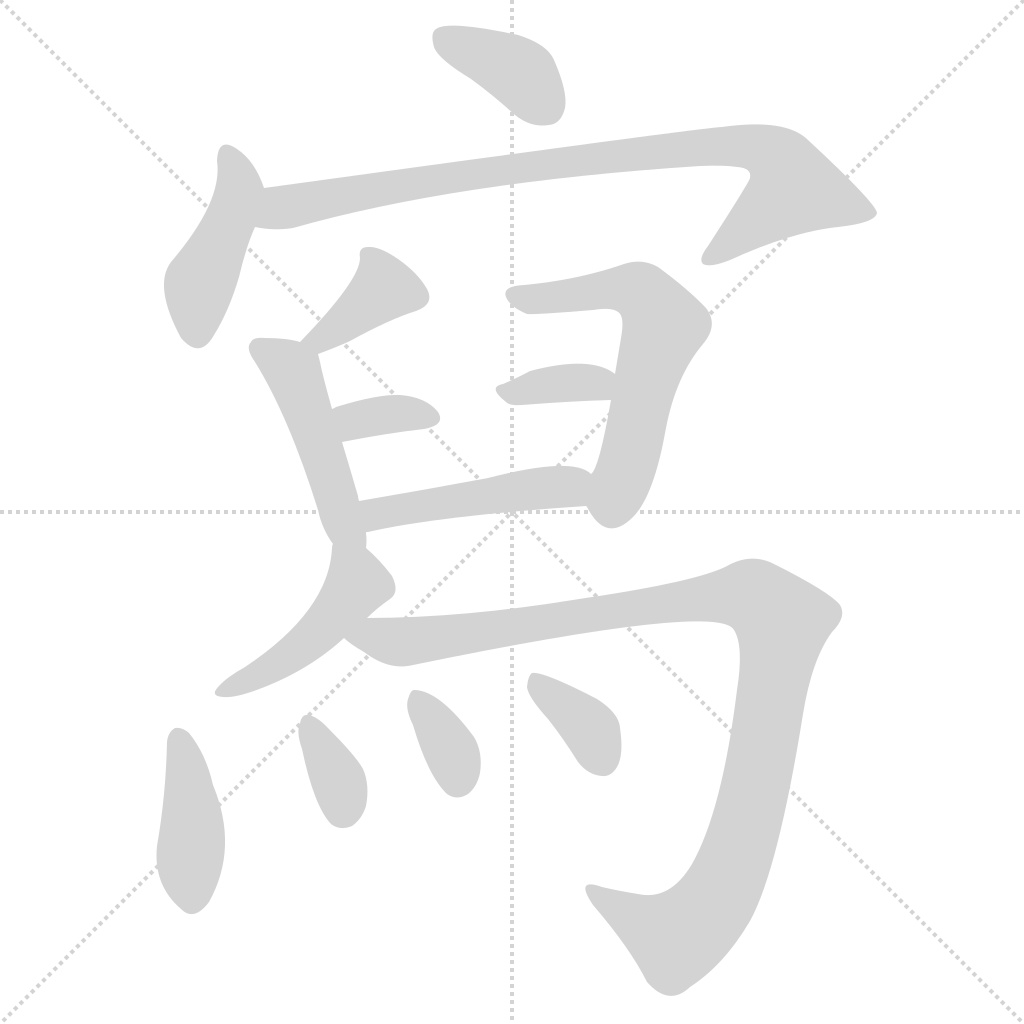
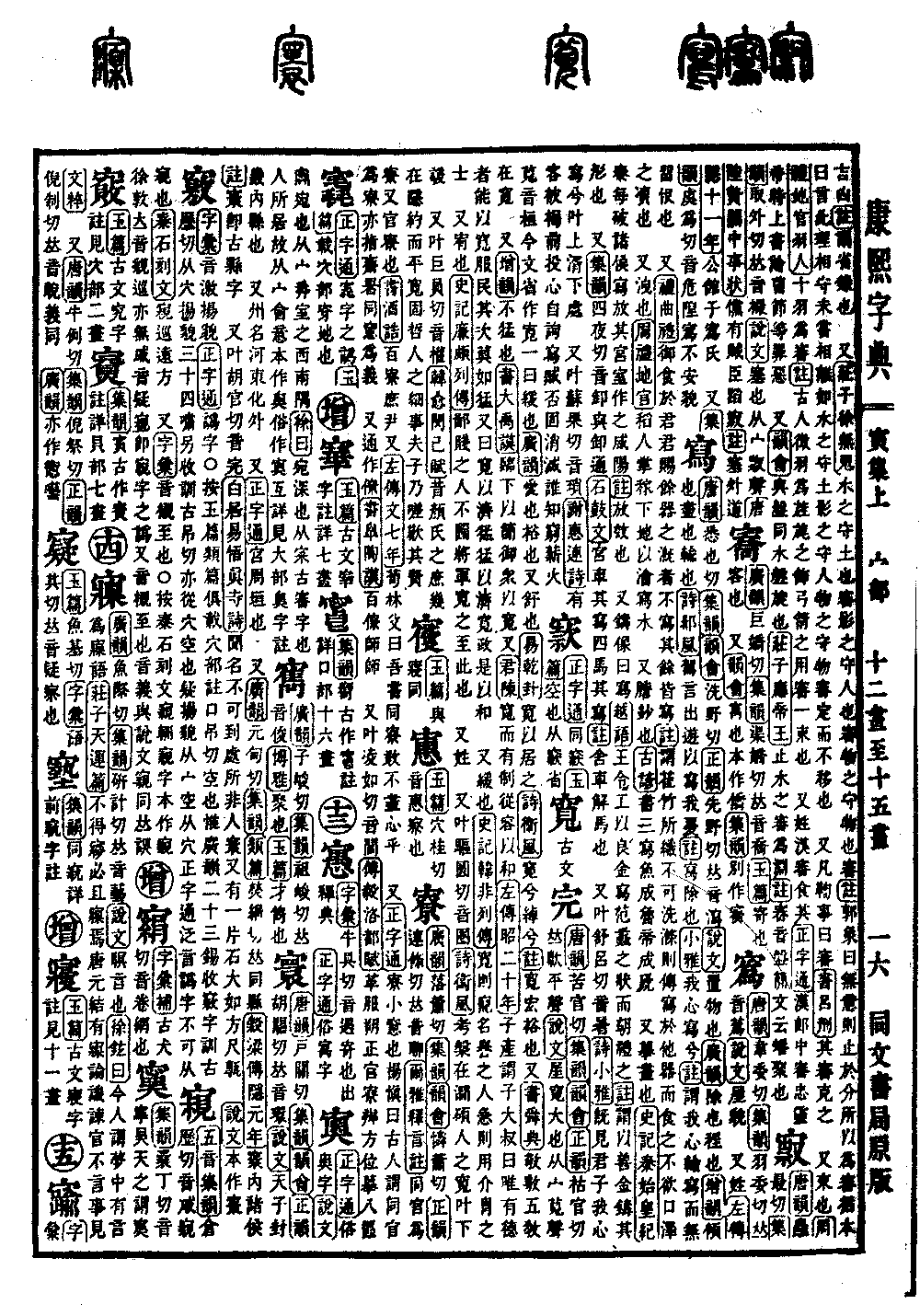
Yin Collection, Upper Volume
Radical: Roof (bù)
Kangxi Strokes: 15
Page 292, Entry 04
Pronounced xie (falling tone).
In the Shuo Wen (Shuo Wen Jie Zi), it means to place an object.
In the Guang Yun, it means to remove, or to evaluate.
In the Zeng Yun, it means to pour out, to exhaust, or to transmit.
In the Book of Odes (Shijing), Beifeng section: "I yoke my carriage to go out and roam, in order to pour out my sorrow." Commentary: Pour out means to remove.
In the Xiaoya section: "My heart is poured out." Commentary: This means my heart is unburdened and has no remaining resentment.
Also, in the Book of Rites (Liji), Quli section: "When dining with a ruler, do not pour out the remains if the ruler has gifted you a vessel that is difficult to wash; for all others, pour them out." Commentary: This refers to items woven from bamboo, which cannot be cleaned, thus one transfers the contents to another vessel to eat, to avoid the contamination of saliva.
Also, to drain or leak. In the Rites of Zhou (Zhouli), Earth Offices section: "The rice official manages the lower fields, using irrigation channels to drain the water."
Also, to transcribe. An ancient proverb states: "If a text is transcribed three times, the character for fish becomes the character for Lu, and the character for emperor becomes the character for Si."
Also, to imitate or draw. In the Records of the Grand Historian (Shiji), Annals of Qin Shi Huang: "Every time Qin defeated the feudal lords, they would imitate their palaces and build them at Xianyang." Commentary: Imitate means to emulate.
Also, casting a statue is called xie. In the Discourses of the States (Guoyu), Yue section: "The king ordered a craftsman to cast the likeness of Fan Li in fine gold and pay respects to it at court." Commentary: This means to cast his form in fine gold.
Also, pronounced xie (falling tone). Interchangeable with xie (to unharness).
In the Stone Drum Inscriptions: "The palace carriage is unharnessed, the four horses are unharnessed." Commentary: This means to release the carriage and unharness the horses.
Also, rhymes with shu (rising tone). In the Book of Odes (Shijing), Xiaoya section: "Having seen my lord, my heart is poured out."
Also, rhymes with suo (rising tone). In the poetry of Xie Huilian: "A guest wearing coarse cloth approaches, revealing his heart to seek counsel. Whether good or bad, it is surely dissolved; who knows the fire of the exhausted firewood."