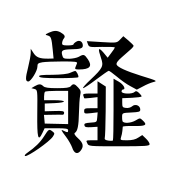
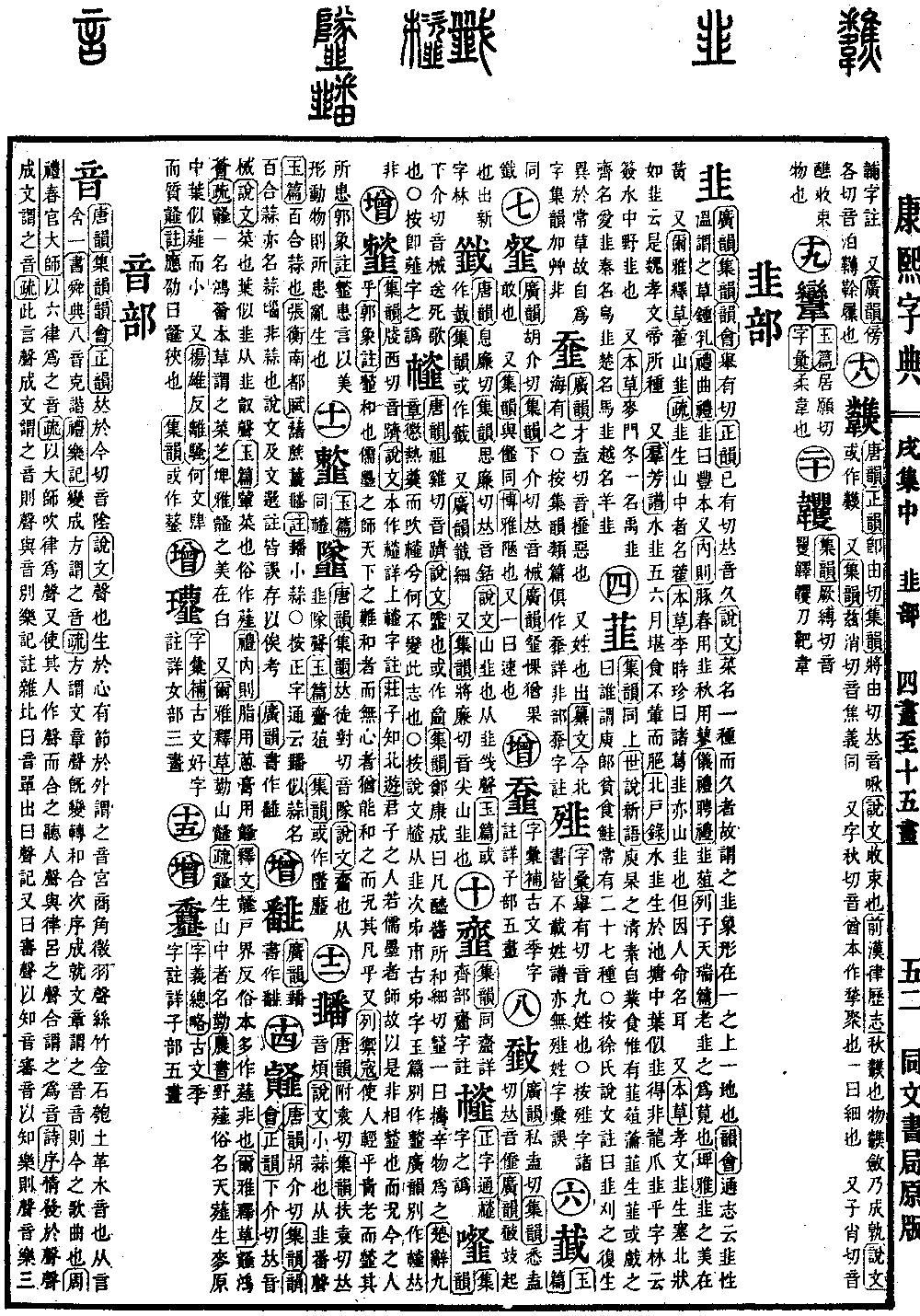
"Tang Yun" (Tang Yun): Hu Jie qie. "Jiyun" (Jiyun), "Yun Hui" (Yun Hui), "Zheng Yun" (Zheng Yun): Xia Jie qie, pronounced "xie." "Shuowen Jiezi" (Shuowen Jiezi) describes it as a type of vegetable with leaves resembling chives. The character is formed from "jiu" (韭) with "㕢" as the phonetic component. "Yupian" (Yupian) records it as a type of pungent vegetable. The common form is written as "薤". "Liji - Neize" (Liji - Neize) states: animal fats are paired with scallions, and plant oils with "䪥". "Shiwen" (Shiwen) annotates the pronunciation: "䪥", pronounced hu jie fan. The common editions often write it as "薤", which is incorrect. "Erya - Shicao" (Erya - Shicao) records: "䪥" is also called "hong hui". The commentary explains: "䪥", another name is "hong hui", and "Bencao" (Bencao) calls it "cai zhi". "Pia ya" (Pia ya) says: the deliciousness of "䪥" lies in its white part.
Additionally, "Erya - Shicao" (Erya - Shicao) records: "葝" is mountain "䪥". The commentary explains: "䪥" that grows in the mountains is called "葝". "Nongshu" (Nongshu) records: wild "薤", commonly known as sky "薤", grows in wheat fields and plains. Its leaves resemble "薤" but are smaller.
Furthermore, Yang Xiong's "Fan Lisao" (Fan Lisao) contains the sentence "He wen si er zhi 䪥". The commentary quotes Ying Shao as saying: "䪥" means narrow. "Jiyun" (Jiyun) records that this character is sometimes written in other forms.