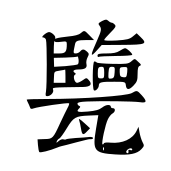
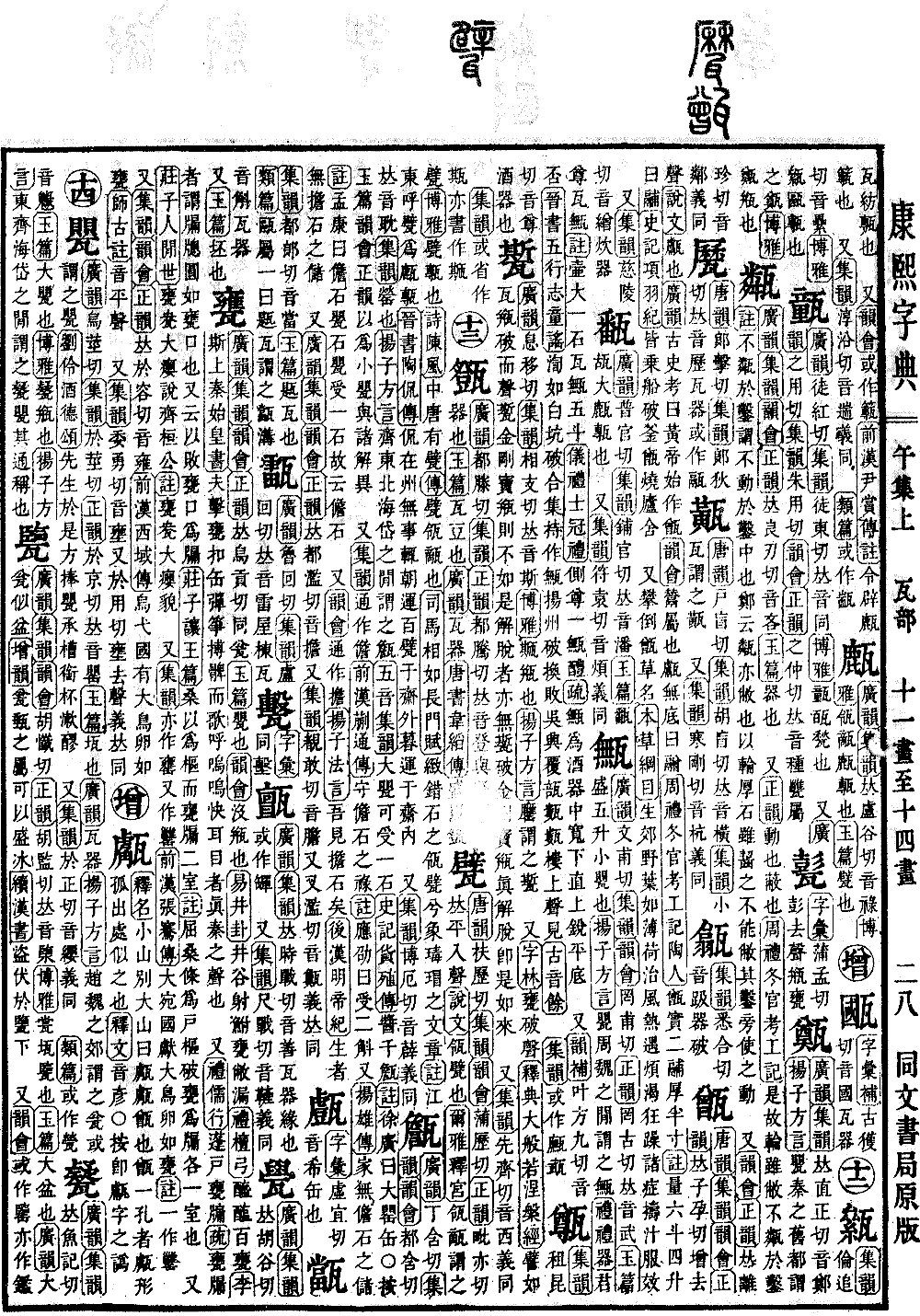
Guangyun (Guangyun), Jiyun (Jiyun), and Yunhui (Yunhui) record the pronunciation as hu chan qie. Zhengyun (Zhengyun) records the pronunciation as hu jian qie, pronounced the same as []. Boya (Boyai) explains: 瓽 is the same as 㽉. Yupian (Yupian) explains: it is a large basin. Guangyun (Guangyun) explains: a large jar resembling a basin. Zengyun (Zengyun) explains: it belongs to the category of jars (zhòu) and can be used to hold ice. Xuhan Shu (Xuhan Shu) records: thieves hid beneath the 㽉.
Also, Yunhui (Yunhui) records: sometimes written as []. Also written as jian. Zhou Li (Zhou Li), Tianguan (Tianguan), Lingren (Lingren) records: in spring, preparations for the jian begin. "Also" records: ice jian are provided during sacrifices. "Note" explains: the jian resembles a zhou, with a large mouth, used to hold ice and place food within it, to guard against warmth.
Also, Jiyun (Jiyun) records the pronunciation as hu zan qie, pronounced the same as jian. It also records the pronunciation as ju xian qie, pronounced the same as jian. It also records the pronunciation as hu lan qie, pronounced the same as lian. The meaning is the same.