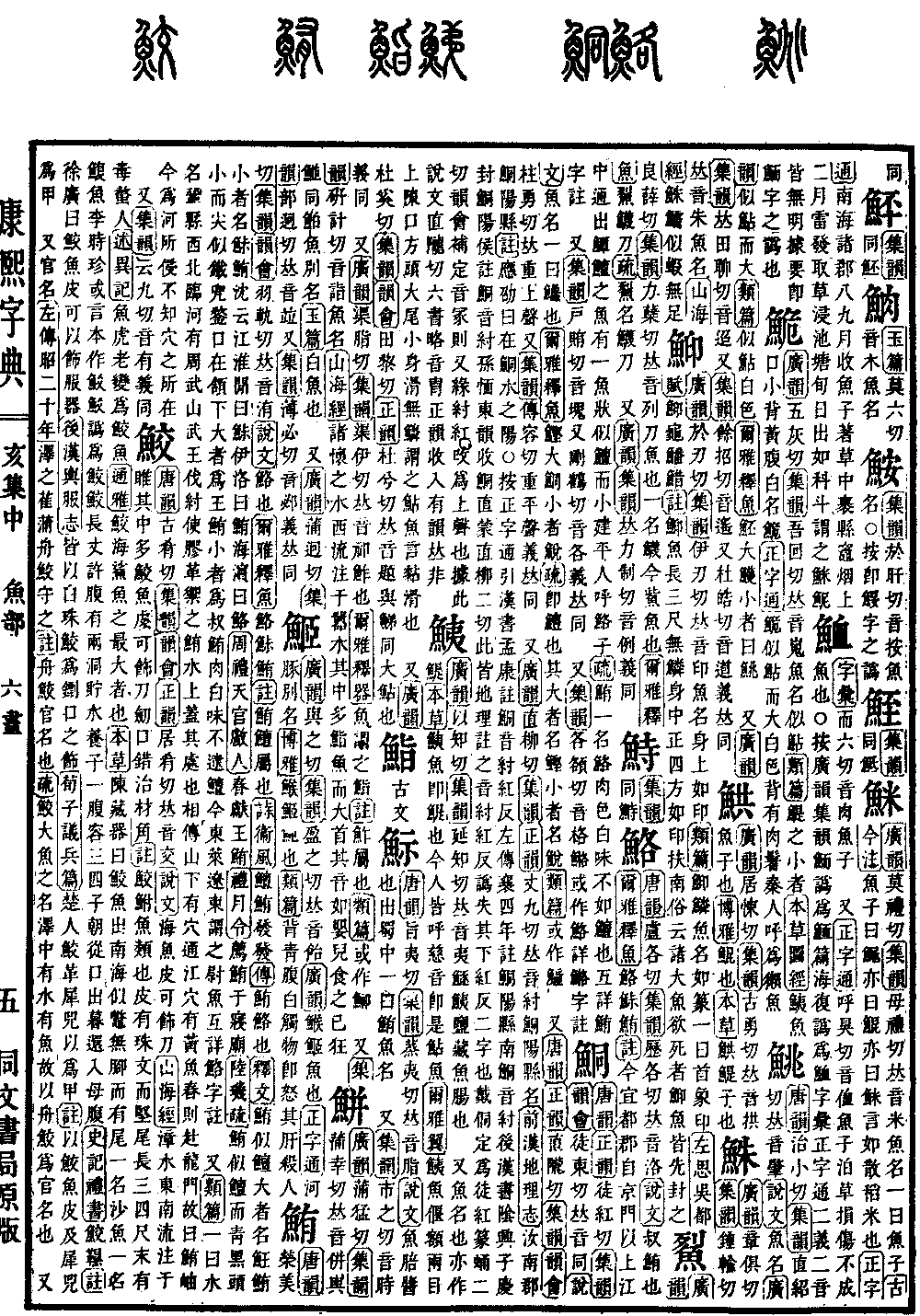
Hai Collection, Lower Volume
Radical: Fish (yú)
Wei
Kangxi Stroke Count: 17
Page 1469, Entry 21
Pronounced wei (rising tone).
According to the Explaining Graphs and Analyzing Characters (Shuowen Jiezi), it refers to a type of sturgeon. In the Approach to the Classics (Erya), entry on interpreting fish, it is described as a sturgeon-like fish. The commentary notes that it is a species of sturgeon. In the Book of Odes (Shijing), within the Airs of Wei, it is written: "The sturgeons are flashing." The commentary states that the wei is a sturgeon. The sub-commentary explains that the wei resembles a sturgeon; the larger ones are called wei, and the smaller ones are called shu-wei. Shen states: In the regions of the Yangtze and Huai rivers they are called shu-wei, in the Yi and Luo rivers they are called wei, and along the seacoast they are called luo. In the Rites of Zhou (Zhouli), section on the officials of heaven, it states: In the spring, present the kingly sturgeon. In the Book of Rites (Liji), monthly ordinances, it states: Offer sturgeon at the sleeping hall and ancestral temple. Lu Ji's sub-commentary notes: The wei resembles a sturgeon but is blue-black in color, with a small, pointed head similar to an iron helmet; its mouth is located beneath its chin. Large ones are called kingly sturgeon, and small ones are called uncle sturgeon. The meat is white, but the taste is not as good as that of the sturgeon. Today, in the Donglai and Liaodong regions, it is called the weiyu. See the entry for the luo character for further details.
Additionally, as noted in the Classified Compilation (Leipian), it is the name of a river. Northwest of Gong County, facing the river, is Mount Zhouwu. When King Wu marched against the tyrant Zhou, he had Jia Ge defend the area at the Wei River, which is believed to be that location. Legend says that beneath the mountain there is a cave connecting to the river, and the cave contains yellow fish which, in the spring, rush toward the Dragon Gate; hence it is called the Wei Cave. It is now submerged by the river, and the location of the cave is unknown.
Also, according to the Classified Compilation (Leipian), pronounced you (rising tone). The meaning is the same.