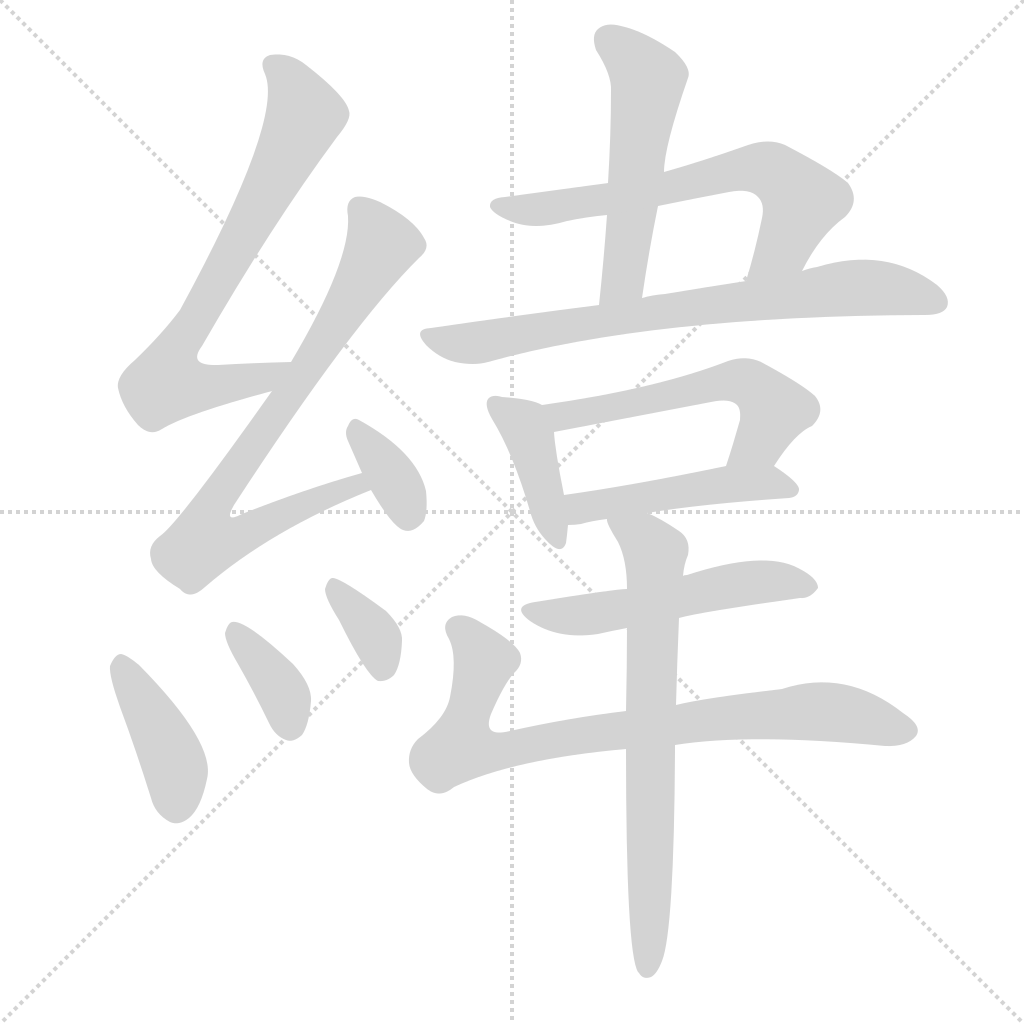
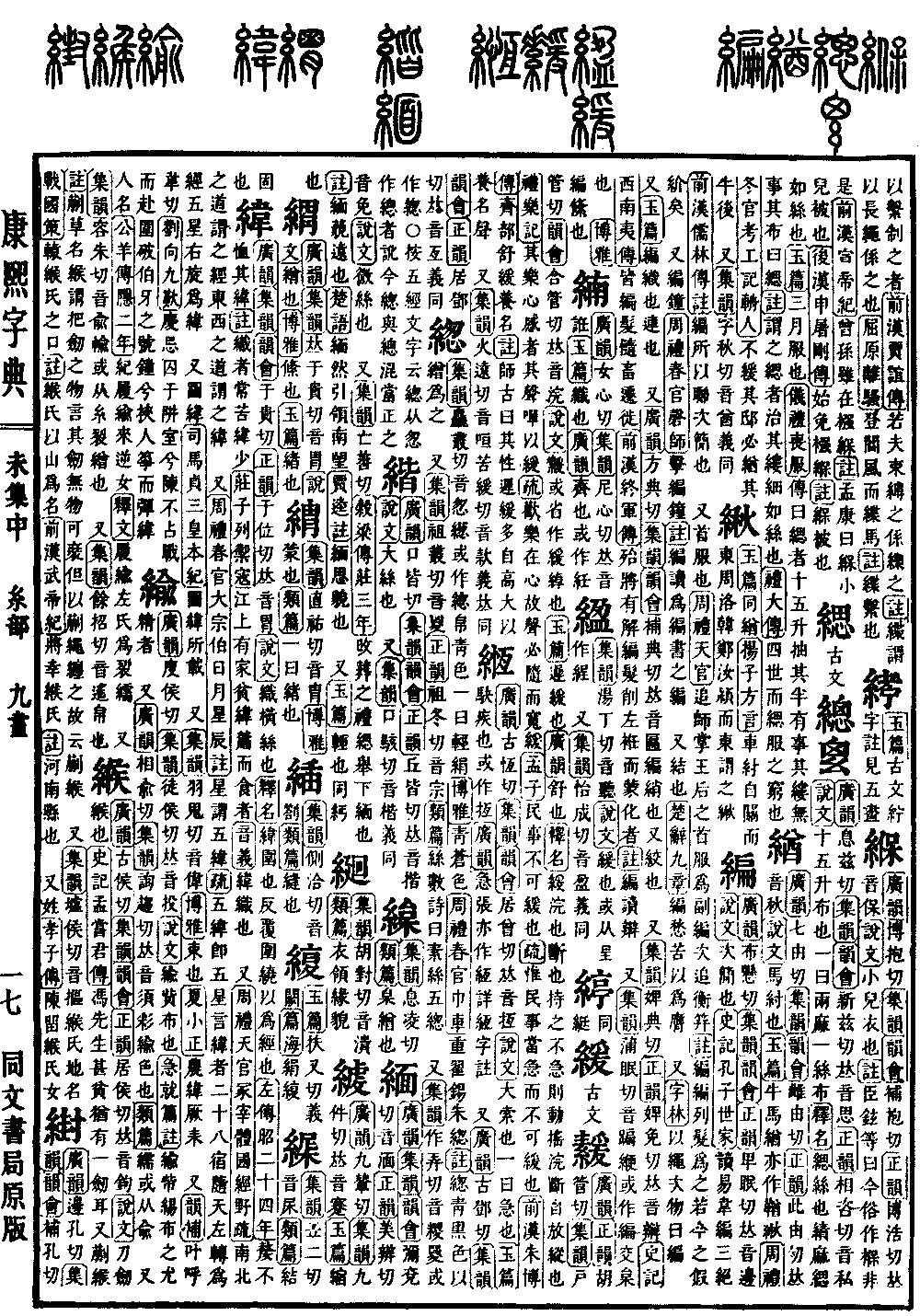
Wei Collection, Middle Volume. Radical: Silk (mì). Kangxi strokes: 15. Page 931, Entry 26.
According to the Guangyun (Guangyun), Jiyun (Jiyun), and Yunhui (Yunhui) dictionaries, the pronunciation is wei (falling-rising tone). According to the Zhengyun (Zhengyun) dictionary, the pronunciation is wei (falling tone).
According to the Shuowen Jiezi (Shuowen), it refers to the horizontal threads used when weaving cloth. According to the Shiming (Shiming), the term wei implies surrounding; it refers to threads that wrap repeatedly around to form the warp.
In the Zuo Zhuan (Zuo Zhuan), under the twenty-fourth year of Duke Zhao, it is written: A widow does not worry about her weft threads. The commentary notes that weavers are often distressed by a shortage of weft threads.
In the Zhuangzi (Zhuangzi), in the Lie Yu chapter, it mentions a poor family living by the river who make a living by weaving reed mats. The commentary on sounds and meanings notes that wei here means to weave.
Also, according to the Zhou Rites (Zhouli), in the commentary on the Heaven Official, it is stated that roads running north to south are called jing, while those running east to west are called wei.
Also, according to the Zhou Rites (Zhouli), in the commentary on the Spring Official regarding the sun, moon, and stars, it is noted that stars refer to the five wei. The sub-commentary explains that the five wei are the five planets. They are called wei because the twenty-eight lunar mansions rotate to the left, which is called jing, while the five planets move to the right, which is called wei.
Also refers to diagrammatic apocrypha. According to the Records of the Three Sovereigns (Sanhuang Benji) by Sima Zhen, these are recorded in the diagrammatic apocrypha.
Also, according to the Jiyun (Jiyun), pronounced wei (falling-rising tone). According to the Guangya (Guangya), it means to bind. In the Xia Xiaozheng (Xia Xiaozheng), it refers to farmers repairing their plows.
Also, according to the Yunbu (Yunbu), rhyming with wei (even tone). In the Nine Laments (Jiutan) by Liu Xiang, it is written: Qingji was imprisoned in a trap-like cell, and Chen Buzhan joined the battle only to rush into heavy encirclement. The Haozhong zither of Boya was destroyed, yet one plays the wei string on another person's zither.