Wu Collection, Middle Volume
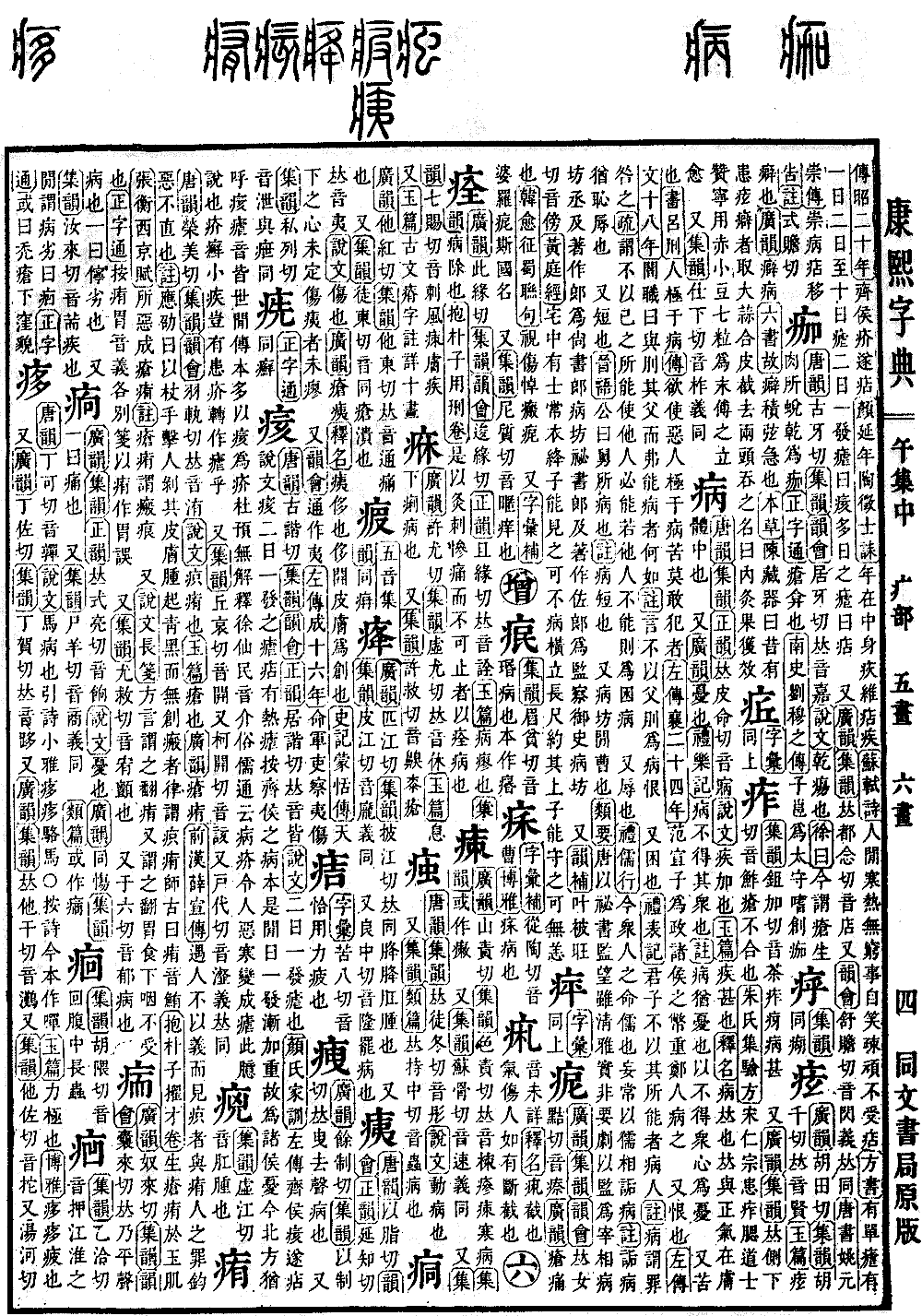
Radical: Sickness (bìng)
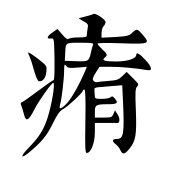
Entry: 痏
Kangxi stroke count: 11
Page 772, Entry 25
Pronounced wei (rising tone).
Shuowen Jiezi (Shuowen) defines this as a type of injury or contusion.
Yupian (Yupian) defines this as a sore or wound.
Guangyun (Guangyun) refers to a sore or bruise.
Book of Han (Hanshu), Biography of Xue Xuan: If one encounters an individual who acts without moral integrity and is beaten to the point of suffering contusions, the perpetrator is subject to the same legal culpability as one who strikes another, as this reflects an abhorrence for dishonest conduct. Commentary by Ying Shao: To strike another with hands or a staff, causing the skin to swell and appear blue-black without resulting in a laceration or open scar, is termed in law as a contusion (zhiwei). Commentary by Yan Shigu: The character is pronounced like wei (rising tone).
Baopuzi (Baopuzi), Chapter on Selecting Talent: Developing sores on skin as fair as fine jade.
Zhang Heng, Western Capital Rhapsody (Xijing Fu): Things that are detested become a source of affliction. Commentary: The term refers to scars.
Shuowen Changjian (Shuowen Changjian): In local dialect, this is called fanwei, also referred to as fanwei (regurgitation), denoting the inability to retain food after swallowing.
Zhengzitong (Zhengzitong): Note: The pronunciation and meaning of wei and wei are distinct; the author of the Jian is incorrect in equating these two terms.
Pronounced you (falling tone). Meaning: to tremble.
Pronounced yu (falling tone). Meaning: illness.