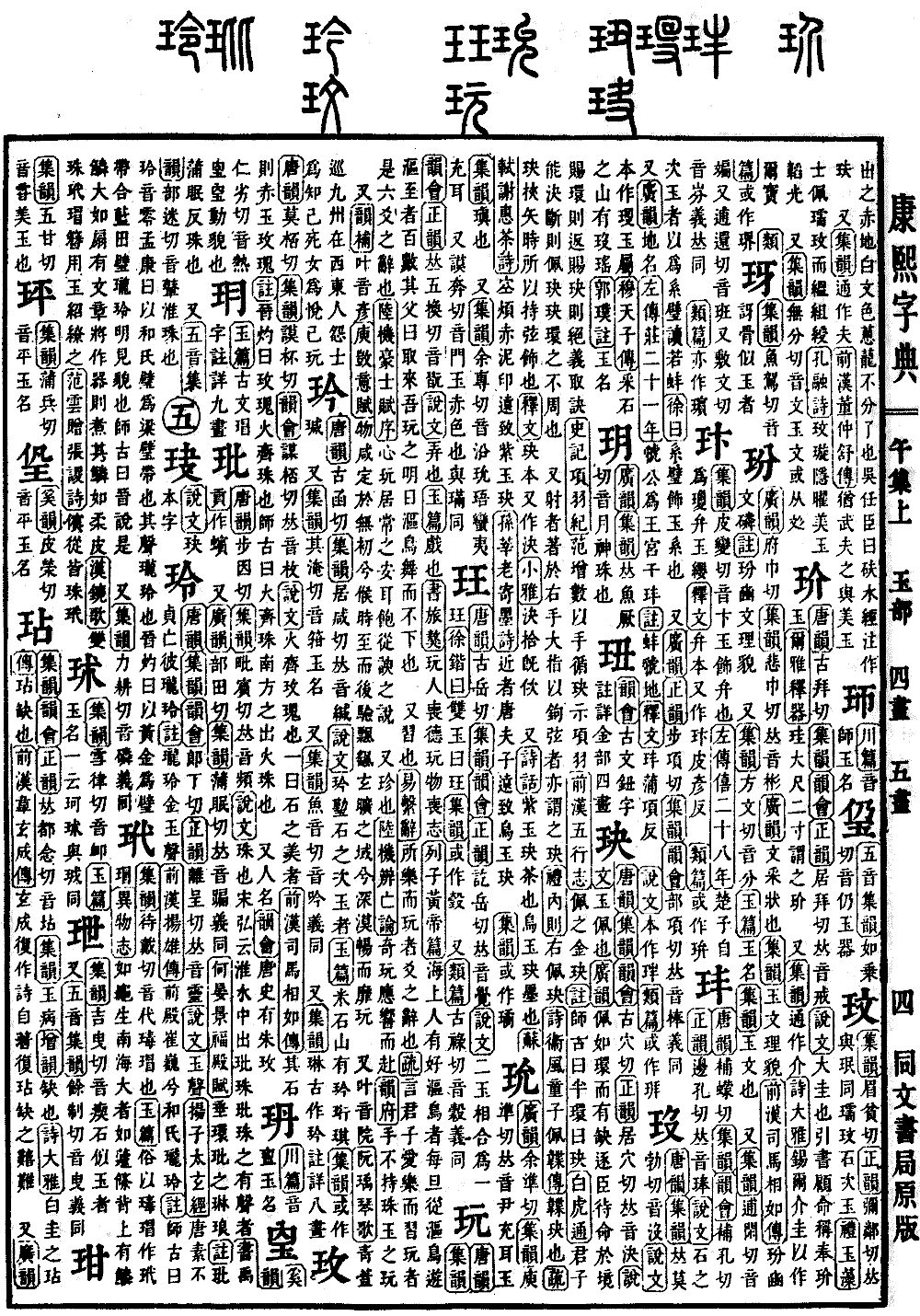
Wu Collection, Upper Volume
Radical: Jade (yù)
Play
Kangxi strokes: 9
Page 728, Entry 15
Pronounced wan (falling tone).
In the Shuowen Jiezi (Explanation of Graphs and Analysis of Characters), it means to play with. In the Yupian (Jade Chapter), it means to joke or play. In the Book of Documents (Shujing), specifically the section titled Hound of Lu, it states: Playing with people causes one to lose virtue, and being obsessed with material objects erodes one's ambition. In the Liezi (Book of Liezi), specifically the Yellow Emperor chapter, it mentions a man by the sea who loved seagulls; every morning he would go to the seaside to play with them, and hundreds would fly down. His father said, catch one for me to play with. The next day, the seagulls circled in the air and would not come down.
It also refers to studying or pondering. In the Book of Changes (Yijing), specifically the Great Treatise, it states: What the noble man enjoys reflecting upon repeatedly are the lines of the hexagrams. The commentary explains that the noble man delights in and repeatedly studies the phrasing of the six lines. In the Preface to the Rhapsody on Valiant Men (Haoshi Fu) by Lu Ji, it states: Inwardly settling for ordinary comfort, while ears become accustomed to hearing flattery.
It also refers to precious items. In the Essay on the Fall of the Kingdom of Wu (Bian Wang Lun) by Lu Ji, it states: Rare treasures and playthings are presented upon request. In the Yunfu, it states: One does not hold pearls, jade, or similar trinkets in one's hands.
Also pronounced yan (falling tone). In the Essay on Intention (Yi Fu) by Yu Kai, it states: All things are destined from the very beginning; the timing must arrive before they can be verified. Drifting in the vast wilderness, deep, silent, and at ease, with nothing left to ponder.
Also pronounced yuan (falling tone). In the Song of the Zither (Qin Ge) by Ruan Yu, it states: The blue carriage canopy patrols the nine provinces, inviting resentment in both the west and the east. A scholar dies for one who truly knows him, and a woman adorns herself for one who loves her.